Get Full Government Meeting Transcripts, Videos, & Alerts Forever!
Get email alerts on the Public Safety Police Budget topic
No spam. Unsubscribe anytime.
Idaho State Police budget review highlights fentanyl response, forensic lab plans and staffing shortfalls
Summary
At the Joint Finance and Appropriations Committee hearing, Idaho State Police requested funding for fentanyl-focused investigators, forensic staffing and lab construction while Director Bill Gardner detailed retention problems and operational gaps in Northern Idaho.
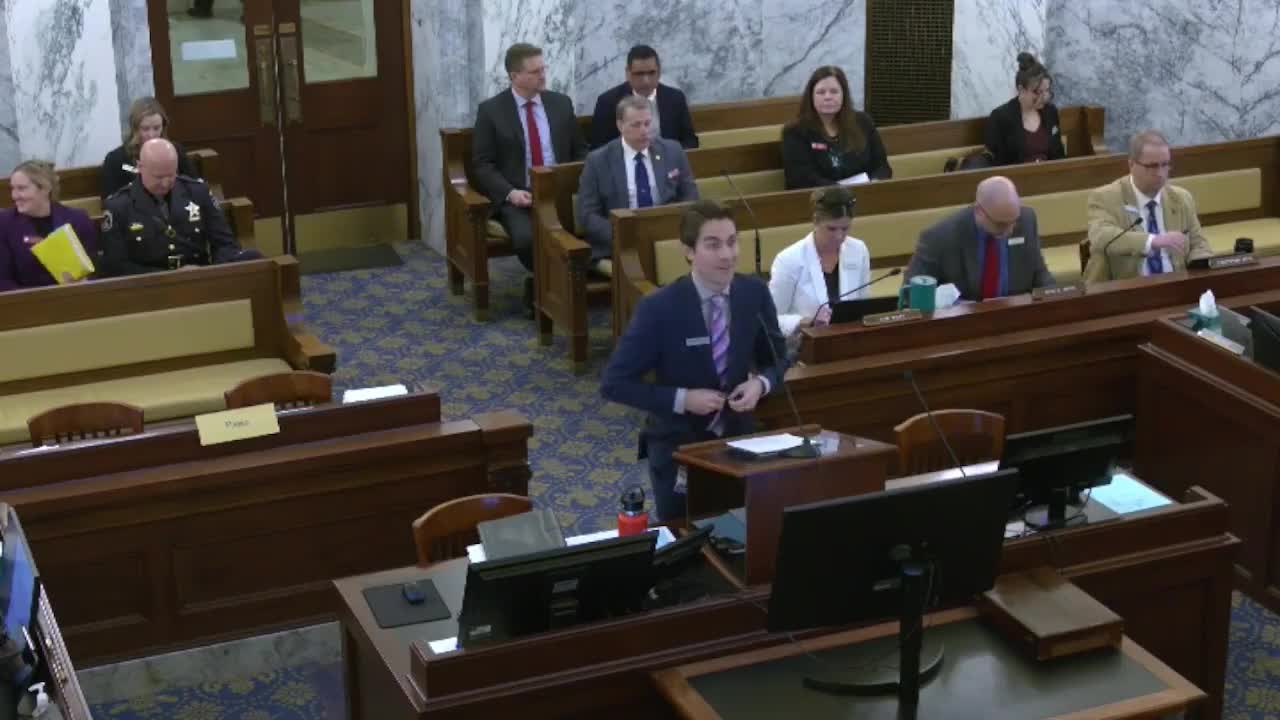
The Joint Finance and Appropriations Committee heard a detailed budget review on Wednesday from the Idaho State Police (ISP), which requested funding for fentanyl-focused investigators, a deputy forensic lab manager, remote housing for officers and other enhancements while directors described growing staffing shortages and retention challenges.
Legislative analyst Noah Peterson summarized ISP’s request and several fund shifts, including a proposed transfer of $4,995,500 and 37.48 FTP tied to the highway distribution account change, and enhancements to create a unit focused on fentanyl trafficking. Peterson said, "This enhancement added 10 FTP and $1,043,300 to create a unit with a focus on fentanyl trafficking and mitigation." The governor’s recommendation included a separate one-time $500,000 Millennium Fund appropriation for a fentanyl public-awareness campaign; Division of Financial Management Administrator Lori Wolf confirmed the governor recommended that $500,000 as one-time funding.
Director Colonel Bill Gardner described operational outcomes, enforcement activity and workforce pressures. He told the committee the state police’s drug interdiction team has "seized over 65,000 fentanyl pills, over a full pound of fentanyl powder, [and] 150 pounds of methamphetamine" and recounted additional recent seizures. Gardner said the agency is struggling with recruitment and retention, particularly in Northern Idaho, noting some trooper positions go unfilled and others are lost to local agencies with higher pay. "We need to get to a place where we can be fully staffed," Gardner said, and he described plans to work with DHR and DFM on compensation and retention strategies.
Key budget requests and details discussed
- Fentanyl-focused unit: enhancement to add 10 FTP and $1,043,300 to create a unit targeting fentanyl trafficking and mitigation (Peterson).
- Special investigations unit for Department of Correction facilities: request for 4 FTP and $757,300 (ongoing $443,300; one-time $314,000) to create a detective sergeant and three detectives to handle criminal investigations at IDOC facilities in the Treasure Valley.
- Forensic services: conversion of temporary/contract forensic staff to full-time, plus a request for 1 FTP and $118,200 for a deputy lab manager to help oversee an expanding forensic services program and a new lab building in Meridian. Gardner said the Meridian lab will be a "top of the line lab" and will replace the outgrown current facility.
- Sexual assault kit initiative investigators (SACI): request to hire post-certified investigators instead of contractors so they can perform required duties; the proposal moves two positions and a net-zero transfer of $402,100 from operating to personnel costs.
- ILETS disaster recovery: ongoing request of $233,000 from the Idaho Law Enforcement Telecommunications Fund to maintain a disaster recovery site so law enforcement can access critical information if the main site fails.
- Digital forensics transfer: program transfer of 2 FTP and $203,700 to move the digital forensics team from the investigations program into Forensic Services (net zero impact).
- OITS modernization: ISP proposed consolidating IT positions under the Office of Information Technology Services (OITS); the governor recommended moving 16 FTP instead of the 20 proposed by ISP, with a net operating cost increase. Peterson acknowledged some details would be confirmed later.
- Remote housing supplemental: ISP requested $268,100 as supplemental funding for a remote housing unit intended to support staffing in remote posts. Colonel Gardner said the site chosen was Fairfield after discussions with transportation department partners.
Budget context and funds
Peterson explained that certain dedicated funds support ISP activities — the Project Choice Fund (vehicle registration fee increase from 2007), the Drug Enforcement Donation Fund (forfeited property and restitution), and the Idaho Law Enforcement Telecommunications Fund (IELTS) (access fees). The presentation noted a re-appropriation pattern in FY2024 tied to one-time appropriations from FY2023 (replacement items, COVID emergency supplemental and fentanyl-related items).
Staffing and retention concerns
Gardner described severe staffing shortages in parts of the state and high turnover from troopers leaving for city or neighboring-state posts that pay more. He said vacancy statistics mask regional disparities: some Northern Idaho districts are far below authorized staffing levels. "We hire the best of the best, we train what we think is the best of the best and then you can't blame someone for leaving for a $15 an hour raise," he said. Committee members signaled interest in returning to compensation and recruitment strategies and indicated they would pursue proposals to address the trend.
Legal and compliance notes
Peterson noted Idaho is out of compliance with sections of the Sex Offender Registration and Notification Act (SORN A/Adam Walsh Act) and requested $50,000 to comply with SORNA requirements. He also described an estimated fiscal impact for proposed DNA-collection legislation that would add certain misdemeanors to offenses requiring DNA collection (estimated $168,100).
What’s next
Committee members pressed for follow-up on several items, including precise staffing and pay grades for the IT consolidation, details on forensic lab timing and capabilities and clarifying federal grant expenditures for the sexual assault kit initiative. Director Gardner said he would work with DHR and DFM and present a plan to address retention and recruitment.
The committee received the ISP presentation and moved to subsequent agenda items; no formal roll-call votes on ISP enhancements were recorded during this session.