Get Full Government Meeting Transcripts, Videos, & Alerts Forever!
Get email alerts on the Vocational Rehabilitation Audit topic
No spam. Unsubscribe anytime.
Audit finds Idaho vocational rehabilitation lacked controls; federal agency designates program high risk and state may need $2.7M match
Summary
Legislative auditors told the Joint Finance-Appropriations Committee that Idaho’s Division of Vocational Rehabilitation lacked procedures to ensure appropriation compliance in FY2024, prompting the federal Rehabilitation Services Administration to label the program high risk and leaving the state with decision points tied to a $10 million federal reallotment and a $2.7 million state match request.
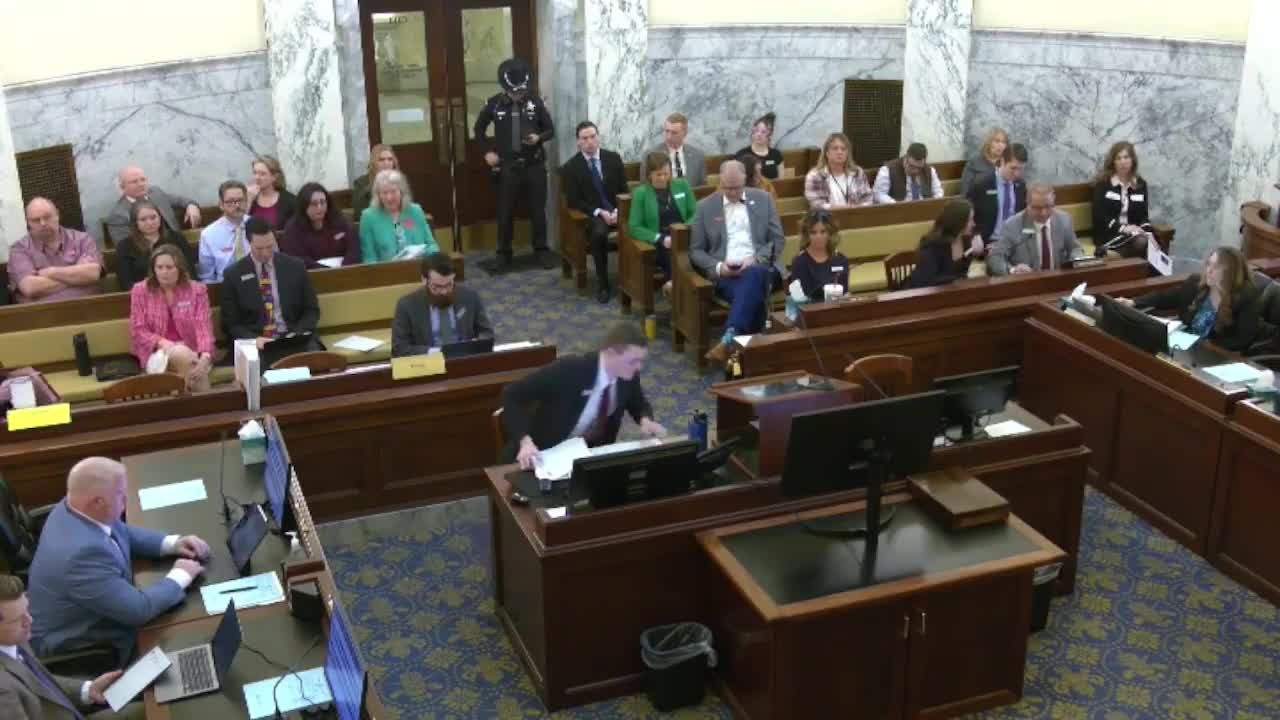
Legislative auditors reported to the Joint Finance-Appropriations Committee on Feb. 24 that Idaho’s Division of Vocational Rehabilitation (IDVR) failed to maintain internal controls needed to ensure compliance with appropriation laws and federal grant reporting, prompting the federal Rehabilitation Services Administration (RSA) to designate the state program as a high-risk grantee.
The finding and follow-up discussions centered on four fiscal issues: a $10 million federal reallotment recognized by the governor in September 2024; a state supplemental request of $2.7 million to meet the required state match for those federal funds; an estimated $1.7 million in charges that the federal partner has already identified as unallowable; and a contractor engagement that initially cost $499,999 and was amended to add roughly $1.9 million in additional services.
Why it matters: IDVR provides job counseling, placement and related services for Idahoans with disabilities. Auditors said the division had obligated far more spending than available appropriation in FY2023–FY2024, had reporting weaknesses tied to its case management system, and submitted federal draw requests that RSA could not fully support because documentation and period-of-performance accounting were inconsistent.
Audit finding and federal response April Renfro of the Legislative Services Office audits division summarized the report’s principal conclusion: "We issued one finding with this report and that was that the division did not establish procedures and control activities to ensure compliance with appropriation laws applicable to fiscal year 2024." Renfro told the committee that RSA placed the division under "specific conditions" pursuant to 2 CFR 200.208, required a corrective action plan and opened a fiscal monitoring review.
Renfro said the division’s case management system did not communicate with the state fiscal system, which complicated tracking obligations to the proper federal grant period. That mismatch, delays in billing and an increase in both the number of clients served and services per client left the division with a backlog of invoices and commitments that exceeded appropriations for FY2023 and FY2024.
Federal reallotment and state match Budget analyst Brooke Dupree explained that RSA reallotted leftover federal funds to Idaho late in the federal fiscal year, resulting in the governor recognizing a $10,000,000 noncognizable federal adjustment. Dupree said the federal grant requires a state match and that the division requested $2.7 million in one‑time general funds to meet Idaho’s required share of roughly 21.3% of federal spending.
Dupree also described a second supplemental request for $1.7 million to cover services already provided that RSA has deemed unallowable in its initial reviews. Dupree said the two supplemental items — the $2.7 million match and the $1.7 million allowance to cover disallowed charges — are decision points for the committee.
Contractor engagement and payments Audits staff reported that IDVR hired a third-party contractor in August 2024 under a $499,999 professional services contract to assist with business process mapping, control-system analysis, forensic accounting and federal report preparation. The contract was later amended in November 2024 to add about $1.9 million and extend work through December 2025. Audits noted the amended contract was exempted from competition by the state purchasing division and that roughly $900,000 has been paid to date from federal funds.
Director Judy Taylor, who is serving as interim director of IDVR, said the contractor was retained to reprogram the division’s case management system and to provide technical capacity that the agency lacked. "The consultant that we engaged is one of the few people in the nation that know how to do that," Taylor said, describing the need to fix period-of-performance reporting so that services booked in case files are billed to the correct federal grant period.
RSA enforcement options and forensic audit Renfro summarized potential RSA enforcement actions if IDVR fails to satisfy corrective actions, including requiring detailed financial reports, withholding authority to proceed on future phases, additional project monitoring or requiring technical assistance. She also said RSA can require return of federal funds proportionate to the harm caused by noncompliance, though the exact remedy would depend on RSA’s final determination.
Audits staff and agency leaders said a forensic audit and a state single-audit process would be used to identify question costs and to support discussions with RSA. Taylor said a forensic audit will look back to 2019 to address maintenance-of-effort questions, and that the agency is cooperating.
Program impacts and caseloads Taylor told committee members the division has 2,735 active clients and about 1,950 qualified applicants on a wait list created as an austerity measure. She said vocational rehabilitation is personnel‑intensive because counselors hold advanced qualifications and must assess eligibility, obtain records and craft individualized plans. The division has about 48 authorized FTP with significant vacancies; Dupree told the committee that 16.5 positions were vacant and many vacancies were being intentionally held as a cost-control measure.
Committee questions and next steps Lawmakers asked for more detail about the composition of the contractor team, why the amendment was needed so soon after the original contract, and how many years back the forensic review would examine. Taylor said the amended contract brings roughly six full‑time staff plus ad hoc experts and that the federal funder encouraged the state to adopt that level of third-party oversight to avoid more severe federal remedies, such as a third-party fiduciary arrangement.
Renfro recommended continued monitoring and said the audits division would include the matter in the 2024 single audit work; timeline and final cost exposures depend on the forensic audit and RSA’s responses. The committee was given two fiscal decision points — the $2.7 million supplemental for the state match and the $1.7 million estimate for unallowable charges — and auditors and staff said more follow-up hearings or oversight may be necessary.
Ending: Committee members said the complexity and potential fiscal exposure warranted continued oversight, and staff committed to provide additional detail about the supplemental calculations and contractor scope as the committee considers budget action.