Get Full Government Meeting Transcripts, Videos, & Alerts Forever!
Get email alerts on the Savings And Reserves topic
No spam. Unsubscribe anytime.
Staff detail large savings balances, statutory caps and use in recession planning
Summary
Legislative staff outlined the growth of Idaho's budget stabilization and public education stabilization funds, described caps and recent statutory treatments that permitted balances above 15% and explained how the funds would be used to smooth revenue shocks in a recession.
Keith Bybee and Legislative Services Office analysts reviewed the state's savings accounts and emergency reserves, including the budget stabilization fund (BSF) and the public education stabilization fund (PSIF).
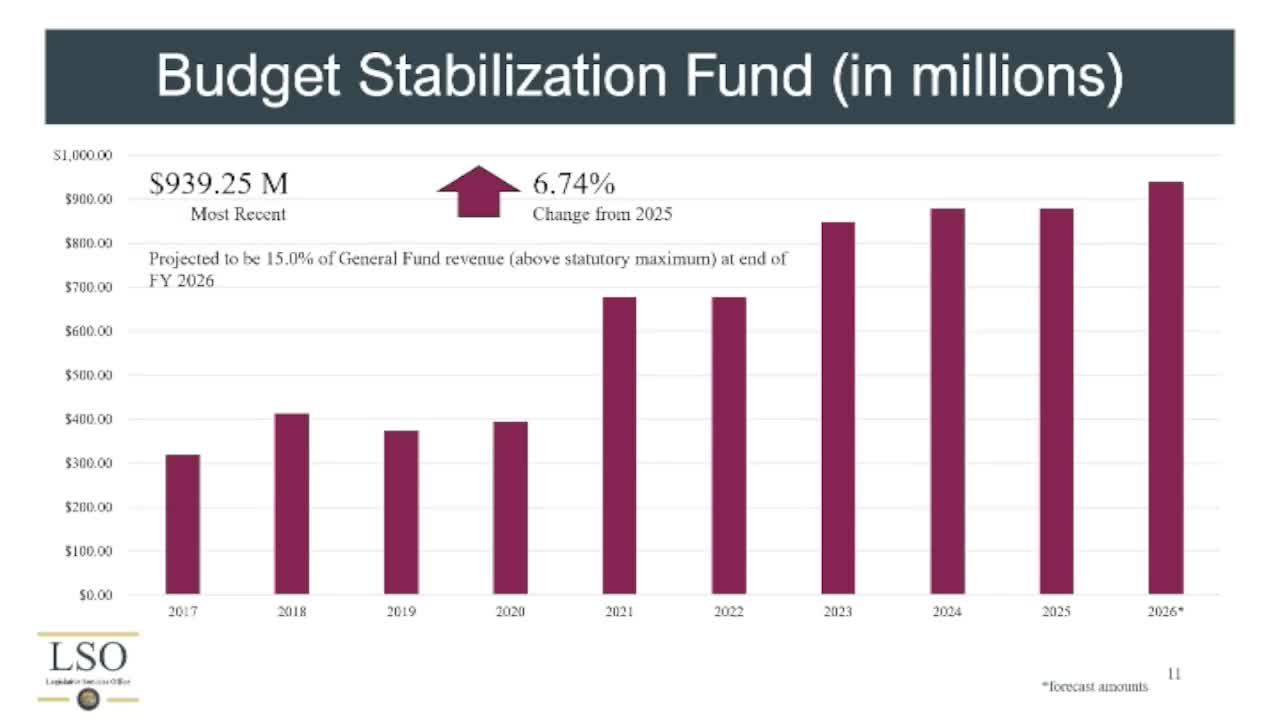
Bybee said the governor recommended a $59 million transfer to the budget stabilization fund that would bring the fund to about $939 million — the largest balance recorded — and noted the statutory cap is 15% of general fund revenues. "That additional $59,000,000 represents a 6.7% increase from fiscal year 2025," Bybee said, explaining how transfers can approach the statutory cap depending on revenue outcomes.
Staff explained the Legislature in a prior session temporarily set aside the 15% cap provision to avoid automatic returns of excess balances to the general fund; otherwise, exceeding 15% would trigger an automatic transfer back to the general fund. The PSIF — which acts as overdraft protection for public school support payments — is also governed by a 15% cap tied to public school support; under the governor's projection the PSIF balance would move to about $293.6 million, the analysts said.
Committee members asked about historical use: staff reviewed 2009 recession experience, when total cash available then (about $641 million) was exhausted over a three‑year downturn and agencies faced steep reductions. Bybee noted the state's current combined reserves would represent approximately 28.7% of the original appropriation under the governor's projections — materially higher than the 2009 level and providing a larger buffer against a moderate recession.
Staff also flagged that interest earnings and short‑term cash management — including tax anticipatory notes and other treasury practices — affect net cash available in a fiscal year; they committed to a subsequent presentation from treasury staff on interest earnings and cash management.