Get Full Government Meeting Transcripts, Videos, & Alerts Forever!
Get email alerts on the Isu Budget Accountability topic
No spam. Unsubscribe anytime.
Idaho State president says university will return forensic lab funds, pledges tighter controls as ISU outlines FY2026 request
Summary
Idaho State University President Rob Wagner told the Joint Finance-Appropriations Committee that a prior appropriation for an Eastern Idaho forensic pathology center will be returned to the state, and outlined steps the university is taking to strengthen controls and focus on student completion while seeking modest FY2026 enhancements.
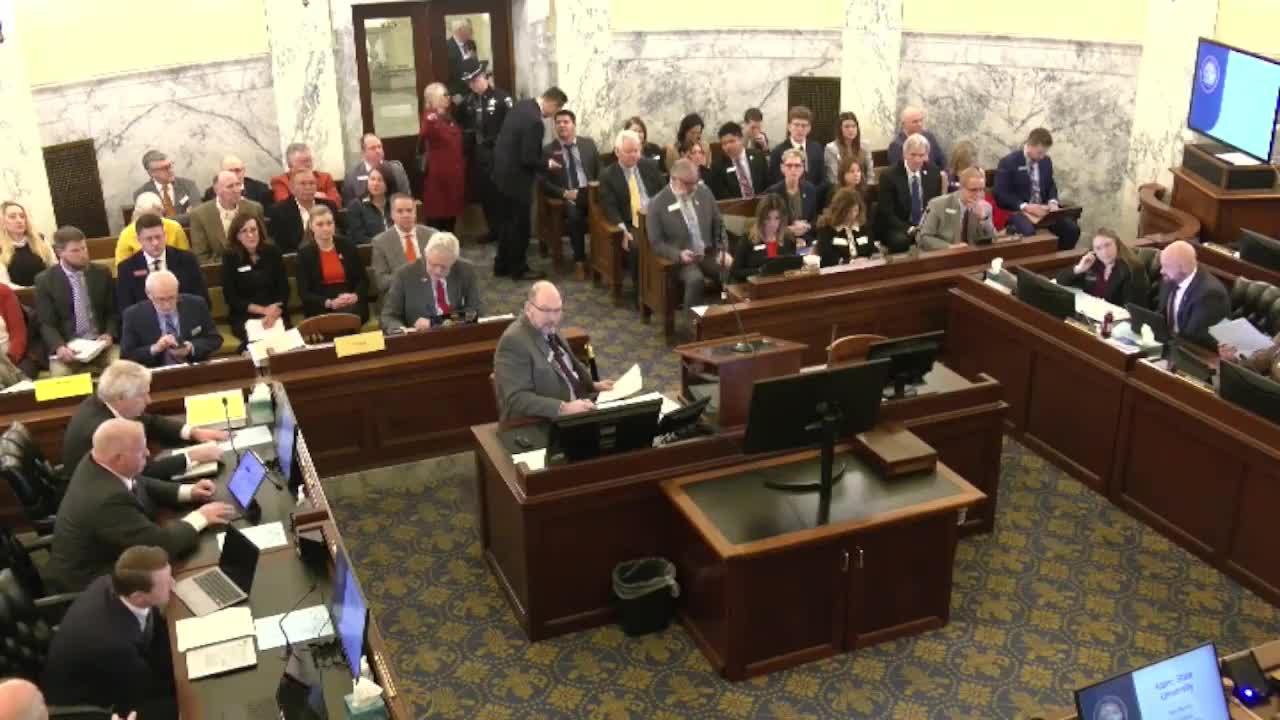
Idaho State University President Rob Wagner told the Joint Finance-Appropriations Committee on Jan. 29 that ISU has begun returning funds tied to a proposed Eastern Idaho forensic pathology center and that he has ordered improved tracking and accountability for legislative appropriations.
Wagner said the university discovered late in 2023 that the county partner no longer preferred a facility on ISU’s Pocatello campus and that “we had at that time expended a small portion of those funds for a consultant.” He told committee members the remaining funds will be returned to the state and that an audit has been requested; a university report prepared by Legislative Services staff also is online for members and the public.
The public interest in the pathology matter prompted several legislators to press Wagner on how ISU will prevent recurrence. “We must do better … recognize that legislative intent is law and it's incredibly important for us as an institution when those funds come to us that we take full and complete responsibility,” Wagner said. He described steps under his leadership to identify ownership of legislative funds, to track invoices and transfers, and to make sure funds are used according to legislative intent.
Why it matters: ISU’s handling of the forensic lab appropriation raised questions about internal controls and the university’s responsibility to follow legislative intent. Committee members said they want confidence that appropriations will be tracked and used as intended.
Beyond the pathology matter, Kevin Campbell of the Legislative Services Office gave a budget overview of ISU’s FY2026 request and the university’s recent financial history. Key facts from the fiscal presentation and Wagner’s answers:
- ISU enrollment: more than 12,000 students; institution-reported workforce of about 1,244 FTE. ISU’s stated base budget was reported as $171,100,000 in the legislative budget book presentation. - ISU reported historical patterns in tuition and fee receipts and an internal technical reporting error affecting a slide’s beginning fund balance; Campbell said the university has not overdrawn its Treasury account and staff are tracing the discrepancy. - Expenditure breakdown: ISU reported roughly 74.8% of expenditures to personnel, 21.2% to operations, and 3.9% to capital outlay in the slides presented. - Recent adjustments: Campbell reviewed multi-year changes including enrollment workload adjustments, operational capacity enhancements (CEC), consolidations of audit and risk-management functions to the state, and other adjustments that produced both reductions and enhancements across FY2021–FY2025. - FY2026 request (as presented to the committee): ISU requested operational capacity enhancement dollars and adjustments to endowment and enrollment workload funding; the presentation listed line-item requests of $907,300 (operational capacity enhancement), $233,700 (endowment funds adjustment), and $988,100 (enrollment workload adjustment).
Student success and DEI-related changes: President Wagner described an institutional refocus intended to raise completion rates. He said ISU closed two campus centers — the diversity resource center and the gender resource center — after a summer/fall review oriented on student completion and academic success. Wagner said each center had one FTE; one position moved to student involvement to support student clubs and the other moved to the office of equal opportunity and Title IX reporting to the president. ISU created a “Bengal Success Center” for campuswide student success services.
Health sciences and workforce training: Wagner highlighted ISU’s health sciences expansion and partnerships. He described the new doctor of nurse anesthetist program launching with 25 seats and reported more than 200 applicants for its first cohort. Wagner emphasized partnerships with the Idaho College of Osteopathic Medicine (ICOM) and other two-year institutions to create clearer on- and off-ramps into clinical pathways and residencies.
Federal grants and CEC concerns: Committee members asked about federal grant risks after recent federal directives; Wagner said ISU calculated a potential exposure figure while guidance was fluid and that the university was relieved by an injunction that temporarily paused parts of the federal action. He told the committee ISU has lost employees to private-sector pay and is using CEC and other funds to try to remain competitive for recruitment and retention.
What the committee took away: Legislators praised ISU’s new president for committing to transparency and accountability and requested follow-up documentation on the forensic lab funds and the university’s plans to improve controls. Wagner said the university will present additional detail on program uses for CEC and retention-focused enhancements if committee members seek it.
Ending note: Committee analysts noted they are working on policy fixes to better represent reappropriated tuition in published charts so year-to-year comparisons are not misleading because of academic-year timing differences.