Get Full Government Meeting Transcripts, Videos, & Alerts Forever!
Get email alerts on the Public Safety Communications topic
No spam. Unsubscribe anytime.
Idaho Military Division requests supplementals for vehicle backlogs, public-safety communications and hazmat equipment
Summary
The Military Division told the Joint Finance-Appropriations Committee it needs supplemental funding to clear a backlog of vehicles requiring communications installs, to modernize public-safety communications infrastructure, and to replace decades‑old hazardous‑materials response equipment across seven regional teams.
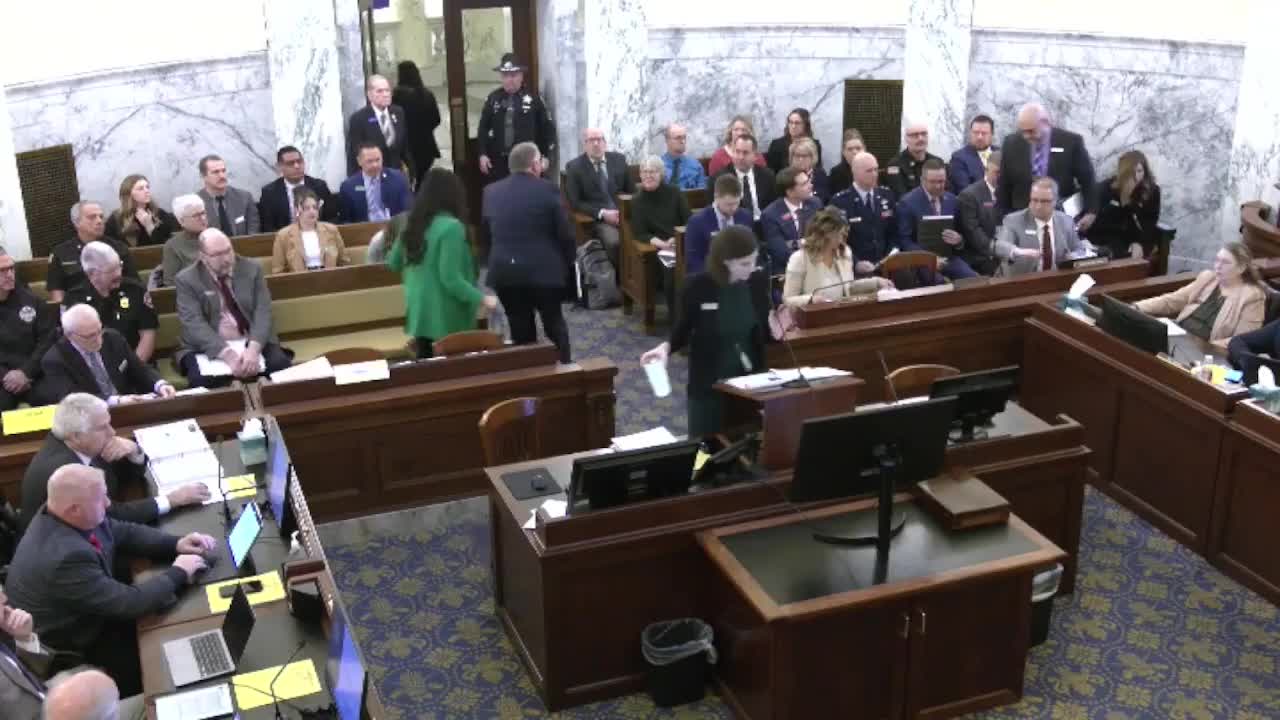
BOISE — The Idaho Military Division presented its fiscal 2026 requests to the Joint Finance-Appropriations Committee (date not specified), pressing for supplemental funding to clear a backlog of vehicles that require radios and communications equipment, to modernize public‑safety communications infrastructure, and to replace hazardous‑materials response equipment that has not been updated since about 2005.
Major General Tim Donnellan, the Adjutant General, described three related needs: (1) contractor work and facility upgrades to clear a backlog of vehicles that were delivered after a period of manufacturing delays, (2) IT infrastructure and licensing to separate a public‑safety network from the state ITS network, and (3) a cash transfer in the governor’s recommendation to provide regional hazardous‑materials teams funds to purchase modern equipment.
Why it matters: The division supports civilian first responders and statewide emergency communications, and the equipment upgrades affect interdiction, 9‑1‑1 dispatch interoperability and public safety. Committee members probed whether supplementals were the correct vehicle for funding and whether the state could spend the money quickly enough to complete installations and procure equipment before fiscal year end.
Requested supplementals and details
- Vehicle backlog and installation bays: The governor recommended supplemental funding that includes a private contract estimated at $240,000 to clear the backlog of vehicles that could not be equipped earlier due to supply‑chain constraints, plus $300,000 for construction to add four installation bays and equipment to prevent future backlogs. Major General Donnellan said the backlog resulted from a multiyear inability to obtain vehicles with electronics while vehicle production and chips were constrained.
- Public‑safety network IT infrastructure: The governor recommended $759,200 for IT infrastructure and licensing to establish a public‑safety communications network that would be independent of the state ITS for improved security. The division also seeks shifting some billing to reflect Office of Emergency Management usage of central IT services.
- Hazardous‑materials regional support: The governor recommended an $8,600,000 appropriation to purchase modern equipment for seven regional hazmat teams via a cash transfer from the state emergency relief fund. Major General Donnellan told lawmakers the division has not updated its hazmat equipment since about 2005 and cited the 2023 propane spill on Highway 95 as an example of a type of incident that requires modernized tools.
- Deficiency warrant: The military division also requested a FY2024 deficiency warrant of $34,200 for hazardous substance response costs it could not recover from incident originators.
Lawmakers’ concerns and agency answers
Committee members repeatedly asked why the items were submitted as supplementals rather than FY2026 enhancements. Donnellan and staff said timing and an immediate operational need drove the supplemental requests; they said contractors and facility work are in place to allow execution this fiscal year and that the supplemental would be split into immediate contractor work to clear backlog and facility work to increase capacity for future installs. Donnellan also described separating microwave‑based public safety networks from ITS and the cost of modernizing servers and hardware.
Senators asked about hazmat team composition, staffing and the reason for a statewide purchase rather than local purchases. Donnellan said there are seven regional hazmat teams attached to local fire departments that respond regionally and that equipment purchases would be managed through the Office of Emergency Management and distributed to the regional teams.
Discussion vs. decisions
The transcript records presentation and committee questioning only; no appropriation votes or committee decisions were recorded in the hearing transcript. The governor recommended the supplemental items described above; committee members asked for details about timing and execution but did not vote during the session covered by the transcript.
Ending
Agency leaders said they are prepared to move quickly if the Legislature approves supplemental funding and that they would provide additional detail on team composition and equipment distribution to staff on request.