Get Full Government Meeting Transcripts, Videos, & Alerts Forever!
Get email alerts on the Banking Debanking Transparency topic
No spam. Unsubscribe anytime.
Senate panel sends debanking bill to amendment order after testimony from account holders and bankers
Summary
The Senate State Affairs Committee voted to send Senate Bill 1027, which aims to require large financial institutions to provide transparency and protections against so‑called "debanking," to the 14th order for possible amendment after testimony from affected account holders and the Idaho Bankers Association.
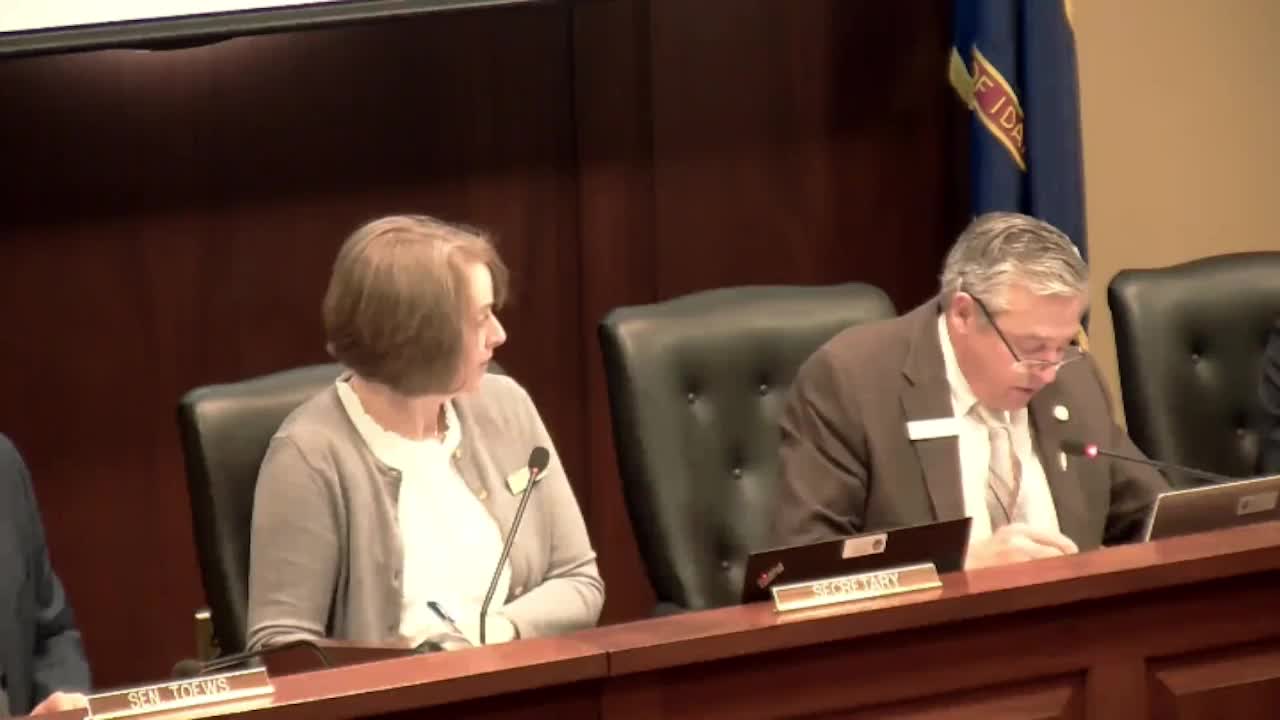
Senate State Affairs on Friday voted to send Senate Bill 1027, the Idaho Transparency and Financial Services Act, to the 14th order for possible amendment after roughly 35 minutes of sponsor remarks, public testimony and questions from senators.
Sponsor Kelly Anthon, a senator from District 27, said the bill would require transparency from very large financial institutions when they close or restrict accounts and would bar debanking targeted at customers because of their religious or political views. "This bill ... gives Idahoans transparency and a right to information as to why, if this happens, their bank account is being closed," Anthon told the committee. He said the measure is limited to institutions processing about $100,000,000,000 per year and is not intended to apply to Idaho-chartered community banks.
Proponents said the bill addresses real harms. Tony Ulrich, state chairman of the Constitution Party of Idaho, described receiving a notice and a check closing his longtime account without explanation. "The bank decided not to do business with you anymore," Ulrich said of what a bank representative told him after hours of calls and branch visits. Michael Ross, legal counsel for Alliance to Pending Freedom, testified about a 2023 incident in which Bank of America closed a nonprofit's account before a mission trip, delaying payments to local workers and shrinking the group's ability to deliver aid.
Banking industry representatives urged caution. Stacy Satterley of the Idaho Bankers Association told the committee that financial institutions already operate under numerous federal and state rules and that the bill’s private right of action and some terms could create compliance conflicts and litigation. "Banks don't use a social credit score," Satterley said, arguing that banks use risk-based criteria and that federal regulations sometimes limit what information banks can disclose to customers.
Committee members pressed the sponsor and witnesses on enforcement and scope. Senator Burn asked whether the bill must include a private cause of action; Anthon said he is inclined to include one to ensure an adequate remedy, citing Idaho Supreme Court precedent that a private cause of action may not exist unless the legislature expressly creates it. Other senators warned that the bill's breadth could require banks to continue service to parties that raise fraud, criminal or extremist concerns; Senator Ruppe said he would vote against the bill as written for that reason. Senator Shepbe noted that protections would operate in both directions — protecting customers across the political spectrum.
A motion to send SB 1027 to the 14th order for possible amendment passed after a motion by Senator Harris and a second by Senator Taves. Senator Rekke asked to be recorded as voting no; the committee chair announced the motion carried.
The bill’s next step is the amendment process on the 14th order and subsequent floor consideration if the sponsor proceeds. Committee discussion identified private-cause-of-action language, federal preemption and the bill’s $100 billion processing threshold as key points for amendment and further briefing.