Get Full Government Meeting Transcripts, Videos, & Alerts Forever!
Get email alerts on the Foster Care Budget Supplemental topic
No spam. Unsubscribe anytime.
Health and Welfare Committee hears $14 million supplemental for foster care, prevention staffing requests
Summary
The Idaho House Health and Welfare Committee reviewed a $14 million supplemental request to cover current-year foster care costs and considered budget requests to expand prevention teams and recruit foster families, as department leaders described a shift away from congregate placements toward foster and in‑home care.
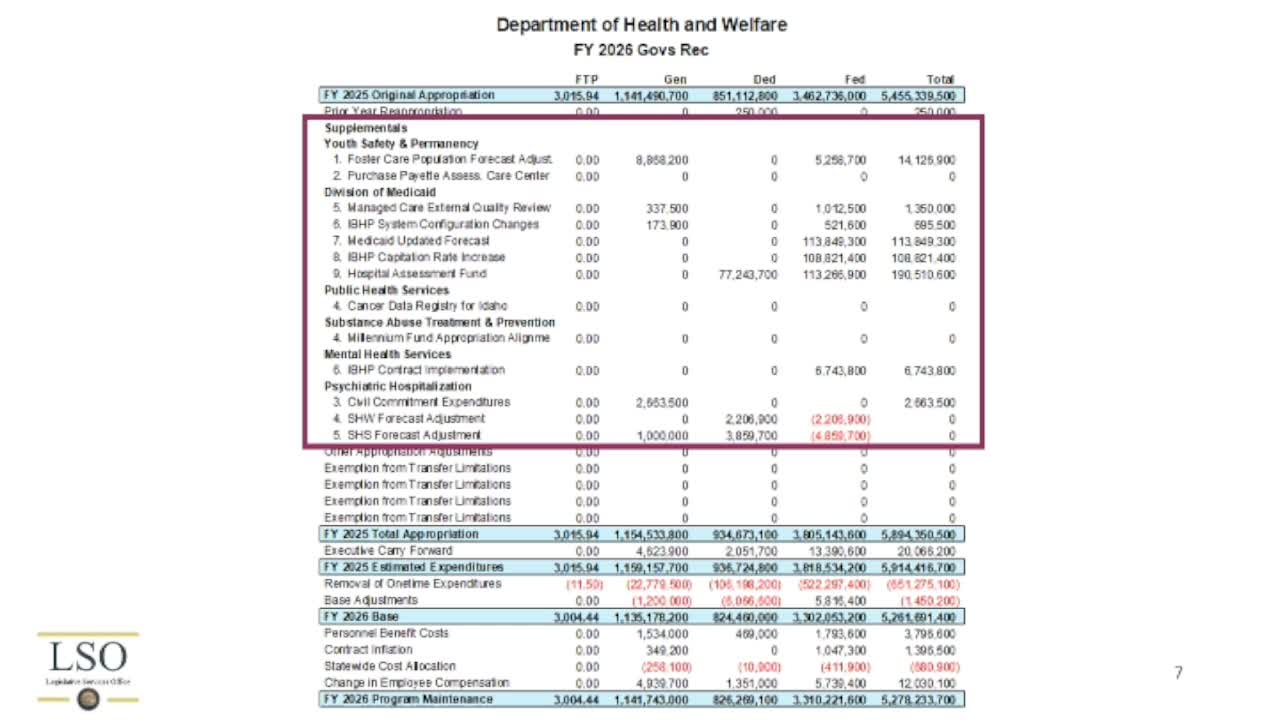
At a meeting of the Idaho House Health and Welfare Committee, Department of Health and Welfare Director Alex Adams and Legislative Services budget analyst Alex Williamson described a $14 million fiscal‑year 2025 supplemental request to cover higher-than-anticipated foster care costs and outlined longer‑term budget proposals intended to reduce reliance on congregate care.
The supplemental, described by Alex Williamson as a “foster care population forecast adjustment of $14,000,000,” addresses current‑year cost overruns driven by rising mental‑health needs, substance use, and a shortage of community‑based placements, Williamson said. Director Alex Adams told the committee the supplemental is a response to legally required care costs when children enter state custody.
“Child welfare is an entitlement program. If a child is committed to the custody of the department, we have a legal obligation to pay for their care,” Director Alex Adams said. “When we don't have foster homes for kids, we have to put them in more expensive settings.”
Why it matters: Committee members and the director tied the supplemental to the department’s larger strategy to lower long‑term costs by preventing removal and expanding foster‑family capacity. Adams described concrete recruitment efforts — including a new team that visits faith communities and other outreach — intended to increase licensed foster families and reduce expensive congregate placements.
Adams provided several figures to the panel: the state had about 176 children placed in short‑term rentals last year and had reduced that number to zero as of November; foster care costs run about $16 a day, while congregate care (group homes, short‑term rentals and similar placements) is substantially higher; and the department has raised its ratio of available foster families from roughly 74 families per 100 foster children to about 93 families per 100. Adams said the number of children in congregate care had fallen from roughly 268 to roughly 190 since he began the current work.
The department also proposed an enhancement to create a prevention specialist team: the governor’s recommendation reduces the department’s original request (about 100 new FTE originally requested by the department) to 58 new FTE overall, including a proposed prevention team of 36 staff with roughly $3 million in support to demonstrate alternatives to removal and to provide oversight and services aimed at keeping children safely at home. Williamson said the prevention team is intended to “demonstrate to the courts that we can keep more kids safely in their home.”
Committee members asked for clarifying detail on how the supplemental and the longer‑term investments would lower costs over time. Adams said the supplemental pays incurred costs in the current year and that the proactive investments are intended to “bend the cost curve” over future years by reducing the use of higher‑cost congregate settings.
The committee did not take a final vote on the supplemental during the presentation; members were told the committee will prepare recommendations to present to the Joint Finance‑Appropriations Committee (JFAC) at a later hearing.
Ending: Several representatives praised the department’s foster‑family recruitment work. The committee scheduled further budget deliberations and said it will make recommendations to JFAC at its next meeting.