Get Full Government Meeting Transcripts, Videos, & Alerts Forever!
Get email alerts on the State Public Defender Funding topic
No spam. Unsubscribe anytime.
New Idaho State Public Defender Requests Millions in One‑time and Ongoing Funding as Transition Reveals Gaps
Summary
Officials and analysts told the Joint Finance-Appropriations Committee that the newly formed State Public Defender office needs supplemental and ongoing funding—including money for transcripts, contracts and hiring—to cover higher caseloads, onboarding of counties and costs uncovered during the agency transition.
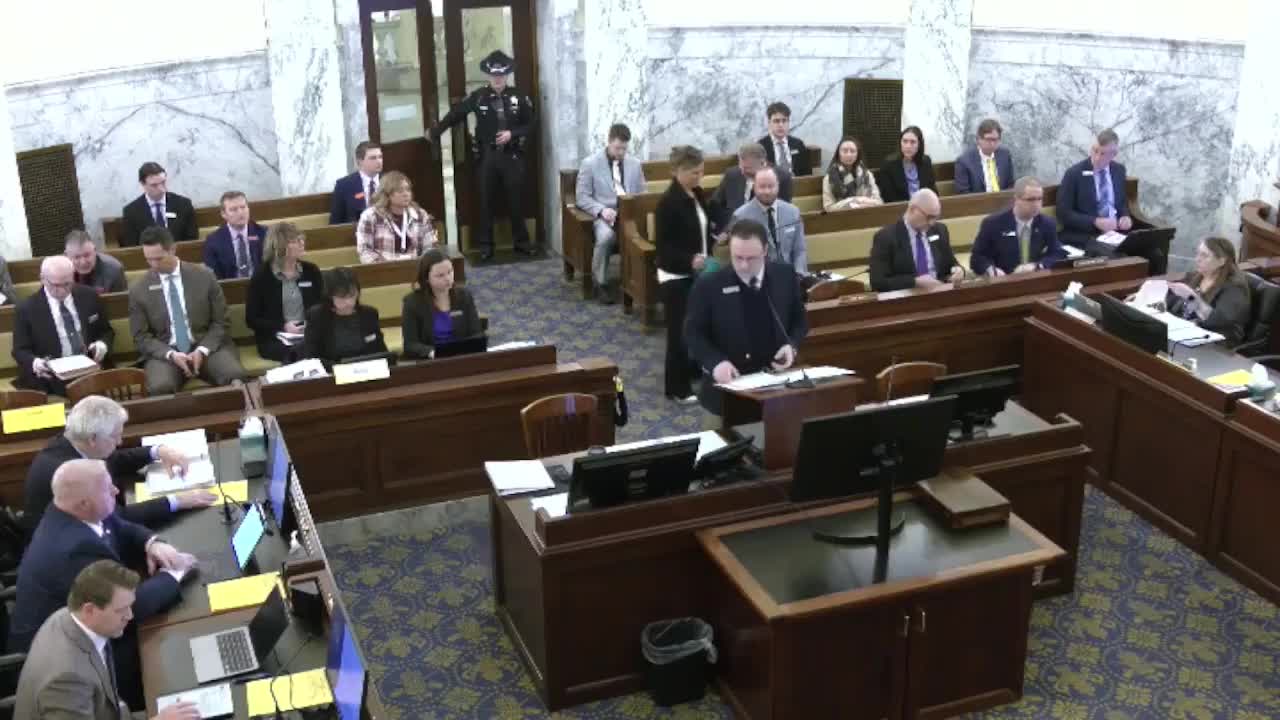
During a Joint Finance-Appropriations Committee hearing the budget analyst and the State Public Defender described the new agency's first months, a complex mix of one‑time and ongoing funding requests, and operational challenges as counties transition to the state system.
Legislative Services analyst Christopher Lahoset said the State Public Defender office is a newly created agency under Title 19, Chapter 60 of the Idaho Code and that the office's budget reflects the transfer of $39,000,000 from the tax relief fund into a dedicated state public defense fund (cited in committee materials as Idaho Code §57-8207). Lahoset told the committee that the agency currently shows 29 vacant positions, a personnel budget of about $37.7 million, and a total authorized appropriation for the current fiscal year of roughly $52,000,015.
The analyst outlined multiple supplemental and enhancement requests. For the current fiscal year the agency requested a one‑time supplemental appropriation of $2,500,000 to fully utilize the $39 million cash transfer; the governor recommended a one‑time supplemental of $390,200 for transcript costs related to an Idaho Supreme Court decision (State v. Blasick) and $5,427,600 one‑time for additional personnel and contracting costs. For FY2026 the agency requested $2,500,000 ongoing to utilize the dedicated funds, $16,000,380 (and $80,800 from the General Fund) for operating increases covering contract attorneys, investigators, experts and transcripts, and authorization for about 17.96 full‑time positions to onboard four counties (Benewah, Elmore, Jerome and Shoshone counties). The governor additionally proposed an ongoing fund shift and a one‑time cash transfer of $16,867,400 from the General Fund to the state public defense fund for recruiting, retention and contract rate increases.
State Public Defender Eric Frederickson described the office's first months after operation began Oct. 1 and said the transition exposed workload and funding gaps. "This is an early, early transition. October 1. Difficult. We walked into 1,300 withdrawals and cases," Frederickson said, explaining that institutional directors and leadership were doing casework while the new agency organized itself. He said the agency has encountered significant increases in capital and complex case costs, that counties previously paid certain evaluation and transcript costs, and that the office had not been given appropriation authority to spend some earmarked funds for Child Protective Act representation despite the cash transfer being made.
Committee members pressed for detail on several items: what "experts" funding would cover, what constitutes "miscellaneous expenditures" in a $3.58 million line for training/transcripts/miscellaneous costs, and how quickly large supplemental sums could be spent. Frederickson and staff identified items such as psychosexual evaluations (about $2,500 each) and other court‑directed evaluations historically paid by counties; they said some statutory change may be necessary to transfer those payment obligations to the state. The agency and analysts said some funds previously appropriated were based on pandemic-era caseloads and that caseload patterns have changed since the original fiscal forecasts were prepared.
Agency leaders and the analyst repeatedly told the committee that the move to a statewide case management system and standardized contract rates is intended to create uniform representation across Idaho and to address disparities between counties. Frederickson said equalizing pay and increasing contract rates is part of recruiting attorneys to rural areas.
The committee did not take an appropriation vote at the hearing. Members asked for additional documentation, including breakdowns of the proposed operating increases, county facility arrangements and the source(s) and use(s) of funds referenced in the analyst's slides. The agency and Legislative Services offered to provide more granular cost breakdowns and lists of the counties scheduled for onboarding.