Get Full Government Meeting Transcripts, Videos, & Alerts Forever!
Get email alerts on the Medical Debt Protection topic
No spam. Unsubscribe anytime.
Committee adopts substitute for Medical Debt Protection Act; bill reported 12–9
Summary
The committee adopted a substitute to the Medical Debt Protection Act that prohibits interest and late fees on medical debt and bars certain extraordinary collection actions; committee reported the substitute 12–9.
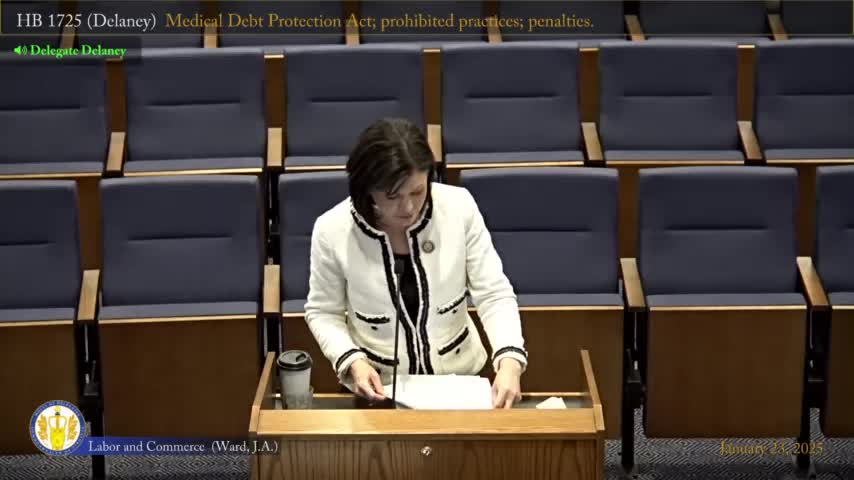
Delegate Delaney presented the Medical Debt Protection Act (HB 1725) to the Committee on Labor and Commerce on Jan. 21. The substitute adopted in committee narrows the original draft: it prohibits charging interest or late fees on medical debt and bars certain extraordinary collection actions, including arrest, foreclosure of a primary residence and wage garnishment. The substitute removed language that would have required providers to offer payment plans before pursuing collections, following concerns that the requirement could conflict with existing law.
Why it matters: The substitute creates statutory limits on some collection practices by large health facilities and medical debt buyers and designates violations as a prohibited practice under the Virginia Consumer Protection Act. If advanced by the House, the change could alter collection practices used against patients with outstanding medical bills.
What the committee did: The subcommittee initially recommended reporting with a substitute by a vote of 5–2. At full committee, the patron offered a substitute that accepted several stakeholder amendments (including proposed language from the Virginia Hospital and Healthcare Association and an IRS‑based definition of “extraordinary collection actions”). The committee voted 12–9 to adopt the substitute and report the bill.
Key clarifications adopted in the substitute: - Prohibitions: The substitute prohibits charging interest or late fees on medical debt and bars certain extraordinary collection actions (examples discussed in committee: arrest related to debt collection, forced sale of a primary residence, wage garnishment). - Payment plans: The committee removed language that would have required providers to offer a payment plan before pursuing collections; members said the mandatory language raised possible conflicts with existing law. The substitute leaves payment plans as a commonly used practice but not a statutory precondition. - Enforcement: A violation of the substitute’s provisions was described in committee as a prohibited practice under the Virginia Consumer Protection Act.
Vote and next steps: The committee adopted the substitute and reported the bill to the next stage with a committee vote of 12–9. The bill will now proceed per the standard legislative calendar and may receive floor consideration; any fiscal implications or further amendments would be subject to subsequent committee action and floor debate.
Speakers on the record: Delegate Delaney (patron); committee counsel/attorney; multiple members asked clarifying questions during debate; stakeholders (including representatives who worked with the patron on substitute language) were referenced during discussion.
Ending: The substitute narrows the original bill toward a compromise position described by the patron; opponents indicated they would continue to study the substitute as the measure moves forward.