Get Full Government Meeting Transcripts, Videos, & Alerts Forever!
Get email alerts on the Occupational Heat Safety topic
No spam. Unsubscribe anytime.
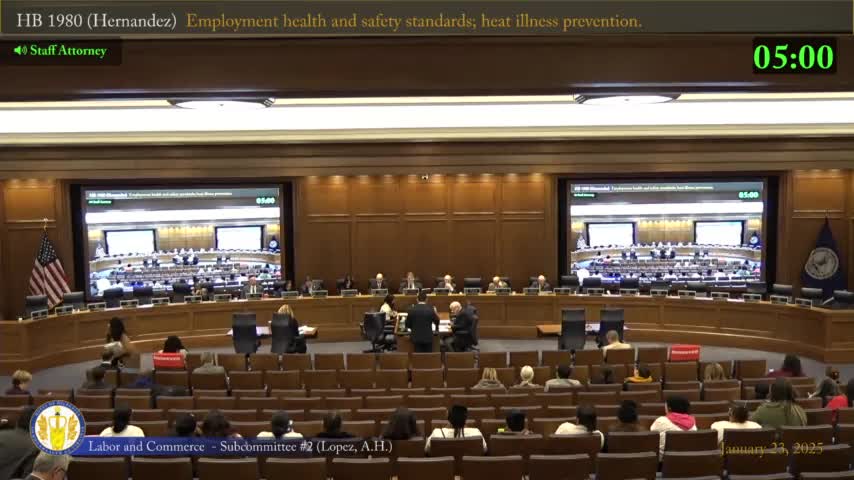
Subcommittee approves data-driven approach to worker heat protections; bill reported with amendments
Summary
HB 1,980 would direct state agencies to create a high-hazard industry list and then develop heat-protection standards; the subcommittee reported the bill with amendments 5–1 after broad testimony from labor, advocates and some industry concerns.
Delegate Hernandez presented HB 1,980, a bill designed to protect workers from occupational heat illness by directing the Safety and Health Codes Board and the Virginia Department of Labor and Industry to identify high-hazard industries using state data and adopt standards addressing water, shade, rest and climate-controlled spaces where practicable.
Hernandez said the bill takes a data-driven, phased approach: first identify industries with the highest rates of preventable heat illness and deaths and then develop substantive standards updated every five years. The bill also includes an exemption for emergency operations and would require the board to reassess the high-hazard list every five years.
Witnesses in favor included worker and public-health advocates. Flannery O'Rourke of the National Employment Law Project told the committee that five states already have worker-heat protections and urged passage; farmworker and labor organizations, climate groups, and unions also testified in support. Opponents or concerned witnesses included the Heavy Construction Contractors Association and the Virginia Farm Bureau, which said the federal Occupational Safety and Health Administration (OSHA) has an active rule pending and that the bill could duplicate standards.
The subcommittee adopted line amendments and reported HB 1,980 with amendments by a 5–1 vote.
Why it matters: Rising extreme heat increases preventable workplace injuries and deaths. The bill uses state data to focus protections on the most affected industries rather than imposing a one-size-fits-all rule.
Outcome: HB 1,980 reported with amendments 5–1.