Get Full Government Meeting Transcripts, Videos, & Alerts Forever!
Get email alerts on the Veterans Benefits Protection topic
No spam. Unsubscribe anytime.
Subcommittee tables bill setting consumer protections for paid veteran-claims consultants
Summary
A Virginia subcommittee gently tabled HB 2,112, the Safeguarding American Veteran Empowerment Act, after testimony from veteran-run companies and veterans organizations that sharply disagreed about whether private claims consultants should be regulated or barred.
A House Labor and Commerce subcommittee on an unspecified date voted 4-2 to table HB 2,112, the Safeguarding American Veteran Empowerment Act, which would add consumer-protection rules for companies that assist veterans with Department of Veterans Affairs disability claims.
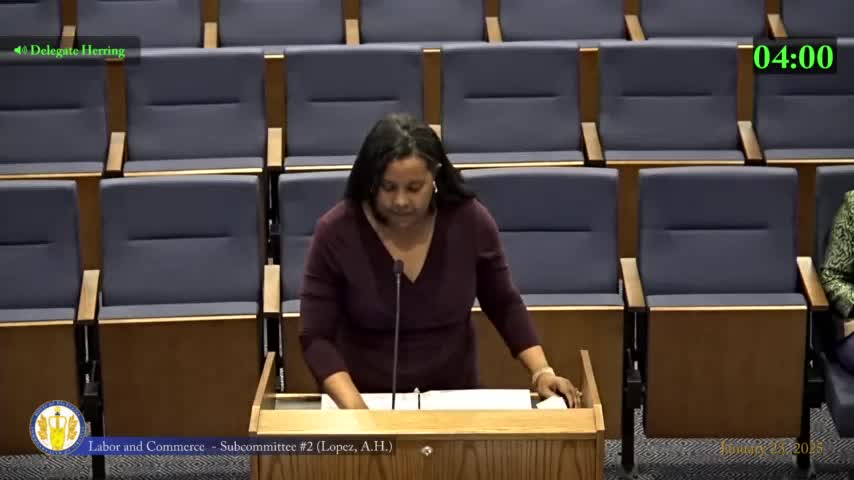
The bill, introduced by Majority Leader Jennifer McClellan Herring (referred to in the hearing as leader Herring), would prohibit advance payments before services, require providers to inform veterans about free resources, require written consent for paid services, restrict claims consulting during the first 365 days after discharge to a signed waiver, require written contracts with contingent-fee caps, ban guarantees of outcomes and reliance on overseas call centers, require HIPAA-compliant servers and background checks, and require personal account protections for veterans’ portal access.
Supporters from the private claims-consulting industry described the bill as a way to protect veterans while preserving choice. William Taylor, founder and CEO of Veterans Guardian VA Claims Consulting, a 23-year Army veteran, told the committee his company supports “protections…while still providing options for veterans” and said his firm operates in compliance with federal law and is working toward accreditation. Another witness, Gonzales of Veterans Benefit Guide, described the industry as providing needed services to veterans who sometimes do not succeed with free service channels.
Opponents included representatives of veterans service organizations who said federal law already requires accreditation. Doug Hoffman, a 20-year submarine veteran and Virginia VFW state senior vice commander, said Title 38 already requires accreditation for anyone who prepares or presents VA claims and argued the state bill was unnecessary because penalties are set at the federal level.
Committee members asked whether similar bills had been considered previously. Leader Herring said last year’s measure differed in approach; she said HB 2,112 aims to keep legitimate providers while curbing predatory actors. Several industry witnesses acknowledged predatory actors exist and supported guardrails like those proposed in Herring’s bill.
Delegate Levar Boling moved to "gently lay the bill on the table" for further work; a second was recorded but not named in the transcript. The subcommittee voted 4 to 2 to table HB 2,112.
Why it matters: The legislation seeks to balance protecting veterans from fee-taking, unaccredited actors while preserving paid options some veterans prefer. The split testimony showed disagreement about whether state-level regulation is necessary given federal Title 38 rules and accreditation processes.
Votes at a glance: HB 2,112 — Moved to table by Delegate Levar Boling; vote to table 4–2.
What’s next: The patron was told the subcommittee hopes the sponsors and stakeholders will continue discussions and return with revisions in a future session.