Get Full Government Meeting Transcripts, Videos, & Alerts Forever!
Get email alerts on the Solitary Confinement topic
No spam. Unsubscribe anytime.
Subcommittee advances measure limiting prolonged solitary and setting restorative-housing rules
Summary
Members adopted a substitute that imposes limits on restorative housing/solitary confinement, adds reporting and review requirements and advances the bill for further consideration; supporters called it a step toward reform while corrections officials warned of safety impacts.
The Public Safety Subcommittee adopted a substitute and reported a bill that places new limits and procedures on restorative housing and prolonged isolation in state correctional facilities.
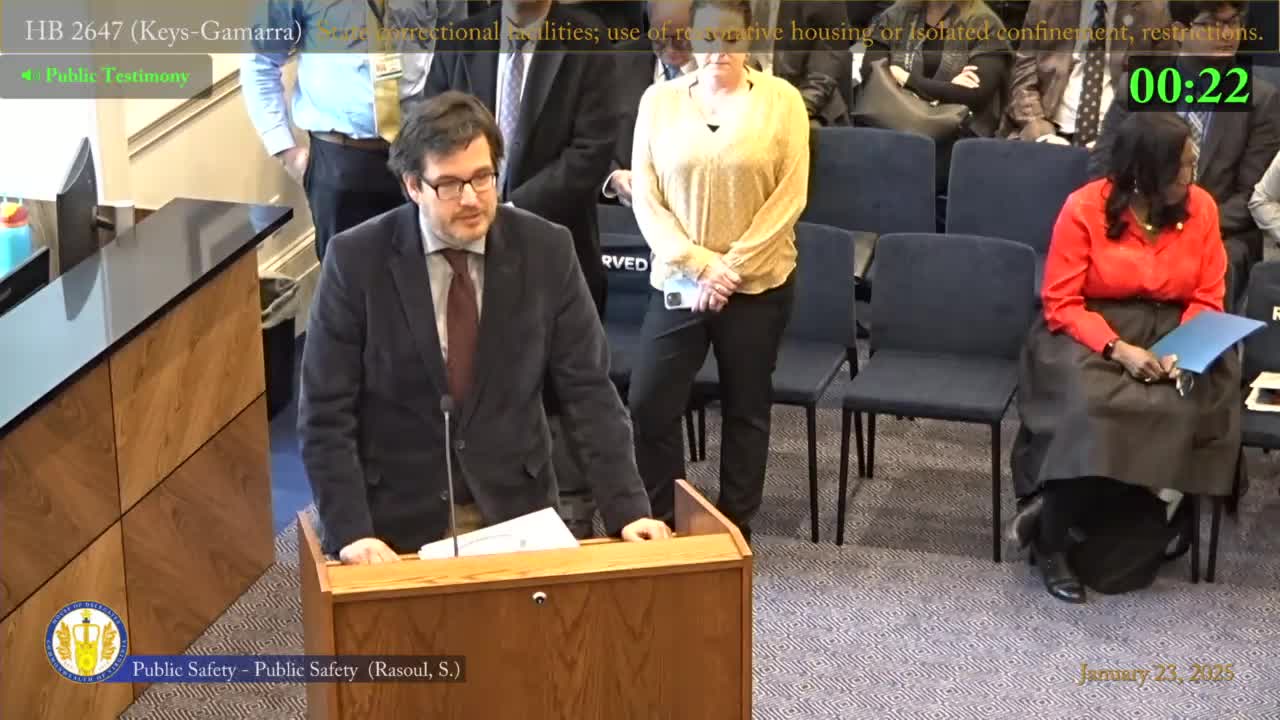
Witnesses who testified in favor described long-term isolation as damaging and argued that restricting its use would improve rehabilitation and public safety. Formerly incarcerated people, advocates and faith leaders recounted experiences of long stays in isolation and urged stricter limits and oversight. The substitute formalizes limits on consecutive days in restrictive housing, requires medical and mental-health reviews, and creates reporting obligations in line with the Department of Corrections’ oversight mechanisms.
Correctional staff and the Department of Corrections raised safety and evidence concerns. A corrections operations administrator said an arbitrary 15-day cap (included in the introduced language) does not account for the gravity of some detainees’ behavior and might undermine facility safety for staff and other inmates. The department said restorative housing is used as a last resort and that an evidence-based approach is needed.
Supporters argued the substitute strikes a balance between safety and humane treatment by preserving exceptions for immediate security risks while curbing long-term isolation and adding review procedures.
Committee members debated language about when unit heads may extend restorative housing and whether statutory sections conflicted in earlier drafts; patrons said the substitute reconciled those concerns. After public testimony and committee discussion the subcommittee voted to report the substitute to the next stage (the clerk recorded the motion and the bill was reported and referred for further consideration). The transcript does not record a roll-call tally for the final report vote in the excerpt.
Votes at a glance: Substitute adopted and bill reported for further consideration (tally not specified in transcript excerpt).