Get Full Government Meeting Transcripts, Videos, & Alerts Forever!
Get email alerts on the Pregnancy Shackling topic
No spam. Unsubscribe anytime.
Subcommittee advances bill to ban routine shackling of pregnant and postpartum jail inmates
Summary
The subcommittee reported House Bill 2235 after adopting a substitute adding protections for pregnant and postpartum people in local jails, including limits on restraints, placement on lowest available bed and bonding time with newborns until hospital discharge.
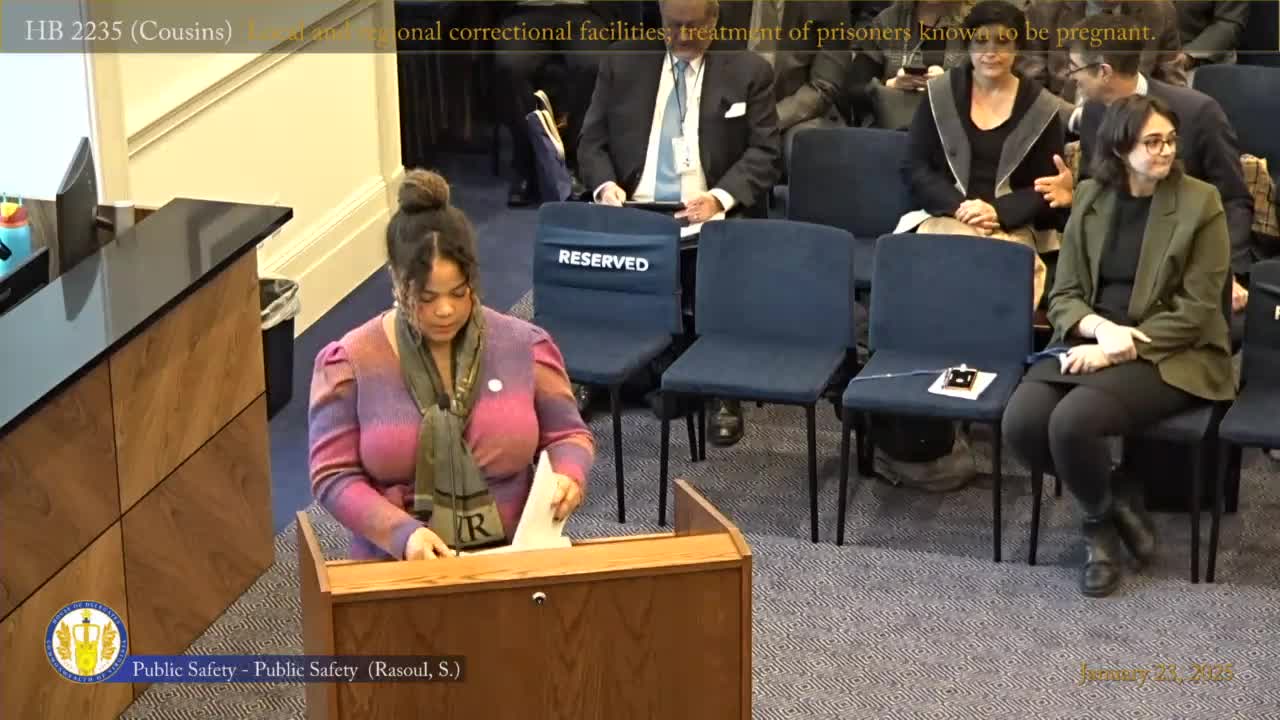
House Bill 2235, sponsored by Delegate Cousins, was reported out of the Public Safety Subcommittee after the panel adopted a substitute that expands protections for pregnant and postpartum people incarcerated in local jails.
The substitute makes several changes to existing practice and law: it adds “totality of the circumstances” as a factor before placing restraints on an incarcerated pregnant person; requires placement on the lowest available bed; extends post-delivery bonding to last until discharge from the facility rather than a fixed 72-hour minimum; requires adequate nutrition as ordered by a health-care provider; limits cavity searches to reasonable belief of contraband; and mandates training for correctional officers on general care for pregnant people.
“HB 2235 promotes the health of pregnant and nursing mothers and the health of their infants by greatly limiting the shackling of pregnant individuals who are incarcerated in Virginia's jails during their pregnancy, labor and delivery, and postpartum,” Delegate Cousins said in opening remarks. Counsel described the substitute as adding a “totality of the circumstances” test and other protections modeled on Department of Corrections code sections and jail regulations.
Supporters included medical providers and advocates who said the protections are both safe and practical. Anna Figueroa, a student in the University of Virginia School of Law’s state and local policy clinic, said the bill codifies protections that align jails with state prison standards and keeps the ability for staff to use restraints when there is a clear threat or flight risk. “Even as this bill creates limits on shackling and restraining, it always gives jail staff the ability to use these restraints when they think a woman is a threat or a flight risk,” Figueroa said.
A licensed midwife and prison doula, Sarah Zee, described examples of women who were shackled immediately after birth and the clinical harms that can follow, such as interruptions to nursing and bonding. Legal Aid attorney Ruby Cherian said Fluvanna Correctional Center for Women does not use restraints in labor and delivery and pressed for the bill so local jail populations receive the same protections.
Officials from the Association of Regional Jails told the committee they were reviewing the substitute and had worked with the patron. The Virginia Sheriffs’ Association said it was taking no formal position because jail standards exist as administrative law; several responding sheriffs supported the bill while others did not.
The subcommittee adopted the substitute and the clerk recorded the bill as reported with the substitute by a 6 to 0 roll call.
Votes at a glance: HB 2235 — Substitute adopted; bill reported (clerk recorded: 6 to 0).