Get Full Government Meeting Transcripts, Videos, & Alerts Forever!
Get email alerts on the Hoa Antennas topic
No spam. Unsubscribe anytime.
Subcommittee tables bill on amateur (ham) radio antennas in HOAs; refers issue for more study
Summary
Lawmakers debated House Bill 2542, which would prevent homeowner associations from banning amateur radio antennas, but laid the measure on the table and signaled referral to the housing commission for further study after supporters and association representatives clashed over covenant preemption and scope.
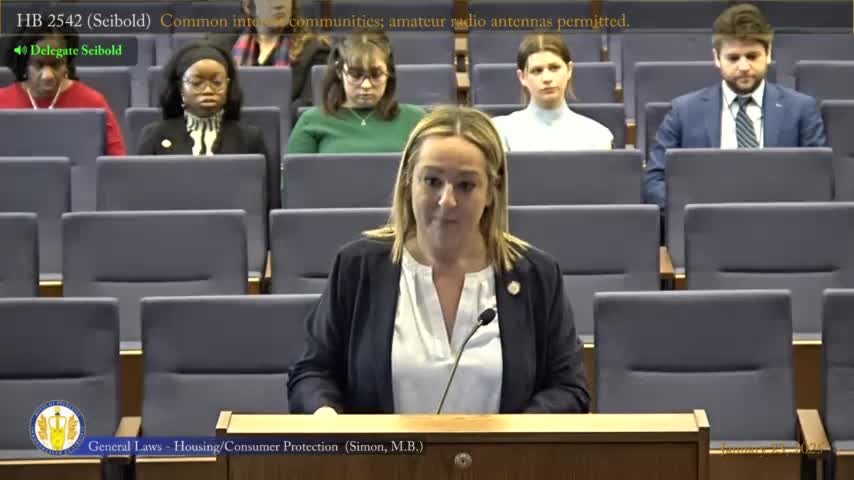
The General Laws Housing Consumer Protection Subcommittee on Monday laid House Bill 2542 on the table and indicated it will ask the housing commission to study the issue further after testimony from amateur radio operators and homeowner association representatives.
Delegate (patron) introduced HB 2542 as a measure to require homeowners associations to treat amateur radio antennas the same as other over-the-air reception devices and to prevent blanket bans that leave licensed amateur radio operators unable to install antennas at their residences. ‘‘Nobody should be required to pay a fee in order to pay their rent’’ was the phrasing used later in a different bill, but on this item the sponsor said the bill would ‘‘ensure that amateur radios are treated equally to other over-the-air reception devices.’’
Benjamin Hofstadter, a licensed amateur radio operator and constituent of Delegate Seabold, described how HOA covenants in his community expressly limit antennas to television devices: ‘‘In my HOA, my covenants that were approved half a century ago only permit TV antennas and forbid homeowners from mounting any other type of antenna. Any attempt to amend these covenants requires 75% of homeowners to vote in favor and that's an extremely high bar and unrealistic,’’ he said, urging legislative relief for operators who provide volunteer emergency communications.
Opponents, including the Virginia Action Committee of Community Associations Institute and legal counsel for common-interest community associations, argued the bill would override private contracts recorded in land records and expose associations to legal and operational uncertainty. ‘‘Associations are private contracts that homeowners expect to be enforced,’’ attorney Pia Trigiani told lawmakers, warning that retroactive statutory changes to recorded covenants could raise constitutional and contract-law concerns.
After extended discussion and testimony from operators, associations, and managers, Delegate Seabold agreed to more study. The subcommittee moved to ‘‘lay the bill very gently on the table’’ and to pursue a letter and possible referral to the housing commission; the clerk recorded the motion to lay the bill on the table as passing by a recorded vote of 5 to 2. Supporters said they would pursue a more comprehensive approach that could include grandfathering, prospective-only relief for new declarations, or a broader study of antenna-related restrictions.
The issue blends private property law, HOA governance and emergency communications policy; the subcommittee’s referral to further study leaves multiple paths open — from narrow prospective changes to broader statutory reform.