Get Full Government Meeting Transcripts, Videos, & Alerts Forever!
Get email alerts on the Employee Compensation topic
No spam. Unsubscribe anytime.
Lawmakers debate change‑in‑employee‑compensation options; original and substitute motions withdrawn for further staff work
Summary
Lawmakers engaged in a lengthy debate on Friday about how to structure FY2026 salary adjustments for permanent state employees, but committee leaders withdrew the pending motions to allow staff time to revise and reissue the proposals.
Lawmakers engaged in a lengthy debate on Friday about how to structure FY2026 salary adjustments for permanent state employees, but committee leaders withdrew the pending motions to allow staff time to revise and reissue the proposals.
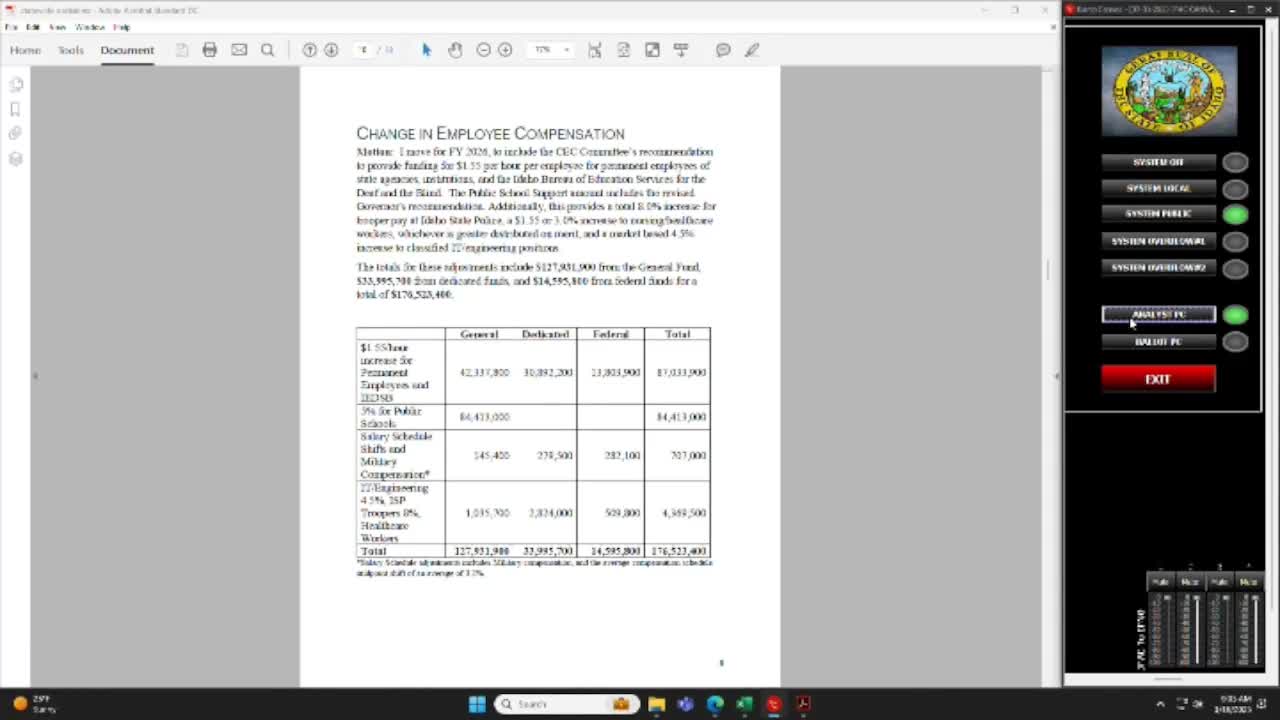
Representative Furness introduced the Economic Outlook/CEC committee recommendation that would provide a $1.55 per hour increase for permanent state employees (which yields larger percentage increases for lower‑paid workers), a market‑based 4.5% adjustment for classified and non‑classified IT and engineering positions, an 8% increase for Idaho State Police troopers, and a $1.55 or 3% increase for nursing and health‑care workers (whichever is greater). Representative Furnace's motion included amounts for public school support and an updated inclusion of non‑classified IT positions after committee members identified an omission.
Senator Cook offered a substitute motion that proposed an ongoing annual salary increase of $1.55 per hour or 4%, whichever was higher, while keeping specific market and recruitment adjustments for certain positions. Members described strong differences in philosophy: some argued the flat dollar increase helps lower‑paid employees proportionally and advances equity, others said merit‑ and market‑based increases preserve incentives and are more appropriate for specialized or high‑skill roles.
After substantial debate that included references to Idaho Code's direction on merit and compensation, committee co‑chairs and representatives of staff recommended additional time for staff to incorporate missing line items and to produce a clear ballot. Both the substitute and original motions were formally withdrawn by unanimous consent so staff can reformat the proposals; the chairs said compensation matters will be revisited at a subsequent meeting. The committee adjourned with a plan to take up maintenance budgets the next day and to return to compensation items later.