Get email alerts on the Budget topic
No spam. Unsubscribe anytime.
Burlington superintendent proposes level-service FY26 budget, estimates 2% property-tax decrease
Summary
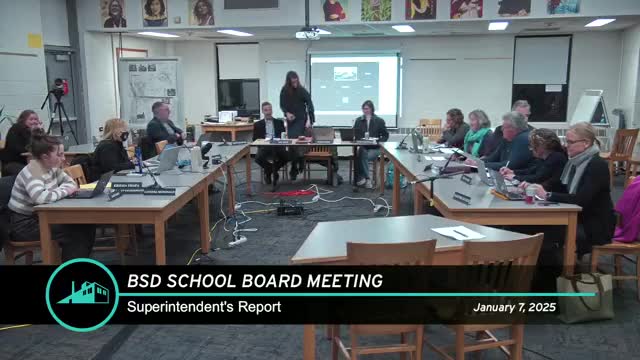
Superintendent Flanagan presented the Burlington School District's proposed fiscal 2026 budget at the Jan. 7 school board meeting, saying it is a level-service proposal that would result in an estimated 2% property-tax decrease if current assumptions hold.
Superintendent Flanagan presented the Burlington School District's proposed fiscal 2026 budget at the school board meeting on Jan. 7, recommending "a budget that maintains the current level of service," and telling the board the package would result in an estimated 2% decrease in property taxes if the proposal and state figures hold.
The proposal keeps overall services intact while aligning staffing to enrollment, increases targeted RISE (equity) allocations for higher-need students, and restores funding for central facilities maintenance. Flanagan said the district is also reducing central-office budgets by 2% while moving money to building maintenance needs such as replacing a boiler at Champlain Elementary School.
Why it matters: The budget package frames short-term reductions and reassignments alongside investments targeted to students identified as most in need. The district described the proposal as a level-service plan that balances enrollment-driven staffing adjustments and one-time or restricted funds (for example, ESSER federal grants) that have supported positions in prior years.
Key numbers and drivers: Flanagan said the district's education-fund spending was about $94 million in FY25 and is estimated roughly at $103–104 million for FY26; other non-education funds (one-time and restricted funds such as ESSER) add to the overall budget. The superintendent told the board the district expects roughly $18 million in combined principal and interest debt service in FY26. Flanagan said the district has better early access to the --Agency of Education-- Common Level of Appraisal (CLA) and related data this year under Act 183, and thus greater budget certainty now than last year.
Board questions and clarifications: Board members pressed for more granular detail on the roughly $200,000 in staffing reductions described as enrollment-driven. Flanagan said one of the reductions is a classroom-teacher alignment at the elementary level (a shift from three 5th-grade sections to two when a cohort moved up), and the remainder are support positions at the secondary level that had been funded previously with ESSER one-time funds and are not core classroom teachers.
Board members also asked for more breakdowns of the FY25 10.4% property-tax impact figure and how bond debt service contributed to prior increases. The administration agreed to provide more detailed charts for neighborhood presentations and NPA meetings, including the bond-debt schedule and a clearer breakdown of “other funds” (federal grants, Title funds, ESSER and similar) versus education-fund spending.
State and statutory context: Flanagan referenced several statewide items the board has tracked: Act 127 (weighted pupil funding changes that increased district weights for students in economic need and multilingual learners), Act 183 (new reporting timing for the CLA), and Act 139 (early-literacy reporting requirements). He also said the district has submitted a final PCB reimbursement request to the state that, if approved as expected, will cover up to $16 million of demolition and remediation costs tied to the old high school and technical center.
Next steps: The administration plans to return with more detailed breakdowns and school-level RISE allocation plans ahead of the board's scheduled budget vote on Jan. 21. Panel and NPA outreach to neighborhoods was described as ongoing; the board expects to present the final ballot language and tax-impact projection with the January 20–21 materials and then again after the legislative session finalizes any statewide changes to dollar yield.
Ending: District leaders said they will provide the board and the public additional detail on the allocation of RISE funds, the makeup of the $200,000 enrollment-based reductions and the bond-debt schedule in the coming two weeks so board members can present consistent information at neighborhood meetings and at the Jan. 21 vote meeting.
AI generated
The text on this page is AI generated. Summaries, highlights, analysis, and video transcripts are all produced from the original source material.
AI can make mistakes, so if you spot one, and we will fix it for everyone.
Note: the source content is unaltered by us. Any content source we link to, be it a video, an audio recording, or a document, is presented exactly as its publisher released it. That publisher is usually a government body, sometimes an individual official or another organisation.