Get Full Government Meeting Transcripts, Videos, & Alerts Forever!
Get email alerts on the Mold Regulation topic
No spam. Unsubscribe anytime.
Committee pauses mold regulation debate after urgent tenant testimony; patrons to reconcile certification and consumer-protection approaches
Summary
Lawmakers heard extensive testimony about mold in rental housing and the need to regulate mold inspection and remediation. Delegates debated whether to require DPOR certification or to use the Virginia Consumer Protection Act; patrons agreed to take related bills by for the day to work out language.
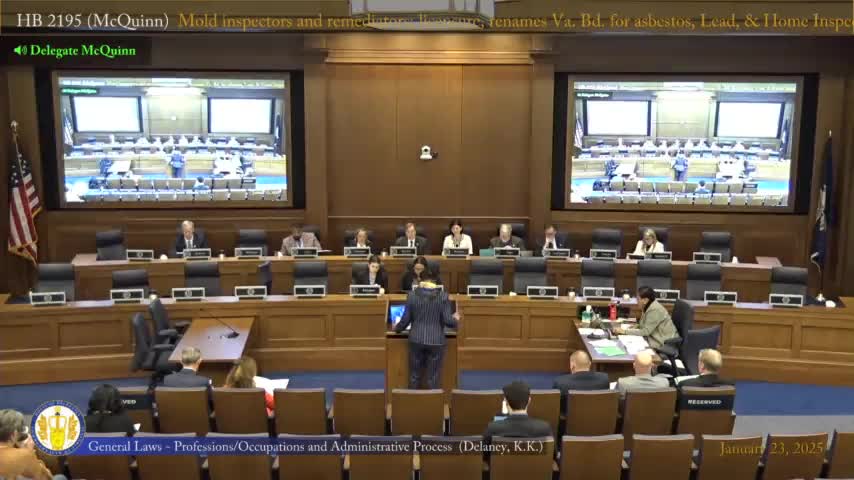
Delegate Marcia McQuinn presented HB 2195, which renames the Virginia Board for Asbestos, Lead and Home Inspectors to add mold and directs the board to establish certification requirements for mold inspection and mold remediation. The bill includes an emergency clause tied to repeal language from last year’s Virginia Consumer Protection Act provision.
Multiple tenants and tenant advocates described widespread mold problems in rental housing and urged regulation. "Mold is not something that should be taken lightly," said Erin Trimmer of Virginia Organizing, citing health effects including asthma and long-term respiratory issues. Tenant organizer Rachel Heffner said tenants often get only "mediocre" remediation and that work sometimes is incomplete or improper.
An online tenant, Abidiah Sims, recounted having to throw out furniture and clothing after a landlord’s inadequate remediation and said contractors had "painted over" black mold rather than properly removing it.
Industry and standards testimony: Robbie Bradshaw (representing industry interests) said he supported the goal but urged requiring recognized industry certifications and adherence to accredited remediation standards such as the IICRC S520; he warned the draft language might allow unqualified providers to continue operating. DPOR Deputy Director Steve Kirschner told the committee the matter had previously been regulated (licensure in 2009) and was deregulated in 2011; he said DPOR can implement regulation and that it could take "probably 6 months" at fastest to stand up licensure if the General Assembly directed it.
Central policy question: delegates debated two approaches. McQuinn’s bill would reintroduce DPOR certification and an oversight board; Delegate Chris Wilt described an alternate approach (his bill) that would use the Virginia Consumer Protection Act and expand the universe of certifiers while requiring certification to hold people to account. Wilt said consumer-protection enforcement under the Consumer Protection Act could make certification effectively mandatory for practitioners offering mold services in the Commonwealth.
Outcome: After extended questioning and public testimony, both patrons agreed to "go by for the day" so they can meet and attempt to reconcile the competing approaches and drafting language. No final action or vote was taken on HB 2195 or the companion proposal during the subcommittee meeting.
Ending: Advocates said they want prompt action to protect tenants’ health; DPOR said it is prepared to implement whatever regulatory level the General Assembly directs but flagged resource and timing implications.