Get Full Government Meeting Transcripts, Videos, & Alerts Forever!
Get email alerts on the Public Safety Retirement topic
No spam. Unsubscribe anytime.
Subcommittee tables bill to allow hazardous-duty pay for conservation police officers
Summary
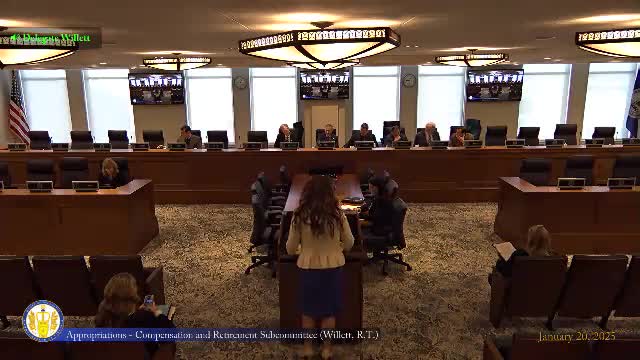
The Compensation and Retirement Subcommittee on an unspecified date voted 4-3 to gently lay on the table House Bill 1590, which would have created a pathway for conservation police officers to receive hazardous-duty supplements through the Virginia Retirement System.
The Compensation and Retirement Subcommittee on an unspecified date voted 4-3 to gently lay on the table House Bill 1590, which would have created a pathway for conservation police officers to receive hazardous-duty supplements through the Virginia Retirement System (VRS).
Supporters, led by Delegate Kent, told the subcommittee conservation officers routinely face hazardous conditions that differ from other law-enforcement roles. "They called our conservation police officers and the only ones that could go in there and trudge through the marsh along the very icy cold banks of the Rappahannock ... and help that gentleman was our conservation officers," Delegate Kent said, recounting a recent river rescue. He told members the bill was meant to provide the same supplements other law enforcement receive and to help retain officers in hard-to-staff roles.
The bill’s proponents said conservation officers often work alone on waterways, at night and in severe winter conditions. Delegate Wyatt said those operational differences — being alone on the water in a john boat or wading in a marsh — distinguish conservation officers from other state law-enforcement roles and justify separate consideration.
Several members redirected the conversation to how hazardous-duty pay is structured within VRS and whether a broader classification review is necessary. A committee member said the issue may require a broader work group or a follow-up study to consider where conservation officers fit among VRS categories and other state law-enforcement groups.
There was no public testimony recorded in favor or opposition during the hearing. After discussion, Delegate Bolivar moved to "gently lay this bill on the table." The motion carried 4 to 3.
Subcommittee members and staff flagged options for next steps including budget amendments to create a study or work group to examine hazardous-duty classifications across multiple public-safety and law-enforcement categories. The subcommittee took no further action on HB 1590 at the meeting and the bill’s proponents said they would follow up with patrons of related budget amendments.
Ending: The tabling leaves HB 1590 inactive pending future committee or budget action; proponents asked for follow-up work to find a pathway that would allow conservation officers to receive hazardous-duty supplements without unintentionally altering other VRS classifications.