Get Full Government Meeting Transcripts, Videos, & Alerts Forever!
Get email alerts on the Civil Commitments topic
No spam. Unsubscribe anytime.
State now pays more for civil commitments; department cites entitlement risk and calls for transfer flexibility
Summary
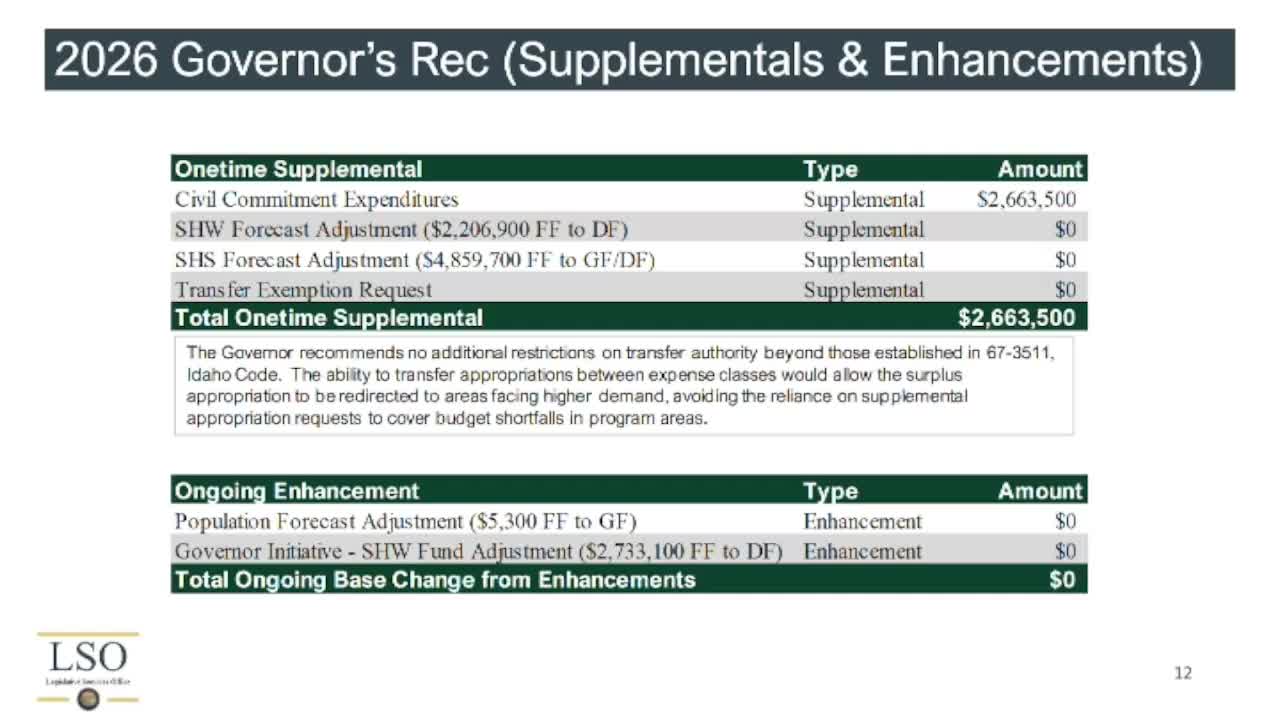
Legislation that shifted civil-commitment costs to the state has increased expenditures; Department of Health and Welfare officials told the appropriations committee the number of holds and related costs have grown and that transfer exemptions would reduce annual supplemental requests.
The committee heard that civil-commitment expenditures rose after the legislature changed responsibility for those costs in 2022. Department leaders said the state now bears costs that counties previously paid, and that the number of holds initiated by law enforcement and health-care providers has increased year over year.
"We offloaded those costs from the counties, we took those costs on as a state," Alex Adams, Director of the Department of Health and Welfare, said, referencing changes enacted in Senate Bill 1327 of 2022. Adams told the committee the department has no control over who is placed on a hold; medical and law enforcement decisions generate legal entitlements that obligate the state to pay for hospitalization and transportation.
Fiscal pressure: Williamson and Adams told the committee the civil‑commitment forecast was underestimated in prior years. The department reported the fiscal-year-2025 forecasted shortfall is roughly $2.6 million (General Fund). Adams said earlier optimistic assumptions in fiscal notes led to underestimates and that, absent transfer authority to move funds within the department, the agency will continue to need supplemental requests for these entitlement costs.
Options and limitations: Adams recommended the transfer-exemption authority the department requested because it would allow underspent programs to cover rising civil-commitment costs. Representative Tanner and others asked whether legislative language could be revised to limit state liabilities; Adams said the Behavioral Health Council has discussed the statute but emphasized that the primary driver of state costs is the number of holdings and resulting hospitalizations, which the department does not control.
Operational context: Ross Edmonds, behavioral health division administrator, said civil commitments have remained relatively flat while holds (the gap between a hold and a formal commitment) have grown. Edmonds also highlighted that restoration‑to‑competency cases — which consume hospital capacity — have increased dramatically over the last decade, adding to the demand for beds that could otherwise serve civil commitments.
Bottom line: Committee members were advised that civil-commitment costs are now a state expenditure subject to public-safety, clinical and court processes outside the department’s direct control. The department urged transfer flexibility to manage year-to-year cost swings without recurring supplemental requests.