Get Full Government Meeting Transcripts, Videos, & Alerts Forever!
Get email alerts on the Wildfire Insurance Pool topic
No spam. Unsubscribe anytime.
Committee introduces wildfire-insurance bill to create mitigation/stabilization pool; three members recorded 'no'
Summary
The committee introduced RS 31831, a proposal modeled on high-risk insurance pools to create a fund and board that would finance home-hardening grants and market-stabilization mechanisms for wildfire-prone areas. Director Dean Cameron detailed six proposed funding sources and said the Board would be industry-led.
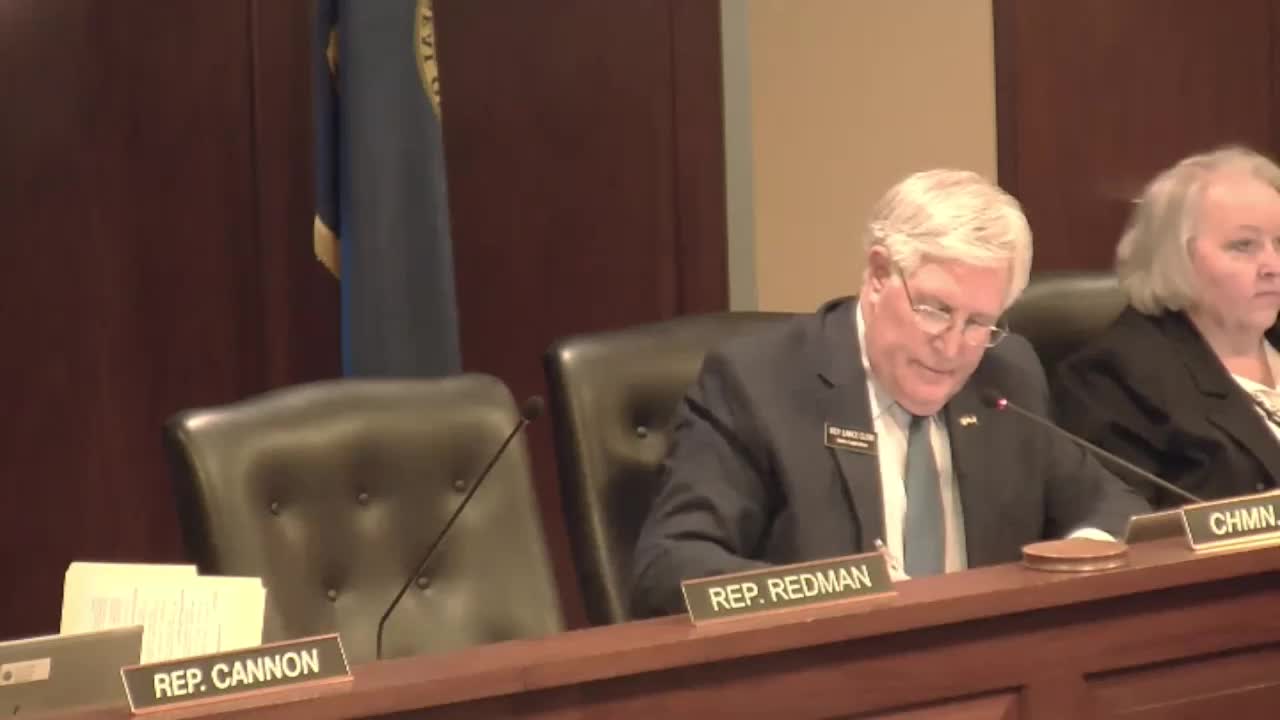
Representative Clow presented RS 31831 and yielded to Dean Cameron, director of the Idaho Department of Insurance, who outlined an industry-driven plan to stabilize the property insurance market and help homeowners mitigate wildfire risk.
Director Dean Cameron told the committee the state experienced a severe wildfire year with nearly 1,000,000 acres burned and the loss of roughly 140 structures, including 41 residences. He described two linked strategies in the RS: (1) a mitigation grant pool to help homeowners harden homes (examples mentioned included screening eaves, replacing flammable landscaping, and roof replacement) and (2) an industry-guided stabilization mechanism the Board could design, such as deductible buy-downs or other market supports.
Cameron said the RS would create a Board, primarily industry-run with nonvoting state seats (including the State Fire Marshal), to develop actuarially sound programs. He outlined six funding sources: (1) a diversion of one-quarter of future premium-tax growth above a baseline, (2) small existing cigarette-tax receipts currently assigned to the State Fire Marshal, (3) excess surplus-lines stamping fees, (4) other premium-tax growth or collections tied to mitigation programs, and (5–6) potential industry assessments or admission charges if the Board establishes a stabilization mechanism. Cameron emphasized that assessment authority would be a backstop and that the industry would control Board spending. "The assessment is the lever that keeps the Board members and the Board honest," Cameron said.
Members pressed for fiscal clarity and program design. Representative Harris asked about perceived contradictions with the fiscal note and cited specific lines in the RS; Cameron and staff explained contracting and that administrative costs would be paid from the Board's own funds. Representative Birch asked about projected revenue, how grants would be allocated, means testing, and the state's role versus homeowner responsibility. Cameron said the RS is intended to use existing and new industry-directed mechanisms, and that precise program rules and eligibility would be developed by the Board and through further legislation as needed.
Representative Muntz moved to introduce RS 31831. The motion carried; the transcript records three members as voting no and asking to be recorded: Representative Harris, Representative Marmon and Representative Razor. The committee recorded their dissent while the motion passed. The RS will return in bill form for further committee consideration, where members requested more detailed estimates of potential revenue, grant allocation criteria, and guardrails for new assessment authority.