Clarkdale commissions approve amended design for 909–911 Main Street newsstand despite preservation objections
Loading...
Summary
The Clarkdale Planning Commission and the town's Historic Preservation Commission voted unanimously to approve an amendment to the design plan for the newsstand at 909'911 Main Street permitting substituted operable storefront windows after a joint hearing that included public comment and technical testimony.
The Clarkdale Planning Commission and the town's Historic Preservation Commission voted unanimously to approve an amendment to the previously approved design plan for the newsstand at 909–911 Main Street, permitting a substitution of operable storefront windows the applicant had already installed.
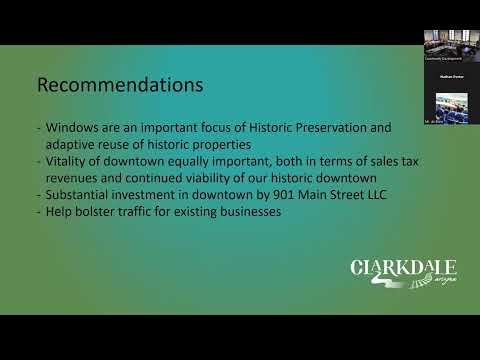
The change drew extended public comment and technical discussion about historic character, manufacturability and economic vitality. The commissions considered staff's recommendation to accept the substitution because the property owner has not opted in to the town's historic-preservation overlay and because staff said the revised storefront will help downtown economic activity.
Staff and project history
Town staff told the commissions the newsstand project was originally approved in June 2022 under the former design-review process and that the design-review responsibility later moved to the Planning Commission. The applicant, 909 Main Street LLC, and its architect, Rene Radocchio of Architecture Works Green Inc., sought approval of a revision limited to the windows on the bar portion of the storefront; the two adjacent retail bays retain the previously approved window treatment.
According to staff, the property owner did not elect to opt into the town's new historic-preservation overlay when that ordinance was implemented, and the project is not pursuing state or federal rehabilitation tax credits. Staff said they were not notified before the substituted, operable windows were ordered and installed.
Ruth (Town staff) told commissioners the substitution was discovered only after installation and said staff judged the economic benefits and the fact that the owner had not opted into the local preservation overlay as weighing in favor of approval. Staff cited downtown economic concerns, including a year-over-year decline in local sales-tax receipts of roughly $500,000, and noted the project represents a multi-million-dollar private investment in downtown.
Public comments and preservation concerns
Residents and preservation commissioners pressed for denial, arguing the altered windows change the building's street-facing character and set a damaging precedent. Nathan Porter, a Clarkdale resident who addressed the boards remotely, urged the commissions not to approve the amendment, saying it would ``set[] a dramatic precedent in a town that we call historic.''
Mike Wenner, a longtime local historian and former Historic Preservation Commission member, said the installed windows cost about $40,000 and warned that if the commissions denied the change that the council would likely overturn such a denial: ``If you vote them down, they'll appeal to the council, and we know the council will approve it,'' he said.
Architect'applicant response and technical details
Architect Rene Radocchio said the change grew out of a late partner request to have operable windows that open to the sidewalk; he apologized to the commissions and said he regretted failing to return to staff before ordering the windows. "I do take some responsibility ... it went right by me to come back to the town for this change," Radocchio said.
Radocchio and other speakers explained the installed system (Western Window Systems, per discussion) uses three operable panels rather than the previously drawn two because of panel height, weight and required mullion dimensions. Commissioners and the applicant discussed alternatives; staff and the architect said manufacturers would not supply a two-panel operable unit at the required size and thermal specification without heavier framing that would prevent reliable operation.
Commission discussion and process concerns
Several commissioners described the situation as primarily procedural. One commissioner summarized the concern as a credibility and precedent issue: the project moved forward in a way that required the boards to "consider forgiveness rather than permission." Commissioners pressed staff and the architect about why SHPO (the State Historic Preservation Office) had not been notified; staff said the project was not pursuing tax credits and no SHPO consultation had been requested.
Board action and next steps
After public comment and discussion, each commission separately moved to approve the amendment. Both the Historic Preservation Commission and the Planning Commission voted in favor; the record shows the motions passed with all voting members present voting "aye." During the meeting the applicant offered to install interpretive material about the building's original facade; a commissioner suggested a plaque or interior display noting that the installed windows are not original. Staff confirmed the item will be recorded in the project file following the commissions' approvals.
The commissions did not adopt any additional conditions beyond recording the approval on the record. Members of the public were reminded that procedural questions about how the town's historic-preservation ordinance was enacted had been raised during the hearing and may be addressed separately through council or ordinance-review processes.