Get Full Government Meeting Transcripts, Videos, & Alerts Forever!
Get email alerts on the Higher Education topic
No spam. Unsubscribe anytime.
Lewis‑Clark State College presents budget; leaders cite enrollment gains, salary gap and prison‑education expansion
Summary
At the Jan. 27 Joint Finance‑Appropriations Committee hearing, Lewis‑Clark State College officials outlined their FY2025 base budget, said state funding formulas will reduce next‑year allocations, and described how LAUNCH grants, new nursing programs and a prison‑education expansion are affecting enrollment and workforce training.
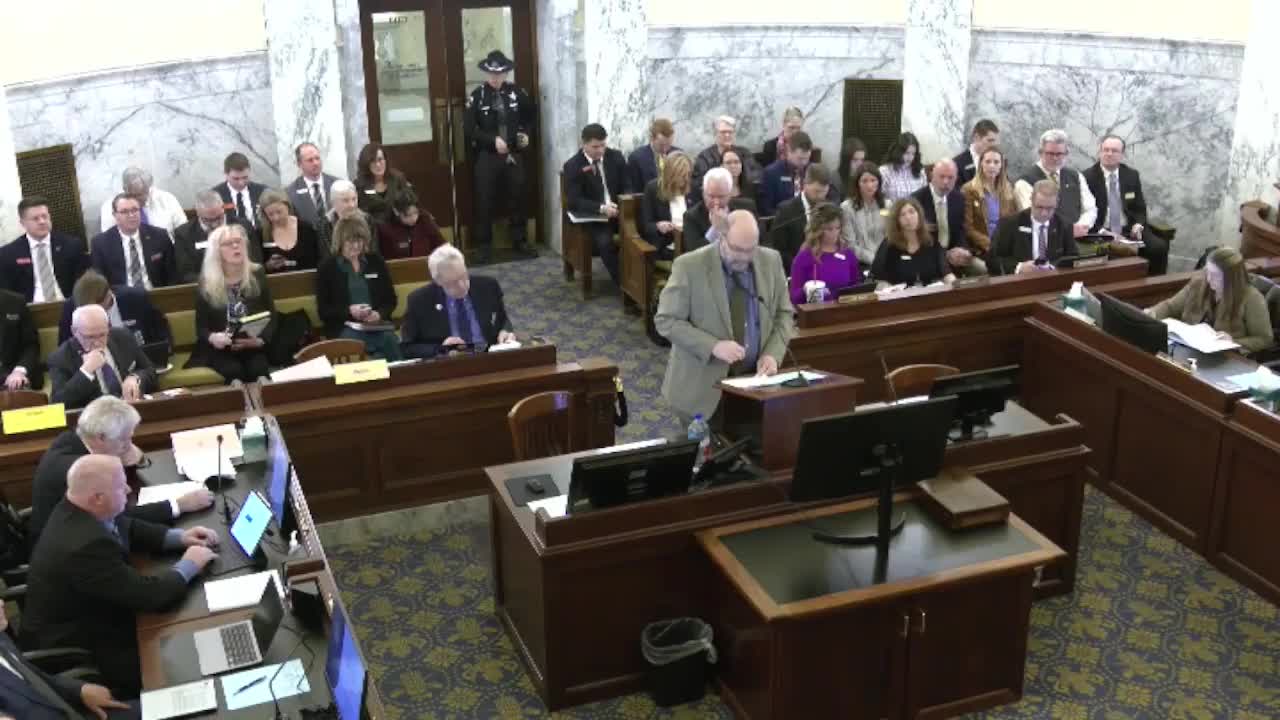
Lewis‑Clark State College President Cynthia Pemberton and Legislative Services Office analyst Kevin Campbell described the college's FY2025 budget and priorities at the Joint Finance‑Appropriations Committee meeting on Jan. 27 in Boise. The college reported modest enrollment gains and asked the committee to consider further help to close faculty and staff pay gaps.
Pemberton said Lewis‑Clark (LC State) enrolled 3,881 students and highlighted gains in career technical education and health programs. "We are North Idaho's health care education leader," President Cynthia Pemberton told the committee, citing new graduate‑level nursing and allied health pathways and partnerships to expand physician assistant and therapy programs.
The budget overview presented by Kevin Campbell, budget and policy analyst with the Legislative Services Office, showed LC State's FY2025 base appropriation at about $41.7 million and explained how the state treats tuition and fee revenue reappropriations. Campbell told members that in FY2024 the college's total appropriation was $40,517,100 and that $23.7 million in tuition and fees was reappropriated into FY2025. He also noted distributions from legacy endowments are governed by Idaho law (Idaho Code §33‑304), which directs how some endowment proceeds are split between institutions.
Why it matters: the college said state funding formulas and pay competitiveness affect its ability to retain faculty, run newly opened facilities and expand programs that feed the local workforce.
Key details from the presentation and Q&A:
- Enrollment and LAUNCH: Pemberton said LC State had 240 students receive LAUNCH funds in the fall and that career technical enrollment rose 19% that fall and another 10% in the following spring. She told the committee that 10 of 11 industrial programs (auto, CNC machining, diesel, HVAC, welding, electronics and similar fields) now include LAUNCH recipients and that 36 of 54 fourth‑year electrical apprenticeship students completed their program with LAUNCH support.
- Budget composition and adjustments: Campbell showed the college's multi‑year budget history and said 82.6% of the campus budget is personnel and supporting staff, 16.5% is operating expenses and less than 1% is capital outlay. LC State received several enhancements in FY2024–25: a combined governor's initiative portion ($370,100), $9,600 related to consolidation of human resources functions, $440,200 in an operational capacity enhancement (OCE) for FY2025, $352,200 in endowment adjustments, and the statutory 2% CEC increase. The college reported an FY2026 EWA (enrollment workload adjustment) reduction of $102,500 under the three‑year weighted credit‑hour formula.
- Salary compression and comparators: Committee members pressed the college on pay. President Pemberton said LC State is behind peer institutions and K‑12 averages. She told the committee that, based on recent data, an LC State instructor earns about $9,000 less per year than the average K‑12 teacher and an LC State assistant professor makes about $3,777 less than the K‑12 average. Campbell and Pemberton both said a salary comparables document is being prepared for all eight state institutions and will be shared with the committee.
- Operational Capacity Enhancement uses: Pemberton said the college used prior OCE funding to cover occupancy costs, custodial staffing and other operating expenses for the Schweitzer Career & Technical Engineering Building after pandemic timing reduced initial operating support. She also said OCE funds supported marketing and IT/cybersecurity improvements. For FY2026 the college requested $287,000 in OCE, to be applied toward competitive employee compensation (CEC).
- Prison education expansion: Pemberton said LC State is serving nearly 200 incarcerated students through experimental prison‑education transitions to full Pell‑eligible programs at sites including Orofino, Pocatello and Boise. She said Lewis‑Clark has completed the approvals needed from Idaho Department of Correction, the State Board of Education, its accrediting agency and the U.S. Department of Education to move from the experimental designation to full prison education status.
Committee context and next steps: Several committee members asked for further documentation, including detailed salary comparators and the enrollment and completion metrics found in the Legislative Budget Book. Analysts agreed to provide additional documents. No formal committee action or vote was taken at the hearing; the presentation and committee Q&A were part of the budget review process.
Pemberton closed by reiterating LC State's mission as a small, teaching‑focused public college that aims to connect "learning to earning," and asked for legislative support to close the remaining compensation gap. "We need 1,200,000 to reach median pay levels; 287,000 will move us part of the way," she said, describing the college's FY2026 request to make incremental progress on pay.