Get Full Government Meeting Transcripts, Videos, & Alerts Forever!
Get email alerts on the Emergency Food System topic
No spam. Unsubscribe anytime.
Food pantry leaders ask for statewide study of emergency food system funding and capacity
Summary
Leaders from food banks and community organizations told the joint committee that emergency food providers are stretched beyond original expectations and urged H.118 to create a special commission to assess financing, workforce and infrastructure needs across the Commonwealth.
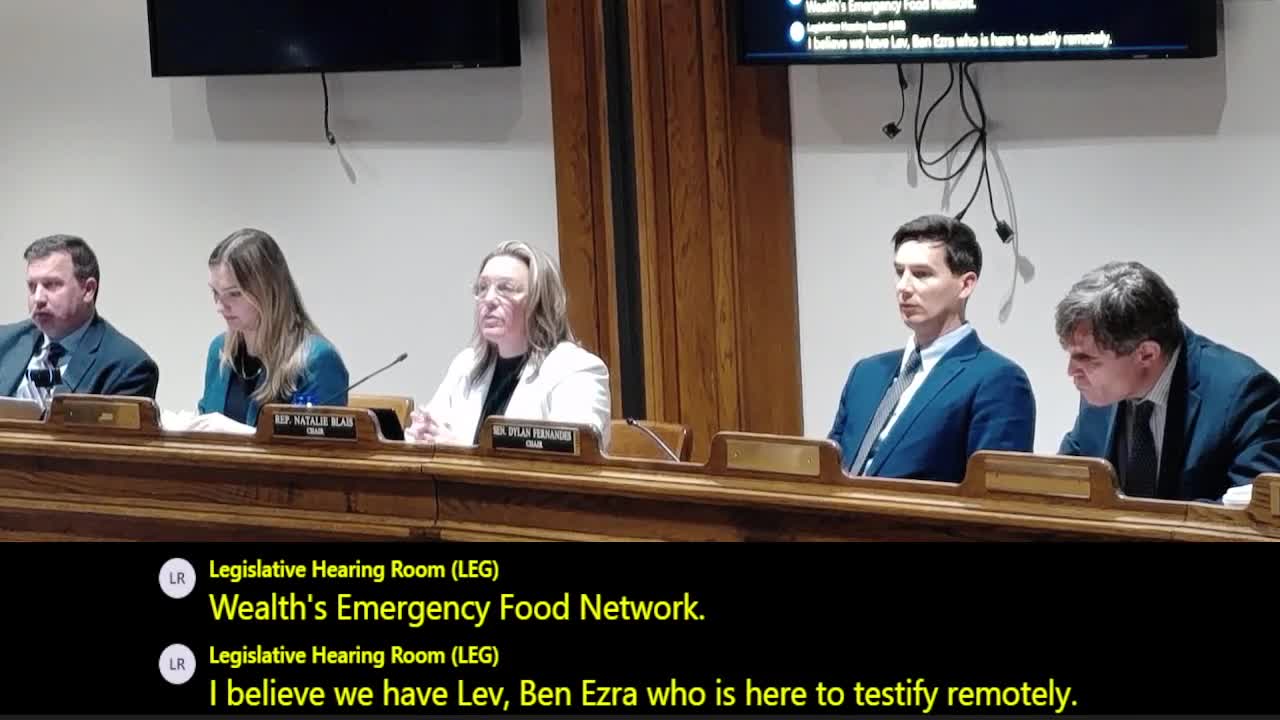
Lev Ben-Azra, executive director of the Amherst Survival Center, told the Joint Committee on Agriculture that his pantry provided about 1,600,000 meals last year to some 11,500 neighbors and that the emergency food system was never designed to shoulder long‑term demand.
"The emergency food system was built about 40 years ago really as a charitable effort intended to help a bit with temporary needs," Ben-Azra said. "The reality we face today is that the need is not short term for many, and the scale is far beyond what the system was designed to carry."
Supporters of H.118 argued the bill would create a statewide commission to assess the sustainability of food pantries and meal programs, covering governance, workforce development, funding models and facility capacity. Ben-Azra described day‑to‑day operations at a large regional pantry: volunteers collecting donated retail food from 17 retailers, multiple weekly trips to the regional food bank to pick up thousands of pounds of food, and up to 300 weekly volunteers sorting and stocking multiple times per day.
"Need has continued to rise far exceeding pandemic peaks, but those resources have gone away," Ben-Azra said, urging lawmakers to consider the real cost of continuing to underfund the system. Committee members asked for detail on the center's services; Ben-Azra said the organization operates a food pantry, prepares hot meals, runs a free walk‑in clinic and provides day services for people experiencing homelessness.
Members of the committee expressed interest in a more holistic review of emergency food infrastructure, and asked advocates for concrete recommendations about funding models and workforce supports. No formal committee vote on H.118 was recorded at the hearing.