Get Full Government Meeting Transcripts, Videos, & Alerts Forever!
Get email alerts on the Wrongful Conviction Compensation topic
No spam. Unsubscribe anytime.
Subcommittee reports bill clarifying compensation rules for wrongfully convicted Virginians
Summary
The Civil Subcommittee reported House Bill 1914, a measure to clarify and adjust compensation rules for wrongfully convicted Virginians and to preserve legislative authority to increase awards in cases of intentional misconduct.
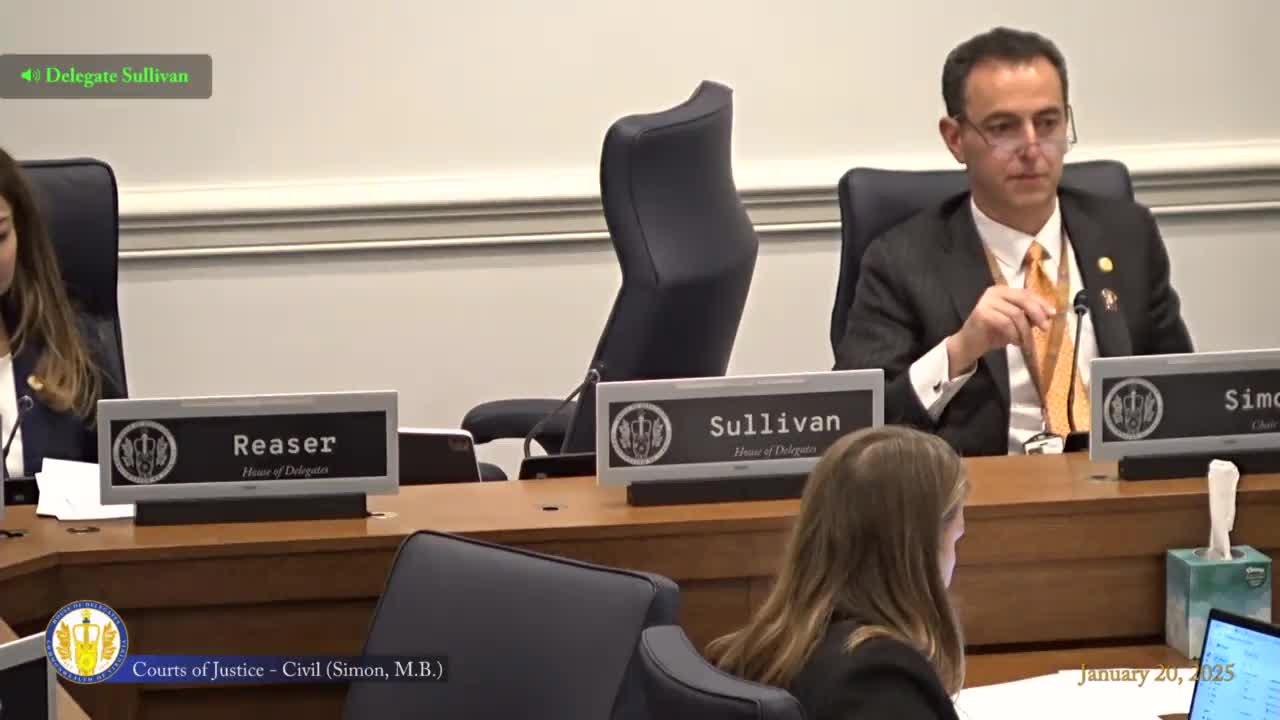
House Bill 1914, introduced by Delegate Sullivan, was reported by the Civil Subcommittee and referred to Appropriations after the committee voted to report the measure by roll call (7-0).
Sullivan said the bill corrects an apparent ambiguity in last year’s amendments to the statute that compensates wrongfully convicted people. He said the legislature intended that additional compensation tied to being listed on a sex-offender registry apply only to time spent on the registry after release from incarceration, not to years while a person was in prison. “As I thought about this upcoming session, that is not how I pitched the bill last year. That is not what this committee and . . . the general assembly intended,” Sullivan said, explaining a targeted clarification to the code.
Sullivan also urged the committee to preserve the General Assembly’s authority to increase compensation in cases where the conviction resulted from intentional misconduct by prosecutors or others. He noted an earlier provision allowing the legislature to award up to four times the base compensation in cases of intentional misconduct and argued the current statute’s linkage to a local government matching decision could block relief when a locality could not or would not match the payment.
Committee members thanked the patron for prior work on wrongful-conviction compensation, and several members noted recent constituent cases. Sullivan said the bill is intended to avoid forcing exonerated individuals into litigation and to make legislative remedies more predictable.
The clerk recorded the vote and the committee reported and referred HB 1914 to Appropriations, 7-0.