Get Full Government Meeting Transcripts, Videos, & Alerts Forever!
Get email alerts on the Rape Conceived Parentage topic
No spam. Unsubscribe anytime.
Subcommittee advances bill to prevent rapists from claiming parental rights
Summary
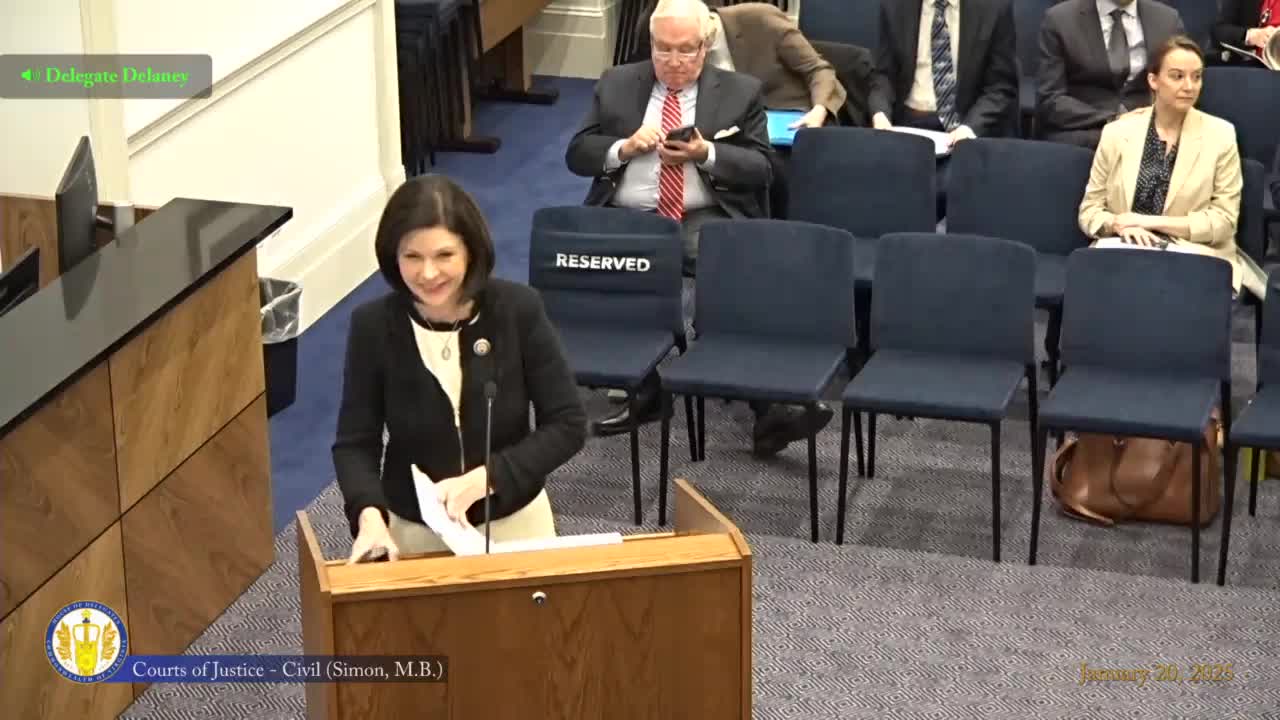
After extensive testimony from survivors, researchers and opposition groups, the Civil Subcommittee reported House Bill 1727, a Delaney-sponsored measure that would prevent a person whose criminal sexual conduct resulted in a conception from establishing parental rights in Virginia under a civil process.
The Civil Subcommittee voted 5-2 to report House Bill 1727 by Delegate Del. Delaney, a measure that would establish civil procedures to prevent a person whose criminal sexual conduct resulted in a conception from obtaining parental rights, or to allow the court to remove or limit parental claims, without requiring a prior criminal conviction.
Delegate Delaney framed the bill as filling a gap in Virginia law that forces survivors who carry pregnancies resulting from rape to continue to interact with and often co-parent with their perpetrators. “If a person claims parental rights and has been proven by clear and convincing evidence to have raped the parent who gave birth, that person should not be able to assert parental rights,” Delaney said in committee testimony.
Several witnesses told the committee why the change is needed. Jennifer, a survivor who testified in person, described prolonged trauma and threats from the man she says raped her and said Virginia offered her no path to separate her family from that person once her child was born. “My life had been completely turned upside down, and despite the promises of protection, the protection of the law did not come,” she told the committee. “No one should have to stay connected to a rapist.”
Dr. Lucy Guarnera, a clinical psychologist who researches pregnancies that follow sexual assault, summarized academic findings for the panel and said her research shows roughly half of women raising children conceived from sexual assault face threats from perpetrators for custody or parental involvement and about one in five end up in court to contest parental rights. “Given that only around 3 out of 100 sexual-assault victims will ever see the perpetrator convicted,” she said, “any law that requires a conviction to operate will fail to protect most survivors and their children.”
Opponents, including the Family Foundation and the Virginia Family Law Coalition, expressed constitutional and procedural concerns. Richard Garriott of the Virginia Family Law Coalition warned the bill would require juvenile or family courts to adjudicate whether a criminal sexual offense occurred under a civil standard and said the juvenile court system lacks jury trials and criminal discovery processes. “We feel that there needs to be a criminal conviction,” he said, arguing the criminal standard protects due process for accused parents.
Sandy Johnson (RAINN) and other advocates said almost half of U.S. states have enacted similar civil procedures following a 2015 federal incentive and that the measures have not produced constitutional challenges; advocates said Virginia’s bill follows family-court processes and uses a clear-and-convincing standard consistent with other parentage and parental-rights proceedings.
Committee members amended the substitute to delay parts of implementation and to preserve work-group review of evidentiary standards and forms; the committee ultimately voted 5-2 to report the bill and referred it to Appropriations for fiscal consideration. Supporters said the bill protects survivors and children; opponents said it risks constitutional and procedural problems and could have unintended consequences for sibling inheritance and related civil matters.