Get Full Government Meeting Transcripts, Videos, & Alerts Forever!
Get email alerts on the Victim Notification Name Change topic
No spam. Unsubscribe anytime.
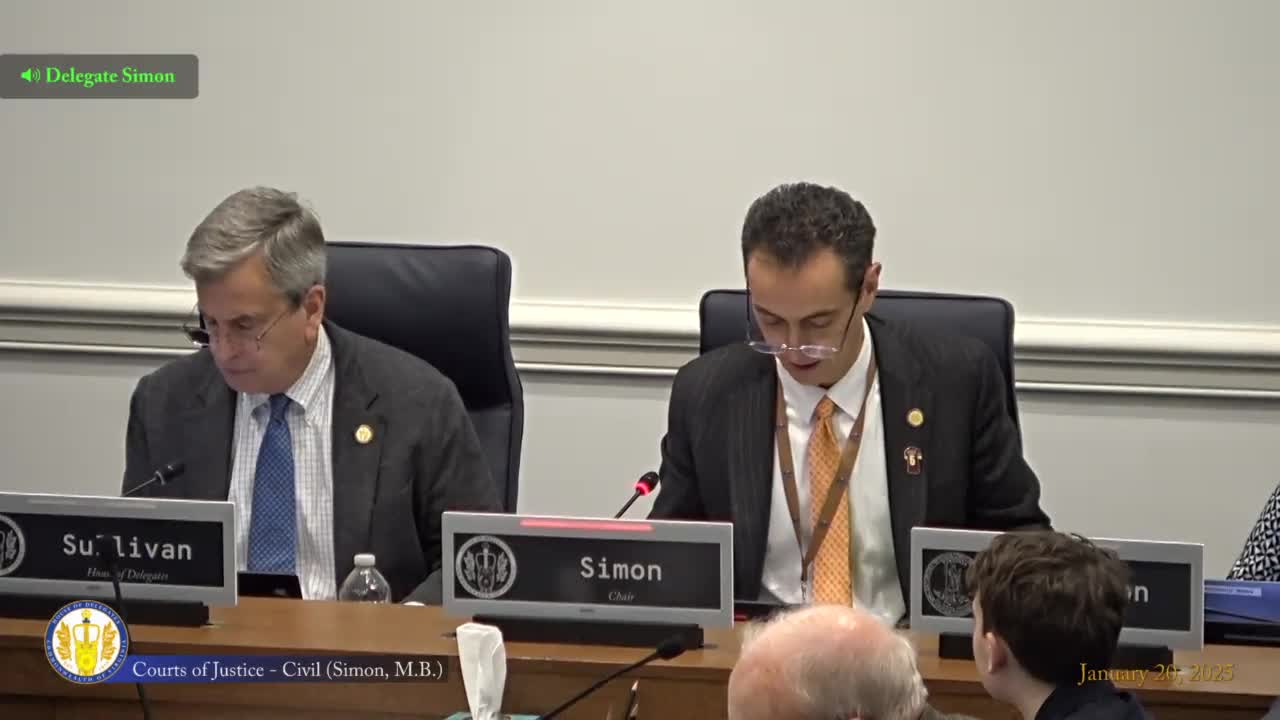
Subcommittee backs bill to notify victims when registry-listed people seek name changes
Summary
The civil subcommittee voted unanimously to report House Bill 1846, which would require commonwealth's attorneys to make reasonable efforts to locate and notify victims when a person listed on the crimes-against-minors/offender registry petitions to change their name.
The Civil Subcommittee of the House Courts of Justice on Monday voted 6-0 to report House Bill 1846, a measure that would require commonwealth's attorneys to attempt to locate and notify victims before a court grants a name change to someone required to register on the crimes-against-minors/offender registry.
Delegate Doug Arnold, the bill’s patron, told the committee the measure “requires commonwealth's attorneys who are given notice of the name change by someone that's required to register on the . . . offender crimes against minor registry to notify the victims of the proposed name change.”
The bill would allow victims to appear personally or by counsel or to submit written comment to the court considering the name-change petition. Under current law, Arnold said, a court can grant a name change for a registrant only after finding “good cause” within the petition and then must notify the commonwealth's attorney; HB 1846 would add a duty for that commonwealth's attorney to use reasonable efforts to locate victims.
David Smith, testifying for Safer Virginia, opposed the bill. “By having the commonwealth's attorneys going out and trying to find people . . . you could actually revictimize folks who have moved beyond or don't want to deal with that part of their past anymore,” Smith said, describing a case in which a woman who had been convicted years earlier married and changed her name and arguing that notification could cause harm.
Robert Tracy of the attorney general’s office testified in support. “This common sense proposal gives victims a voice in the process. It's not conclusive. It merely says a victim of a crime for which someone is on the registry should be heard in the process and have the dignity of his or her voice received by a circuit court,” Tracy said, listing serious offenses covered by the registry such as kidnapping and aggravated sexual offenses.
Committee members pressed patrons about whether there was a known case that prompted the bill; Arnold said he did not have a specific case but described the measure as a uniform, victim-oriented standard to make sure victims know “what's going on as opposed to having to respond after the fact.”
The committee voted to report the bill by a voice and roll call; the clerk recorded the motion and the report passed 6-0. The measure will move to the next steps in the House process.
The bill does not change the statutory “good cause” finding required for registrants’ name-change petitions; it adds a notification and outreach duty for the commonwealth's attorney and an opportunity for victims to participate in the court process.