Get Full Government Meeting Transcripts, Videos, & Alerts Forever!
Get email alerts on the Injection Wells topic
No spam. Unsubscribe anytime.
Committee approves revised injection-well rules, adds framework for recycled-water injection
Summary
The Senate Resources and Environment Committee approved updated injection-well rules that reorganize permitting standards, align definitions with other state rules, and add standards for potential injection of recycled municipal and industrial wastewater.
The Idaho Senate Resources and Environment Committee approved a revised chapter on injection wells that the department says balances groundwater protection with new uses such as land application and potential recycled-water injection.
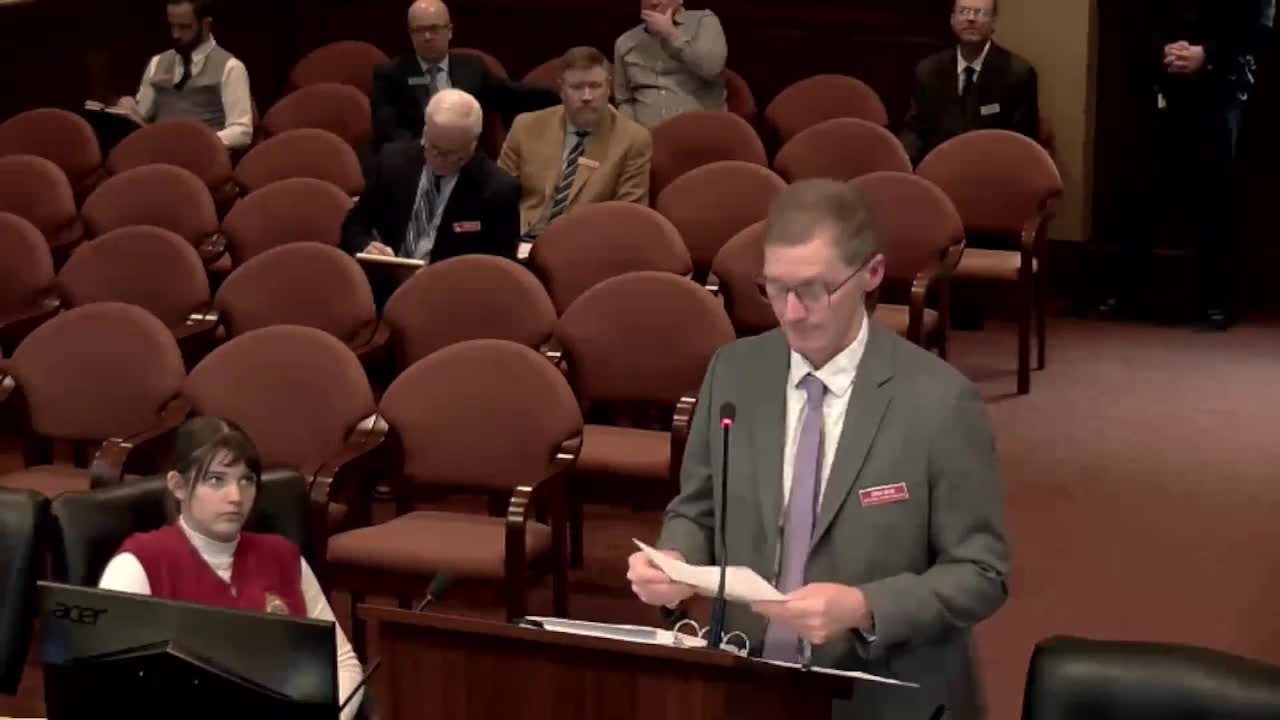
Eric Boe, Water Compliance Bureau Chief and rules review officer for the Department of Water Resources, told the committee the injection-well rules (docket 3703032301) provide procedures and minimum construction and operational standards for injection wells and are necessary to maintain the state's primacy over Class 5 injection-well regulation under the federal Safe Drinking Water Act of 1974. "The injection well rules specifically address classifications of injection wells, authorizations and exemptions, permitting and application requirements, construction and operational requirements, standards for injected fluids, monitoring, and enforcement," Boe said.
Boe said the department reorganized the chapter to make content easier to find, clarified definitions such as "endangerment," "groundwater quality standards" and "underground source drinking water," and aligned terms with Department of Environmental Quality rules for recycled water. The department added Rule 55.06 to establish standards for the "quality of recycled water derived from municipal or industrial wastewater sources," reflecting increasing stakeholder interest in the concept.
Sen. Guthrie asked for a plain-language description of injection wells. Boe explained that the federal classification system spans several well classes and that Idaho regulates Class 5 wells — those that inject nonhazardous fluids into or above underground sources of drinking water. He said an "injection well in Idaho is a well that's 18 feet or deeper" and that Class 5 wells vary widely, "from aquifer recharge to heat-pump return flows," with depths ranging from just over 18 feet to thousands of feet for geothermal operations.
Jason Van Gilder, public works director for the city of Middleton, testified in favor of the rules. He said Middleton is pursuing land application of highly treated municipal effluent onto agricultural fields and that the previous rules required a waiver to permit subsurface drip application. "IDWR has promulgated rules before you today that will enable the situation Middleton is encountering while still ensuring the protection of our groundwater resources," Van Gilder said.
The department said it published the proposed injection-well rules Oct. 2, 2024; it held five public meetings over two years, collaborated with the Idaho Department of Environmental Quality and received moderate public participation. The pending rule published Dec. 4, 2024, reduced the total rule text by 1,521 words (14.5%) and decreased restrictive word count by 10 words (8%).
Sen. Harris moved to accept docket 3703032301; Sen. Ben Orton seconded. The committee approved the pending injection-well rules by voice vote.