Get Full Government Meeting Transcripts, Videos, & Alerts Forever!
Get email alerts on the Walk Bike Plan topic
No spam. Unsubscribe anytime.
Clackamas County planning commission unanimously recommends adoption of Walk Bike Clackamas plan
Summary
After a two-and-a-half-year public process, Clackamas County Planning Commission voted unanimously April 14 to recommend the Walk Bike Clackamas plan (ZDO 292) to the Board of County Commissioners, asking the board also to consider a pedestrian crossing in Rhododendron.
The Clackamas County Planning Commission on April 14 voted unanimously to recommend that the Board of County Commissioners adopt ZDO 292, the Walk Bike Clackamas plan, which combines the county’s pedestrian and bicycle master plans and updates active-transportation policies in Chapter 5 of the comprehensive plan.
The recommendation stemmed from a 2.5-year project staff said is the first countywide update to the pedestrian and bicycle master plans since 1996. Scott Holscher, the county’s senior planner, told the commission the package is intended to bring the county into compliance with statewide planning requirements, saying, “This project will serve as the bicycle and pedestrian element of the TSP.” The commission’s recommendation will be forwarded to the Board of County Commissioners, which will hold a de novo hearing May 13, 2025.
Why it matters: The plan identifies 236 projects across multiple planning areas, updates policy language in the transportation chapter, and creates a menu of programs to support walking and bicycling. Staff and committee members said adoption will position the county to pursue grants and to feed the forthcoming Transportation System Plan (TSP) update, even though the Walk Bike plan does not itself commit county funds.
Key details
• Project scope and purpose: The Walk Bike Clackamas plan merges the pedestrian and bicycle master plans into a single active-transportation element and updates related comprehensive-plan policies. Staff described the proposal as intended to satisfy state requirements for pedestrian and bicycle planning (referenced in the staff presentation as Oregon administrative rule "OAR 6 66 6 60" and as Statewide Planning Goal 12 — Transportation).
• Scale and organization: The plan divides the county into planning areas (staff described five planning areas with an additional split of the town center area, effectively six) and lists 236 projects. Projects are organized into linear facilities (sidewalks, bike lanes, trails) and point projects (crosswalks, bike signals), and are prioritized into three tiers (Tier 1 = high priority).
• New program concepts and policies: The plan proposes programs — many without dedicated funding — to support active transportation. Staff highlighted two programs that received broad public support: a school-zone safety campaign (building on existing Safe Routes to School efforts) and a "no parking in the bike lane" education campaign. The plan also introduces a "shared streets" concept for low-volume local streets that would pair reduced speeds with signage and traffic-calming measures.
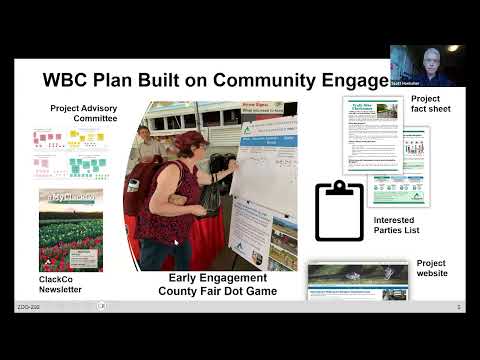
• Public engagement: Staff described sustained outreach across four engagement milestones. Holscher reported more than 300 participants at an early county-fair engagement, 800 written comments and 270 online map submissions during a virtual open house, more than 400 participants at a later outreach milestone, and 660 responses to the final draft survey. An 18-member advisory committee also reviewed deliverables and helped shape prioritization criteria.
• Funding and implementation: The plan contains no capital funding commitments. Staff listed potential funding sources for projects and programs, including ODOT-administered Safe Routes to School grants, urban renewal (tax-increment financing), community road funds, vehicle registration fees, and fees-in-lieu from development. Staff noted funding will be addressed later during the county’s TSP update, when projects across all modes are compared against a funding forecast.
Public testimony and commission discussion
Two members of the public testified in support. Jim Schroeder of Happy Valley said, “I completely support what you’ve done, and look forward to kind of the funding aspects of it,” and described personal safety and connectivity reasons for backing the plan. Joseph Edge, who said he served on the county’s Pedestrian-Bikeway Advisory Committee, urged adoption and described the draft plan as consistent with accepted practice.
Commission discussion ranged from clarifying the plan’s legal basis under state rules to questions about how shared streets would be implemented and whether the plan would require specific expenditures. Commissioners and staff repeatedly stressed that the plan is a facilities plan (identifies projects and policies) and is not itself a capital-improvement program.
Action and next steps
The commission voted unanimously to recommend adoption of ZDO 292 to the Board of County Commissioners, adding a request that the board consider adding a pedestrian crossing in Rhododendron (a project several commissioners had noted in earlier meetings). The Board will hold a de novo hearing on May 13, 2025.
Ending note
Staff said the Walk Bike plan is intended to inform the county’s TSP update, which staff expects to begin later in the year and which will address funding projections and the capital program. Commissioners and members of the public who testified praised the breadth of outreach and said the plan gives the county a framework to pursue grants and coordinate with cities and ODOT.