Get Full Government Meeting Transcripts, Videos, & Alerts Forever!
Get email alerts on the School Safety topic
No spam. Unsubscribe anytime.
Committee sends school safety advisory board restructuring bill to floor after debate on membership
Summary
House Bill 42, which would shrink the state school safety and security advisory board to a smaller voting membership while retaining a broad invited list of experts, was recommended to the House floor with a due-pass recommendation by an 8-4 roll call after testimony from education and law enforcement stakeholders.
Representative Ted Hill, R., presented House Bill 42 to the House Committee on Education, saying the bill would restructure the state school safety and security advisory board to address chronic quorum problems.
"We'd like to maintain the broad spectrum of stakeholder representation," Hill said, while explaining the bill would reduce the formal voting membership to a smaller group so the board can reliably meet and act. Hill told the committee the intent is to retain invited experts while creating a "lean" panel of voting members.
Matthew Reiber of the State Board of Education told the committee the state board supports the bill and that the "invite list" of experts would remain unchanged even as formal voting membership is reduced. "We still want the experts in the room," Reiber said, and he pledged the state board would work with the governor's office to appoint school experts and others with "boots on the ground" experience.
Quinn Perry, deputy director of the Idaho School Boards Association, testified in opposition to shrinking the statutory seat for school officials. "We do believe that there should be a school official on this board," Perry said, asking that the statute retain at least one school board member or school administrator as a voting member.
Sheriff Chris Gertz (Colorado County) told the committee he was concerned about removing a dedicated law enforcement seat. "To not have an official seat there and be a voting member...there was a reason this was really done the way it was where you had a Chief of Police, a Sheriff, and the Idaho State Police all on there," Gertz said, adding that law enforcement can accept a single consolidated seat but insisted the board must include someone who deals with these issues day in and day out.
Committee members debated the tradeoffs between broad representational seats and a smaller voting panel that can achieve a quorum. Representative Mathias requested a roll call, noting that other sections of state code depend on the committee's recommendations and that voting membership therefore matters.
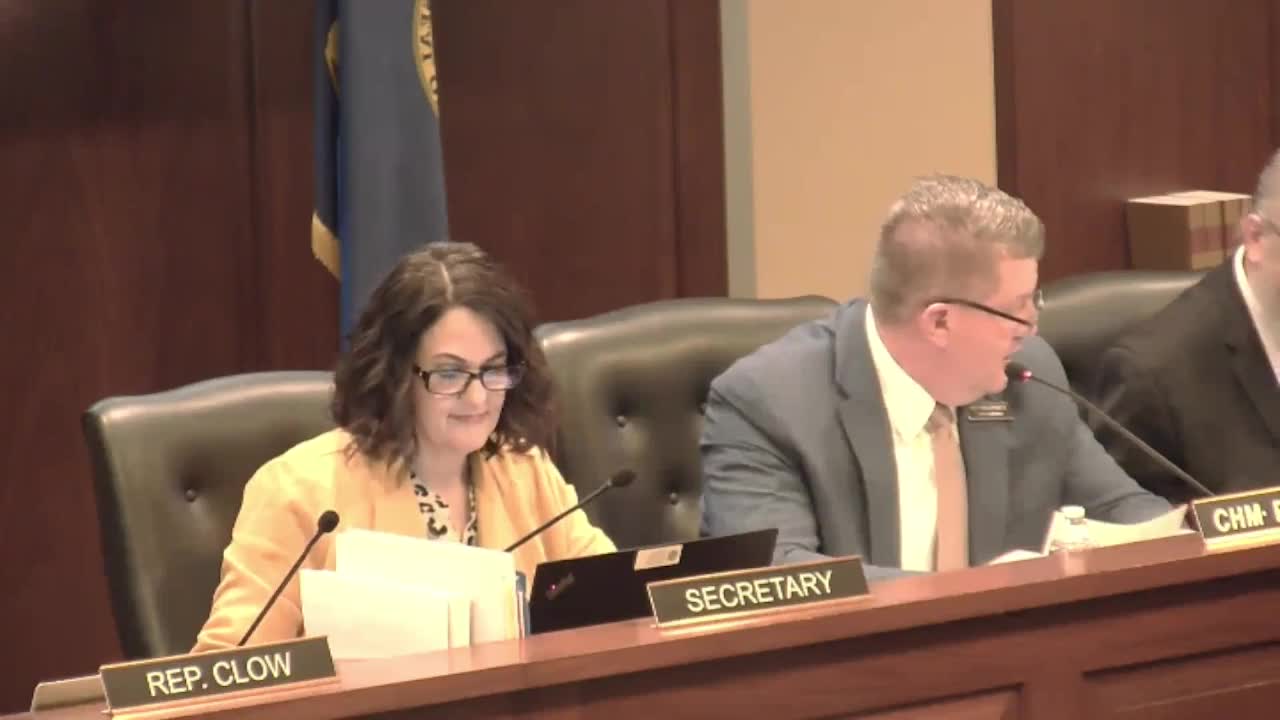
Representative Clow offered a substitute motion to send House Bill 42 to the floor with a due-pass recommendation. The committee conducted a roll call vote and the substitute motion passed 8 to 4. The chair announced the motion carried and the bill will be sent to the House floor with a due-pass recommendation.
Speakers on both sides told the committee they expect the state board and the governor's office to invite nonvoting experts — including school board members, school administrators, law enforcement, the FBI and the state Fusion Center — to participate in meetings even if they are not formal voting members. The committee did not adopt statutory language restoring a permanent school-board or law-enforcement seat during the hearing; supporters said appointments remain at the governor's discretion and that additional seats could be added later if necessary.
The committee's substitute motion to send House Bill 42 with a due pass came after multiple members expressed both support for reducing the size to secure quorums and concern about losing direct statutory representation for school officials and law enforcement.