Get Full Government Meeting Transcripts, Videos, & Alerts Forever!
Get email alerts on the State Police Budget topic
No spam. Unsubscribe anytime.
Idaho State Police seeks funds for fentanyl unit, forensics and retention as staffing shortfalls persist
Summary
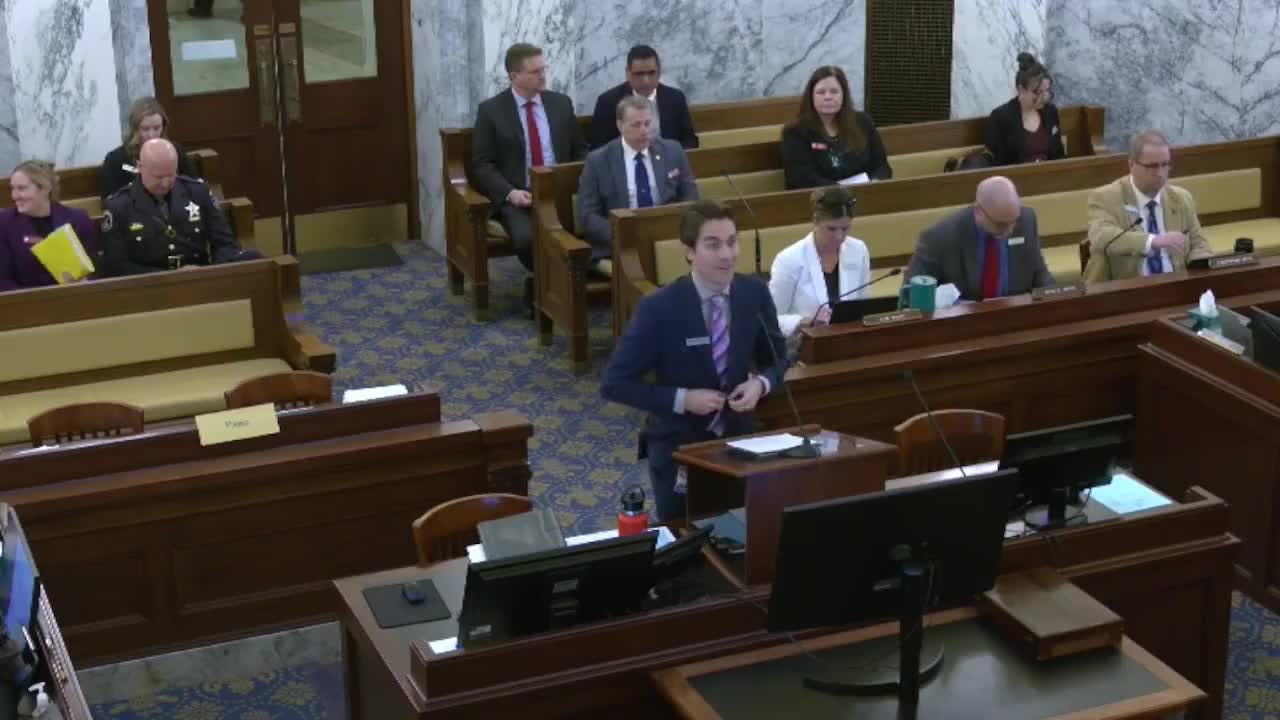
The Joint Finance and Appropriations Committee heard Idaho State Police leaders on Feb. 12 seeking new and restructured funding to fight fentanyl, expand forensic capacity and retain troopers amid notable vacancies.
The Joint Finance and Appropriations Committee heard a detailed budget review from the Idaho State Police on Wednesday, as agency analysts and Director Colonel Bill Gardner described enhancement requests to expand fentanyl enforcement, bolster forensic capacity and shore up retention amid persistent vacancies.
Noah Peterson, budget policy analyst with the Legislative Services Office, summarized the division’s structure and the highest‑priority requests for FY2026. The division that houses Idaho State Police has 583.67 FTP allocated and reported about 38.67 vacancies, Peterson said. The agency’s spending pattern included $26 million in one‑time appropriations in FY2023 and a $15.8 million reappropriation into FY2024 tied to replacement items, COVID related supplemental funding and fentanyl response work.
Peterson outlined the larger FY2026 enhancement requests, including a 10‑FTP, $1,043,300 fentanyl unit; conversion of contract forensic staff to full‑time positions; a special investigations unit assigned to Department of Correction facilities (4 FTP, $757,300); a forensic deputy lab manager (1 FTP, $118,200); and an estimated $168,100 fiscal impact of proposed DNA‑collection legislation expanding collection to certain misdemeanors. Peterson also described a requested transfer related to the highway distribution account (HDA) shift of roughly $4,995,500 and 37.48 FTP to maintain patrol operations if that revenue disappears.
Several items aim to adjust how positions and contracts are funded: an investigators request tied to the sexual‑assault kit initiative (SACI) was restructured so investigators would be hired as permanent employees to allow post certification, converting earlier plans to use retired‑officer contractors; Peterson described that as a net‑zero transfer from operating to personnel costs ($402,100 net transfer). The division also requested $233,000 ongoing from the Idaho Law Enforcement Telecommunications fund for an ILETS disaster‑recovery site and a program transfer of 2 FTP ($203,700) to move the digital forensics team into Forensic Services.
Peterson said the governor recommends a $500,000 one‑time appropriation from the Millennium Fund for the governor’s “fentanyl takes all” communications campaign; Division of Financial Management Administrator Lori Wolf confirmed the governor’s recommendation is one‑time and that the Millennium Fund review committee had not yet made a disposition.
Colonel Bill Gardner described operational impacts and recruitment challenges. “We’ve seized over 65,000 fentanyl pills, over a full pound of fentanyl powder, [and] 150 pounds of methamphetamine” during recent interdiction efforts, he said, and described frequent targeted “saturation” patrols by the interdiction team. Gardner said the agency is losing troopers to cities and other states because of pay differences and that vacancy patterns are especially acute in northern Idaho. “We put all this time and energy into making what I think is the cream of the crop and somebody scoops them up and takes them to another agency,” he said, urging more permanent pay and retention solutions.
Gardner described two lab projects: a full new forensic laboratory planned in Meridian that will relocate current staff and equipment, and a renovation‑scale addition to a District 4 office in Twin Falls to create a drug‑identification lab for the Burley/Twin Falls/Rupert region.
On staffing and pay, Gardner urged broader authorities and tools to pursue financial investigations, including “administrative subpoena power,” to follow money in drug and human‑trafficking cases; Representative Manwaring had asked about tools to address rising financial crime. Christine Otto, ISP chief financial officer, said converting previously contracted investigators to state employment was intended to enable post certification and would not materially increase program costs other than standard employee benefits: “The amounts should actually be exactly the same except, well, with the exception of benefits,” she said.
Other requests covered replacement items ($5,090,700, largely from dedicated funds), IT replacement ($942,800), federal grant‑related appropriation shifts ($659,700), and a $50,000 request for Adam Walsh Act (SORNA) compliance. Peterson also noted an OITS modernization change: the agency proposed moving 20 IT positions to the Office of Information Technology Services; the governor recommendation reduced that number to 16, with a net operating cost change tied to OITS billing.
Committee members pressed for details: senators and representatives asked about the Meridian lab schedule, the scope of the HDA fund impact (relating to Senate Bill 1201 of 2019), how federal grant amounts flow through ISP, and the source and longevity of funding for fentanyl work. Gardner repeatedly emphasized that pay differentials—he cited pay gaps of roughly $15.20 an hour in some comparisons—are driving departures and that some districts are functionally understaffed.
Committee members signaled interest in addressing turnover and retention beyond the governor’s recommendation; one senator said she will bring a proposal with larger pay changes next session. No committee votes on ISP budget enhancements were taken during the presentation; staff and the agency agreed to follow up with specific revenue and vacancy data.