Get Full Government Meeting Transcripts, Videos, & Alerts Forever!
Get email alerts on the School Choice Education Savings Accounts topic
No spam. Unsubscribe anytime.
Committee prints education opportunity RS to create accounts that let state funds follow qualifying students
Summary
RS 32171 (Idaho Education Opportunity Program) was introduced; it would let a portion of state K–12 funds follow eligible students into education savings accounts for private schools, tutors or personalized plans, with eligibility limits and an estimated fiscal impact.
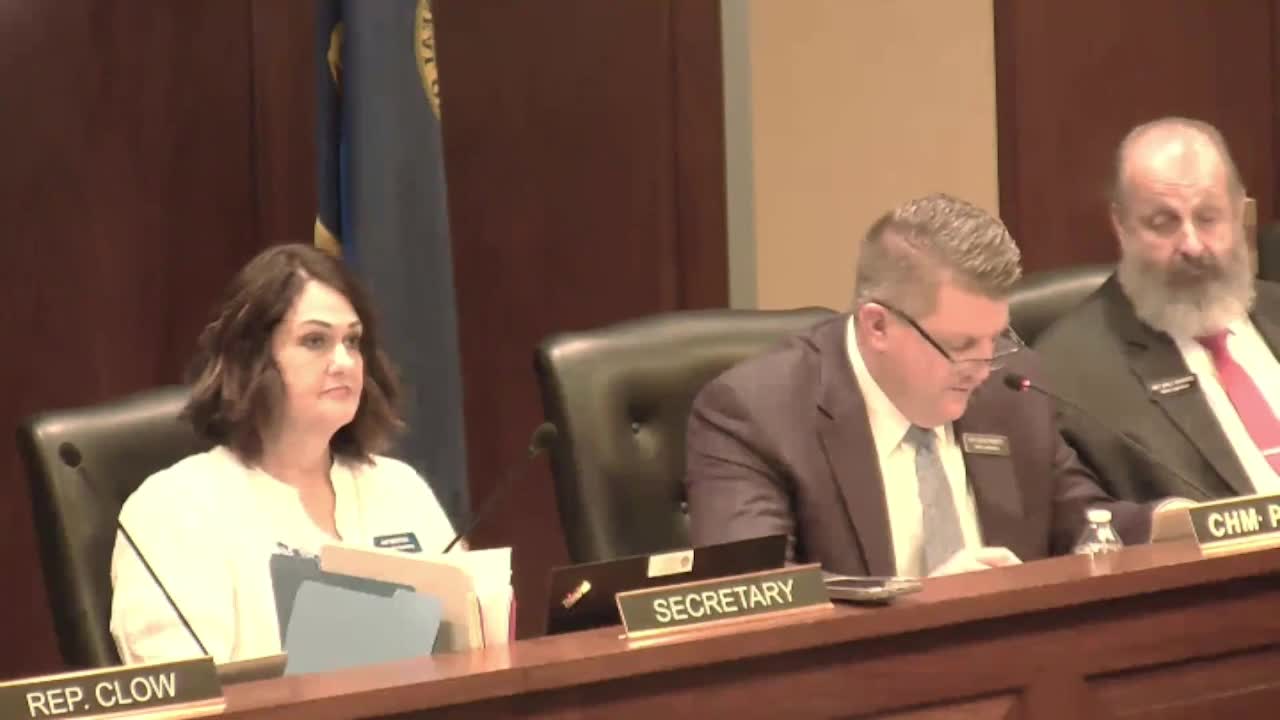
Representative Lance Clow presented RS 32171, the Idaho Education Opportunity Program (IEOP), a school-choice style proposal that would allow a portion of the state education funding formula to follow qualifying students into an education opportunity account to pay tuition, curriculum, tutors and other enumerated expenses. The sponsor said the program targets low- and moderate-income families; eligibility would generally require prior enrollment in a public school (grades 1–12) or be an entering kindergartner and sets an adjusted gross income cap of $75,000.
Clow described the funding formula he proposes: the state portion of average per-pupil distribution (estimated at $8,440 for 2025) would be used as the benchmark; 80% of the state average would follow the student into an IEOP account (roughly $6,700 by the sponsor's estimate) with 20% remaining with the resident district to hold a seat and cover district obligations. Special-education students would be eligible for the full per-pupil amount, Clow said. Monies in an account could roll forward year-to-year and could be applied to postsecondary education if funds remain after K–12 use.
Clow said he estimated initial participation of a few thousand students, suggested the State Department of Education would need two additional staff (estimated under $200,000 including benefits) to administer the program, and said third-party account administration costs were capped at 3.5 percent. He also proposed an income-tax change allowing taxpayers to deduct private-school tuition paid out of pocket (but not funds received through the IEOP) from taxable income. Based on his assumptions, Clow estimated an annual fiscal impact of roughly $14 million when combining tax deductions and program payouts.
Representative Harris asked whether the $200,000 estimate included benefits; Clow replied that it did. Representative Tanner asked how homeschoolers would fit in; Clow said parents choosing a personalized education plan would no longer be classified as homeschooled for the purposes of this program and would be subject to the plan's accountability measures. Representative Nelson and others said they appreciated the detail but had policy concerns about public funds going to private religious schools; nonetheless the committee voted to introduce RS 32171 for a formal hearing.