Lifetime Citizen Portal Access — AI Briefings, Alerts & Unlimited Follows
House Resources committee advances bill allowing conflicted Board of Fish and Board of Game members to participate in deliberations
Loading...
Summary
The Alaska House Resources Committee voted 5-4 on March 17, 2025, to advance House Bill 33, which would let members of the Board of Fisheries and the Board of Game who disclose an interest remain in deliberations to answer technical questions while barring them from voting if the chair or a majority determines a conflict exists.
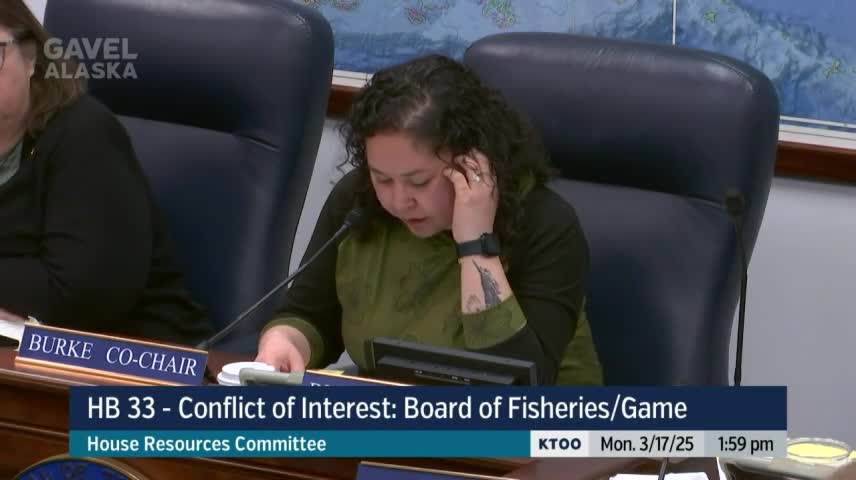
The Alaska House Resources Committee voted 5-4 on March 17, 2025, to move House Bill 33 out of committee. The bill, sponsored by Representative Cathy Stutes, would clarify that members of the Board of Fisheries and the Board of Game who disclose an interest may take part in discussion during deliberations but may not vote if the chair (the board’s designated ethics supervisor) or a majority of board members determines the participation would violate the Executive Branch Ethics Act.
Representative Stutes, the bill sponsor, told the committee the measure “doesn't change the qualifications of a conflict. It doesn't change anything except one thing. If the board says you have a conflict … you may not vote. You may participate in the discussion.” She said the change is intended to let subject-matter experts who would otherwise be “conflicted out” explain technical details during deliberations without permitting them to cast a vote on that matter.
Why it matters: the Board of Fisheries and Board of Game are allocative bodies that set harvest limits, area closures and other measures that directly change who may harvest state resources and how much. Proponents told the committee that, because many commercial operators are automatically considered conflicted for local issues, the boards often lose the expertise of people who know a specific fishery or hunt area best.
Major commercial fishing and fishing-industry groups, and some hunting and conservation organizations, testified in support. Tracy Welch, executive director of United Fishermen of Alaska, said UFA “strongly supports House Bill 33” and described the bill’s intent as allowing conflicted members to “clarify when it becomes apparent that board members are not understanding the effects and intent of a proposal.” Nelson Evans of the Petersburg Vessel Owners Association, Linda Behnken of the Alaska Longline Fishermen’s Association, and other associations told the committee the change would let knowledgeable members ask targeted questions during deliberations that staff and other board members might not think to ask.
Several public witnesses including long-time commercial fisherman Jerry McCune and representatives of regional aquaculture and seiners associations echoed that point, saying the committee-of-the-whole and public testimony processes do not always produce the same clarifying technical questions that a sitting board member with local experience could ask during deliberations.
Opponents and skeptical committee members pressed on the bill’s language and its effect on voting. Representative Lance Sadler objected to the motion to move the bill, saying he remained concerned that the statutory language could, in some circumstances, allow a member with an interest to vote if the majority or the supervisor determined no conflict existed. Sadler said he wanted more time to research the procedural interaction between the bill’s language and the Executive Branch Ethics Act.
Art Nelson, executive director of the Alaska Department of Fish and Game (testifying as staff), confirmed the board chair functions as the designated supervisor for these ethics determinations. Representative Stutes and others pointed to existing statute and the bill’s text that would leave the ultimate determination to the supervisor or a majority of members present while preserving the prohibition on voting where an ethics violation is found.
Votes at a glance: The committee moved HB 33 out of committee by a 5-4 vote. The committee record shows the motion to move the bill was made by Co‑chair Deibert; Representative Sadler recorded an objection prior to the roll call. The committee clerk announced the final tally as 5 yeas and 4 nays.
What’s next: With committee passage, HB 33 advances to further House consideration; the committee record shows no amendments filed at the March 17 deadline.
Ending: Supporters said the change would retain technical expertise at the deliberation table while preserving existing ethics restrictions on voting; skeptics asked the Legislature to tighten or clarify how the supervisor’s determination interacts with the Executive Branch Ethics Act before final passage.