Get Full Government Meeting Transcripts, Videos, & Alerts Forever!
Get email alerts on the Bsu Budget Dei Lawsuit topic
No spam. Unsubscribe anytime.
Boise State president says university used non‑taxpayer funds to defend lawsuit; emphasizes LAUNCH, free‑speech programming and student success
Summary
Boise State President Marlene Tromp told the Joint Finance-Appropriations Committee that the university used non‑taxpayer funds to defend a recent lawsuit and has spent about $1.5 million; she also reviewed LAUNCH enrollment, DEI center transformations, free‑speech initiatives and requests for capacity funding.
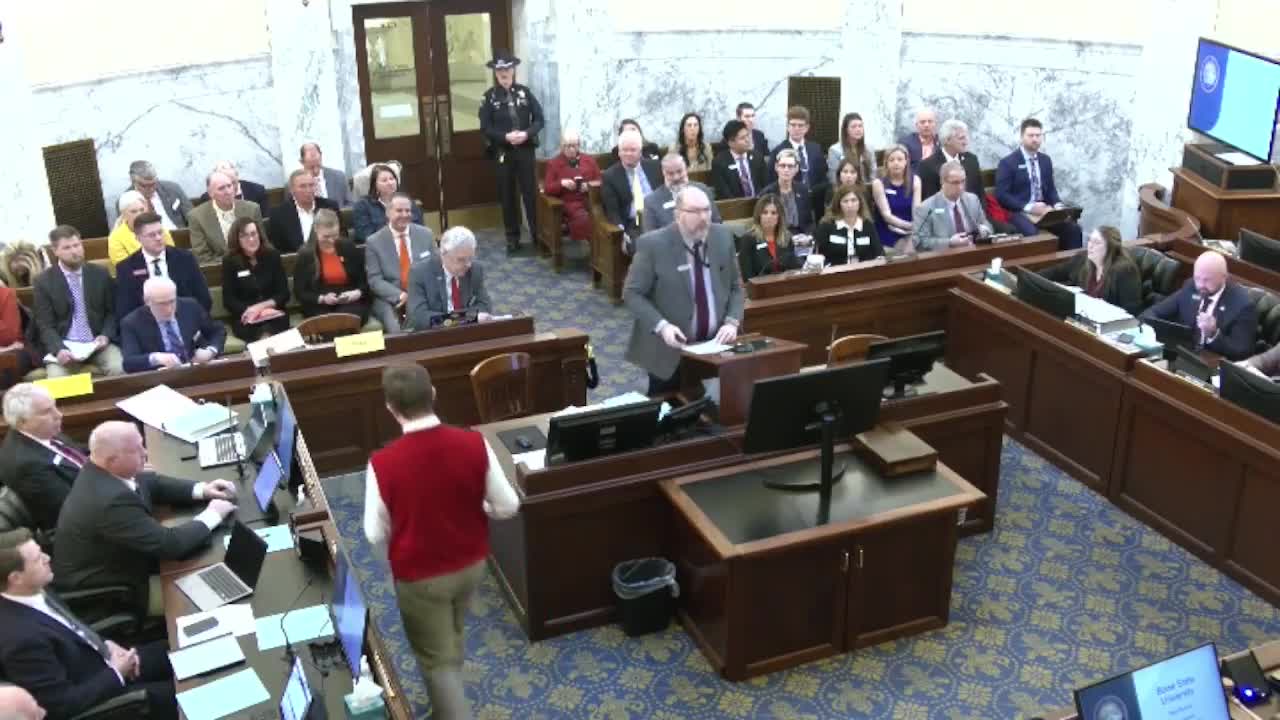
Boise State University President Marlene Tromp told the Joint Finance-Appropriations Committee on Jan. 29 that the university used non‑taxpayer funds to defend a lawsuit and has spent about $1.5 million, and she described changes to DEI-related centers alongside efforts to expand student success and workforce programs.
Tromp said the university "used only non taxpayer funds to support the defense of that lawsuit," and reported approximately $1,500,000 in legal-defense expenses to date. "We do not anticipate that the appeal will add a significant amount to that total at this time," she said. Tromp told senators and representatives that employees who appeared at trial did so as part of the general counsel team or by taking personal time; she offered to follow up with detailed accounting for the committee.
Why it matters: Committee members expressed concern about use of funds in litigation and asked for an itemized accounting; Tromp told the committee she would provide the requested breakdown and confirmed non‑taxpayer funds were used for the legal defense.
Tromp also walked the committee through Boise State’s LAUNCH participation and student-success work. She said 1,300 students are enrolled in LAUNCH and 600 of those rely on LAUNCH as their only financial support. She credited a multi‑year institutional focus on academic completion with a large improvement in graduation rates: "in the last 5 years we've improved our graduation rate 39%," Tromp said, describing university investments in student‑success centers and a responsibility-centered management model.
On campus climate and curricular concerns, Tromp described the Institute for Advancing American Values and programming designed to foster civil dialogue and free inquiry. Tromp said the university has encouraged adoption of the Chicago principles on free expression by faculty and student government, and described programs such as "Idaho Listens" that bring diverse community perspectives to campus.
Tromp addressed committee questions about DEI-related centers and classes. She said Boise State had 8 staff in prior DEI‑related centers that were restructured and that five staff reductions were reported in recent changes; she said some programs were closed previously (the transcript notes a BUILD program closed in October 2024). On required coursework, Tromp said UF‑100 and UF‑200 are required general-education courses but that students choose among many sections and are not required to enroll in a gender‑focused section. "No student is required to take one of those classes," she said. Committee members asked for written assurance that courses comply with state law (the committee specifically cited Idaho Code 33‑138 and 33‑139, the dignity and nondiscrimination statutes); Tromp agreed to provide the committee additional documentation and compliance assurances.
Tromp also described Boise State’s response to workforce opportunities related to semiconductor manufacturing, noting partnerships with community colleges and a unique piece of equipment (an X‑tron) used for silicon wafer research. She said the university would prioritize nursing, cybersecurity, computer science, construction management and electrical/computer engineering if state capacity funds become available.
Discussion versus decision: Tromp presented institutional details and committed to follow up with accounting for the legal defense costs and written confirmation that course offerings comply with the cited Idaho statutes; the committee did not take formal action during the hearing.
What’s next: Tromp said the university will submit the requested financial detail for the lawsuit defense and documentation of course compliance; she outlined program areas that would be priorities for any new state capacity grants.