Get Full Government Meeting Transcripts, Videos, & Alerts Forever!
Get email alerts on the Isu Finance Audit topic
No spam. Unsubscribe anytime.
Idaho State president says forensic lab funds will be returned; audit underway, university pledges tighter accountability
Summary
Idaho State University President Rob Wagner told the Joint Finance-Appropriations Committee that remaining funds appropriated for an Eastern Idaho forensic pathology center will be returned to the state and that an audit is underway after a transfer of funds to a county following a memorandum of understanding.
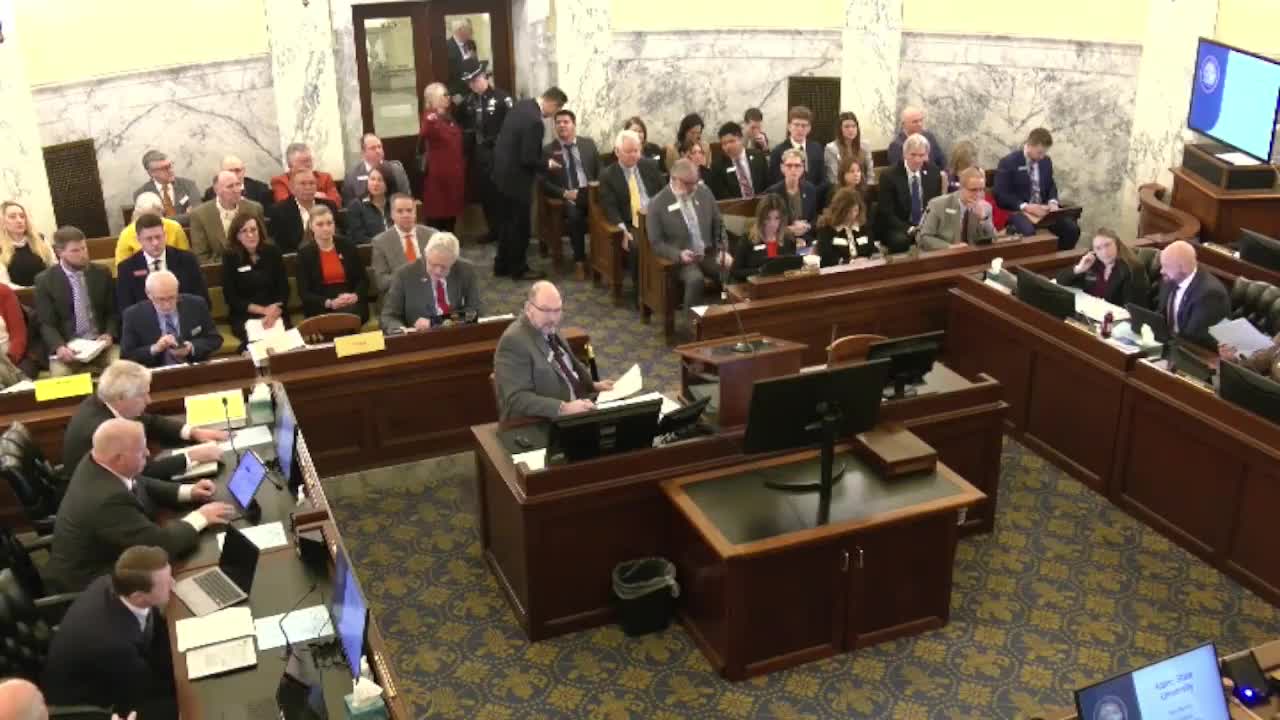
Idaho State University President Rob Wagner told members of the Joint Finance-Appropriations Committee on Jan. 29 that the university will return remaining appropriated funds for an Eastern Idaho forensic pathology center and that an audit is in process after the university transferred the balance of the appropriation to a county following a memorandum of understanding.
The committee’s budget analyst, Kevin Campbell of the Legislative Services Office, opened the ISU presentation with an overview of the school’s budget and noted a technical reporting error in the tuition and fees beginning balances. "Happily, ISU has not overdrawn its bank account," Campbell said. He said the error affects only how the beginning fund balance appears in the slides and that staff are tracking down the discrepancy.
Why it matters: The forensic lab funds had drawn media attention and prompted the committee to request facts and a formal audit. Wagner, who marked his first-year anniversary as ISU president during the committee meeting, acknowledged institutional shortcomings in tracking and documenting the handling of the appropriation and described steps to strengthen oversight.
Wagner said the appropriation originally was intended to house an Eastern Idaho Forensic Pathology Center on ISU’s Pocatello campus and to provide experiential opportunities for health-sciences students. "As I looked deeply ... it became very apparent that there was a lot of communication going on, a lot of different parties," Wagner said. He said ISU expended a small portion of the funds for a consultant and, after the county indicated a campus facility was no longer desirable, an MOU transferred the remaining funds to the county. "I believe Idaho State University should have kept those funds," Wagner said, adding that ISU will accept responsibility and improve controls so the legislature can trust the institution to follow legislative intent.
The committee chair noted a separate staff report was posted online and that an audit has been requested and is "just now in process". Committee members praised Wagner’s stated commitment to return the funds and strengthen accountability. Wagner and Campbell also discussed ISU’s budget picture: ISU reported more than 12,000 students supported by roughly 1,244 full‑time equivalent positions and a base general fund budget cited in the presentation. Campbell described the composition of expenditures—about 74.8% personnel, 21.2% operating, and 3.9% capital outlay—and outlined ISU’s FY2026 requests, which Wagner listed in the presentation materials as approximately $907,300 in operational capacity enhancement, $233,700 in endowment adjustments and $988,100 for an enrollment workload adjustment (requests subject to the normal appropriations process).
Wagner also described recent organizational changes tied to student success and the university’s response to prior diversity, equity and inclusion (DEI) resource centers. He said ISU closed its diversity resource center and its gender resource center effective Nov. 15 as part of a refocus toward academic and completion outcomes. Wagner said two FTE associated with the centers were reassigned: one to student involvement to support student clubs and one to the office of equal opportunity and Title IX, which now reports to the president. He said ISU established a "Bengal Success Center" (university-provided student success services) to serve traditional and nontraditional students across campuses.
On workforce and program priorities, Wagner flagged growth in health‑sciences enrollments and said ISU is pursuing partnerships and expanded clinical and residency pathways so graduates remain in Idaho communities. Wagner described a planned doctor of nurse anesthetist program with 25 initial seats and strong applicant interest.
Discussion versus decision: Committee members requested further details, the staff report is publicly available, and the committee requested an audit; no formal legislative action was taken during the hearing on the forensic lab funds or the university’s budget requests. Wagner repeatedly framed the steps as commitments from his administration rather than final outcomes of this committee.
What’s next: The audit is in progress and ISU’s leadership said the university will provide additional documentation and tracking of legislative funds; the university’s FY2026 request will be considered through the standard JFAC budget process.