Get Full Government Meeting Transcripts, Videos, & Alerts Forever!
Get email alerts on the State Employee Health Insurance topic
No spam. Unsubscribe anytime.
JFAC adopts $14.13K per‑FTE health‑insurance funding level after debate over reserves
Summary
The Joint Finance‑Appropriations Committee approved a compromise funding level of $14,130 per eligible full‑time equivalent for state employee health insurance after lawmakers debated reserve balances and actuarial projections.
The Joint Finance‑Appropriations Committee approved a funding increase for state employee health insurance on Jan. 31, adopting a compromise level of $14,130 per eligible full‑time equivalent (FTE) for fiscal 2026.
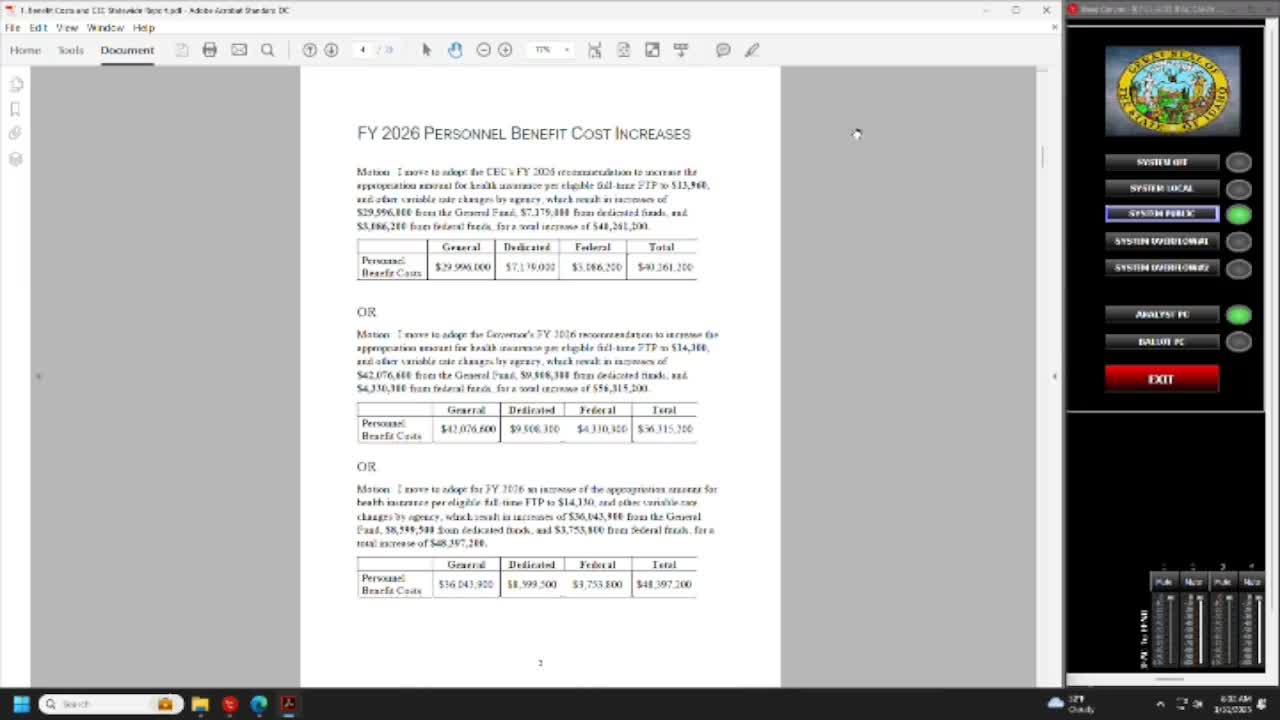
Legislative Services Office analyst Mr. Bybee presented three dollar‑amount options for the committee: the CEC committee recommendation of $13,960 per FTE, the governor's recommendation of $14,300 per FTE and a midpoint compromise of $14,130 per FTE. "The most significant adjustment in these personnel benefit cost increases is, of course, the health insurance," Bybee said as he described the three options to the committee.
Why it matters: the committee's choice affects the budgeted appropriation for agency employer costs as well as the projected balance in the state's insurance reserve. During discussion, lawmakers cited past reserve levels and actuarial projections when arguing for lower or higher funding.
During debate, Representative Handy and others urged adopting the governor's higher figure as a truer reflection of costs; Representative Handy argued that using reserves to buy down premium figures in prior years had masked actual cost trends. Senator Ward Engelking said the governor’s figure "reflects the actual cost of insurance" and warned that using reserves to lower the figure this year could make next year’s change look larger. Representative Furness urged a more conservative funding level, citing Milliman projections and historic reserve amounts.
Mr. Bybee provided reserve projections tied to the options on the table: a projected ending reserve balance of $51,600,000 for the $13,960 option and $61,400,000 for the $14,300 option; Bybee did not provide a calculated ending balance for the $14,130 midpoint during his remarks. Representative Furness had earlier stated the CEC option would yield a projected reserve of about $50,000,000 and the governor's about $60,000,000; Bybee confirmed the specific numbers above when asked.
After rolling the vote through the joint procedure the committee adopted the $14,130 per‑FTE funding level. The committee recorded that the majority of the joint committee voted in the affirmative; the motion was announced as passing with a combined total of 17 ayes, 0 nays and 3 absent or excused members. The committee chair directed that the motion carry a "do pass" recommendation.
The committee also discussed how the joint voting procedure would be applied at the meeting — including whether majority counts should be of members present — and located a 2023 leadership letter that the chair read aloud describing the joint voting process. The committee later stated publicly that for this meeting it would apply the letter's precedent requiring six votes from each body where applicable.
The committee moved on after approving the health insurance funding level to consider the separate change‑in‑employee‑compensation (CEC) motions.