Get Full Government Meeting Transcripts, Videos, & Alerts Forever!
Get email alerts on the Elections Administration topic
No spam. Unsubscribe anytime.
Oregon elections officials describe controls, audits after DMV data errors; automatic voter registration file transfer resumes
Summary
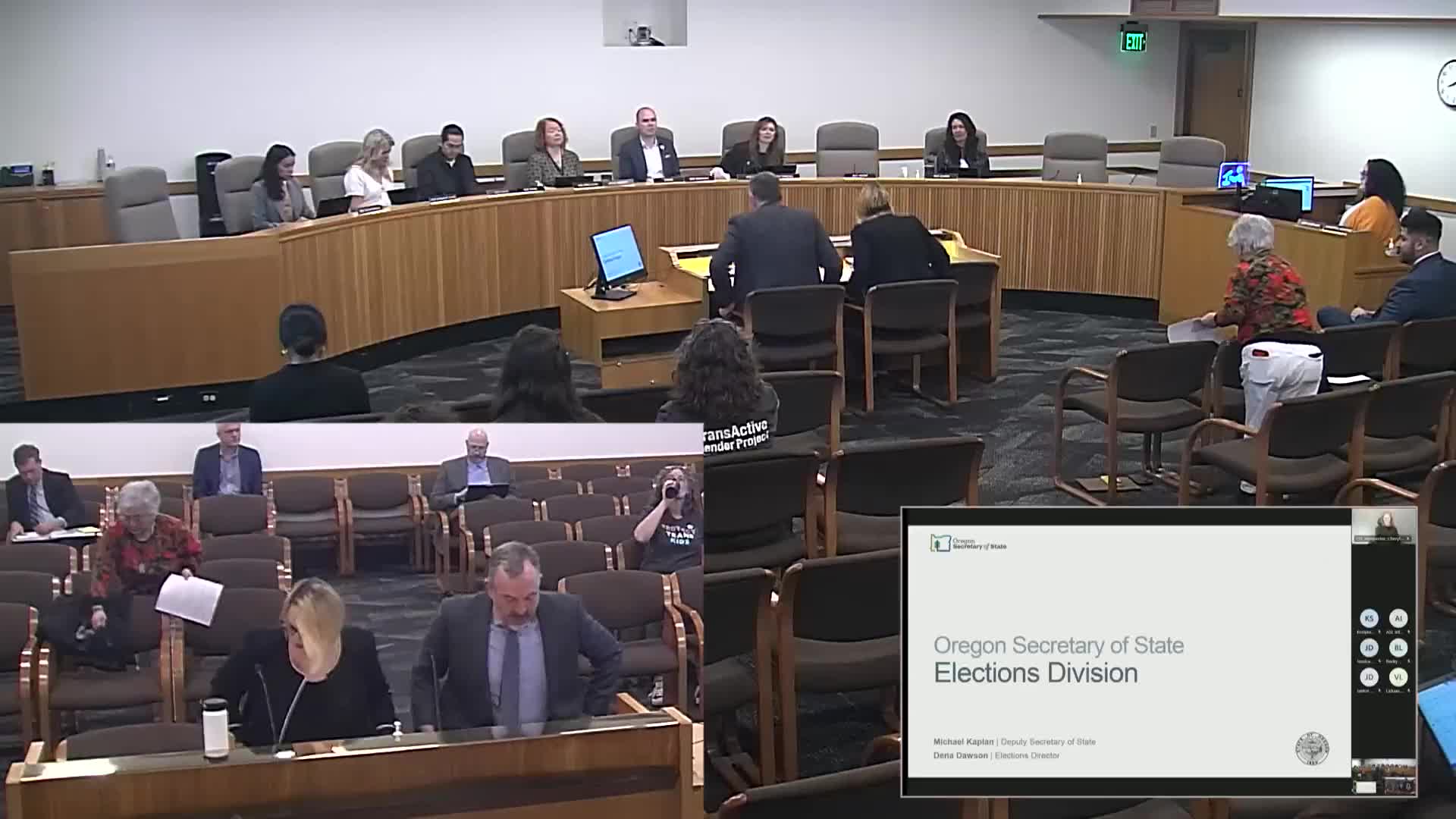
Deputy Secretary of State Michael Kaplan and Elections Director Dina Dawson told the House Committee on Rules on March 3 that the Secretary of State’s Office, DMV and ODOT have implemented new controls and audits after errors in Oregon Motor Voter data; the OMV file transfer was resumed Feb. 26 while DAS and other reviews continue.
Deputy Secretary of State Michael Kaplan and Elections Director Dina Dawson told the Oregon House Committee on Rules on March 3 that the Secretary of State’s Office, the Department of Transportation’s Division of Motor Vehicles and ODOT have put new controls and reviews in place after identifying data errors in the Oregon Motor Voter (OMV) transmission and related registration records.
The office of Secretary of State told the committee the OMV file transfer — paused after the governor’s directive last year — resumed on Feb. 26, and that the agencies are using monthly sampling, manager review and other controls while an external audit and additional reviews continue.
The resumption matters because counties need accurate registration and address data to assemble ballots and run the May election. Officials told the committee they are balancing the urgency of delivering files to counties with longer-term remediation and auditing work.
Kaplan said the Secretary of State is treating integrity, accountability and competence as the guiding principles for the elections division and that the office is “not partisan” in operational work. “We just need a little bit of time to try and get it right,” he told lawmakers, adding the office is working “as fast as we can.”
Dina Dawson, who took the job as elections director about a month before the hearing, outlined the division’s programs and priorities and flagged several large projects: replacing the statewide voter registration and election management system (OCVR), implementing House Bill 4024’s campaign finance tracking requirements and analyzing and modernizing automatic voter registration with ODOT and DMV. Dawson said the elections division has 35 full‑time staff and is directly managing multiple major IT projects, a campaign finance investigations backlog and strained working relationships with some counties.
DMV Administrator Amy Joyce told the committee that DMV staff reviewed about 1,400,000 OMV‑related records after discovering data problems in 2024 and implemented a series of mitigations: revised data‑entry screens that separate documents that prove U.S. citizenship from those that do not; daily managerial checks comparing entries against scanned documents; expanded staff training; and monthly sampling of new OMV files. Joyce said four monthly samples after those changes yielded zero errors.
Travis Brower, assistant director for revenue, finance and compliance at ODOT, said the department hired its first voter‑registration integrity analyst to oversee improvements and convened an expert review team to advise on implementation. ODOT is the originator of the OMV files sent to the Secretary of State; Brower described three reviews ODOT is coordinating: a data‑quality maturity assessment, a Deloitte data‑integrity review (finalized in late February) and an audit by the Department of Administrative Services (DAS) due April 30.
Deloitte’s final report, Brower said, identified 14 opportunities to strengthen data integrity beyond the steps DMV already took, including assessing staffing skill sets, improving data extraction and analytics, reducing manual data entry by implementing automated document detection, and enhancing verification practices.
Officials described the immediate technical controls now in use: - a reconfigured DMV intake screen that clearly distinguishes documents that establish U.S. citizenship from those that do not (and now includes a check for U.S. nationals from American Samoa); - a daily control file exchange between DMV and the Secretary of State to confirm the number of records transmitted and received; - random sampling of files and annual joint review panels that include Secretary of State staff and county clerks to inspect DMV processes; and - monthly sampling of at least 500 new OMV records, reviewed by subject‑matter experts.
Dawson and Kaplan also outlined broader challenges. Dawson said the replacement of OCVR, the centralized voter registration system begun in 2021 and previously expected to go live by mid‑2025, remains a top priority because the project has experienced “failed training attempts, inadequate user testing and minimal collaboration with counties.” She said the elections division is developing a framework and policy work while evaluating technology options.
The Secretary of State’s office and DMV also described the backlog of records accumulated while OMV transmission was paused. Kaplan said the agencies had accumulated “close to 270,000 records” from DMV transactions during the pause; Joyce said DMV staff reviewed roughly 1.4 million records during their internal review last year. Officials said the backlog will be transmitted and “dispositioned” to counties in time for the May election, while noting work to verify and clean the data is ongoing.
Committee members pressed several points. Lawmakers asked how frequently records are updated when a voter changes an address, how duplicate ballots are handled when voters receive replacement ballots, and whether DMV re‑registers voters already in the statewide roll. Dawson and Joyce explained that changes in a voter’s registration (including name, address or party affiliation) result in the original ballot being voided and a replacement ballot being issued, and that DMV is required by the National Voter Registration Act to use certain transactions as registration events. Dawson said counties immediately update records when they receive changes and that voided ballots are flagged by unique ballot identifiers.
Several lawmakers expressed concern about the decision to resume OMV transmission before the DAS audit is complete. Vice Chair Draisen said the pause impacts county preparations for the May election and emphasized the urgency of transmitting cleaned records; Dawson and Brower replied that while transmission was restarted to meet election timelines, the agencies consider data integrity work ongoing and are continuing external review and sampling.
On campaign finance modernization, Kaplan and Dawson told the committee that House Bill 4024 (adopted in 2024) requires a new, web‑based system to track contributions and spending across Oregon. Dawson described implementation risks tied to major IT changes, training and the statutory timeline for rollout and said the division is evaluating whether to build in‑house capability or contract development to ensure timely delivery.
What happens next: ODOT’s DAS audit is due April 30, Deloitte’s recommendations are expected to inform medium‑ and long‑term fixes, and the Secretary of State said it will continue monthly sampling, manager checks and annual reviews with counties. Dawson and Kaplan asked lawmakers for time and resources to complete systems replacement and campaign finance implementation work.
Quotes from the hearing “Integrity, accountability and competence are our North Stars,” Deputy Secretary Michael Kaplan said. “We just need a little bit of time to try and get it right.”
“As the chief election official, the Secretary of State provides guidance to local election officials,” Elections Director Dina Dawson said. “Our primary and overarching goal is to build Oregonians’ trust in the electoral process.”
“We reviewed about 1,400,000 records and provided information to SOS elections on the errors,” DMV Administrator Amy Joyce told the committee, describing DMV’s internal review last year.
Deloitte’s final report “identified 14 opportunities to further improve data integrity,” ODOT assistant director Travis Brower said, and officials said many of those opportunities involve reducing manual work and building analytic capacity.
Why it matters: County election officials must have accurate registration and address data well in advance of the May election to create and mail ballots. Lawmakers who pressed agencies at the hearing repeatedly cited a public “trust deficit” and said transparency, auditors’ findings and written reports will be necessary to rebuild confidence.
The committee did not take a vote; the session was informational and concluded with an agreement to send follow‑up questions to staff.