Get Full Government Meeting Transcripts, Videos, & Alerts Forever!
Get email alerts on the Vocational Rehabilitation topic
No spam. Unsubscribe anytime.
Legislators hear update on vocational rehabilitation audit, $10 million federal reallocation and contractor costs
Summary
Lawmakers reviewed an audit and federal actions after the Division of Vocational Rehabilitation reported commitments exceeding appropriations and receiving a $10 million federal reallocation with state-match requirements.
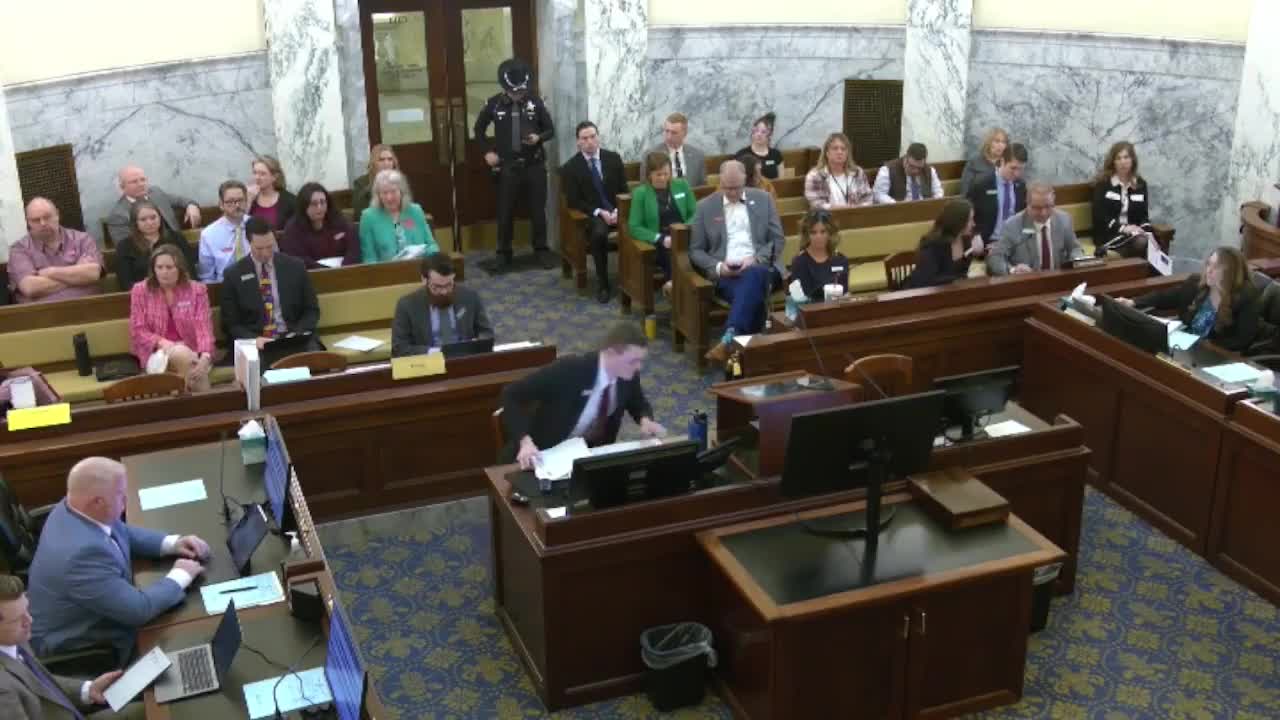
Lawmakers on the Joint Finance-Appropriations Committee spent substantial time Monday on the Idaho Division of Vocational Rehabilitation (IDVR), where auditors and agency leaders described reporting failures, a federal designation of the agency as a high‑risk grantee, a $10 million federal reallocation recognized by the governor, and a contested remediation path that includes a costly consultant contract and an ongoing forensic audit.
Brooke Dupree, a Legislative Services budget analyst, told the committee the governor recognized a $10,000,000 noncognizable adjustment after the federal Rehabilitation Services Administration (RSA) reallotted unused grant funds and offered them to states that could absorb them. Dupree said the reallocated funds require state matching dollars and the division requested a $2,700,000 one‑time general‑fund supplemental to provide the state match; the governor’s recommendation includes that request plus an additional $1,700,000 one‑time general fund to cover services RSA may deem ineligible.
April Renfro of the Legislative Services audits division summarized the office’s accountability report and told the committee “the division did not establish procedures and control activities to ensure compliance with appropriation laws applicable to fiscal year 2024.” The audit found internal-control weaknesses, an insufficient financial-management system, inaccurate and unsupported federal financial reporting and failures to account properly for obligations and expenditures. Those deficiencies led RSA to designate IDVR a high‑risk grantee and to require a corrective-action plan; auditors said the plan IDVR submitted lacked necessary specificity.
Judy Taylor, interim director of IDVR, described the practical consequence of the fiscal position: “We realized running our numbers that we were going to run out of, appropriation in early September. By October, we would have been defaulting on our bills and by December we wouldn't have been able to meet payroll.” She and auditors told the committee the agency faced a near-term risk of being unable to operate and that RSA warned of potential stronger remedies if corrective steps were insufficient, including financial remedies or other actions authorized by federal regulation.
Auditors and agency leaders described steps already taken to address the problems: IDVR engaged a contractor to implement a corrective-action plan, initially signing a professional-services contract for $499,999 in August 2024 and then amending it in November to add about $1,900,000, bringing the total contracted amount to roughly $2.4–$2.5 million and extending the contract through December 2025. Auditors noted the amendment and original contract were both granted one‑time exemptions from competitive procurement by the state purchasing division and expressed concern that the cost is a significant burden on an agency already out of fiscal alignment.
Renfro said about $900,000 had been paid to the contractor to date and warned that those payments were charged to the federal grant and will require state match. She described the forensic and fiscal monitoring work RSA required and the potential consequences if corrective actions prove insufficient: additional reporting requirements, prior approvals, withholding authority and, ultimately, a determination of dollar amounts that RSA might require returned to federal coffers based on the extent of identified noncompliance.
Committee members pressed for more detail. Dupree and auditors explained that the federal grant operates on a federal fiscal year and carries a 120‑day closeout period; services documented in individual plans for employment (IPEs) can span multiple grants, complicating accurate period-of-performance accounting. Members also asked about Pre‑Employment Transition Services (Pre‑ETS) and draw requests; Taylor said the division encountered a high rejection/breakage rate on one draw for Pre‑ETS charges submitted for reimbursement, and that IDVR estimated $1.7 million in charges that RSA had or would deem unallowable for the fiscal year.
Several quantifiable items were provided to the committee by IDVR and auditors: about 1,950 qualified applicants were on IDVR’s waitlist at the time of the hearing and the division reported 2,735 active clients being served; the federal grant requires a state match of 21.3% of funds expended; the agency’s original trustee-and-benefits appropriation for FY 2025 was increased by the governor’s noncognizable recognition to include the $10,000,000 federal reallocation; and IDVR requested a $2,700,000 one‑time match to access the $10,000,000 and the governor also recommended $1,700,000 to cover unallowable charges already incurred. Auditors said the division will need to restate some federal reporting and that the forensic audit will examine activity dating back to 2019 for maintenance‑of‑effort concerns.
April Renfro said RSA’s designation and the audit’s findings leave several unknowns, including how RSA will calculate any returned funds or specific remedies beyond the required corrective action. She told the committee that the federal agency could assess an amount “proportionate to the extent of harm the violation caused to an identifiable federal interest” but could also reduce or waive amounts based on mitigating circumstances.
Lawmakers signaled concern about both immediate fiscal exposure and long-term service impacts. Representative Petzke asked whether the consultant contract had produced a return on investment; Director Taylor said the contractor provides specialized expertise, including system reprogramming and financial-restatement capability that the division lacked, and that RSA encouraged the approach as a model to regain confidence. Taylor said the contractor team currently includes multiple full‑time staff and that work is intended to be phased out as division staff are trained.
Renfro and committee staff said the Legislature’s auditors would continue single‑audit work and that additional oversight hearings might be needed. No formal appropriations vote was taken during the hearing; the committee has decision points pending that include whether to approve the $2.7 million supplemental match and how to address the $1.7 million in potentially disallowed charges.