Get Full Government Meeting Transcripts, Videos, & Alerts Forever!
Get email alerts on the Prison Security topic
No spam. Unsubscribe anytime.
Corrections outlines security package after transport ambush: drones, mail scanning and a dedicated transport bureau
Summary
The Idaho Department of Correction told lawmakers on Feb. 4 it is requesting surveillance technology and dedicated transport resources after a spring ambush of staff during an inmate medical transport left three employees wounded.
The Idaho Department of Correction told lawmakers on Feb. 4 that a targeted attack on staff during an inmate medical transport last spring revealed security vulnerabilities the agency wants to fix with technology and personnel changes.
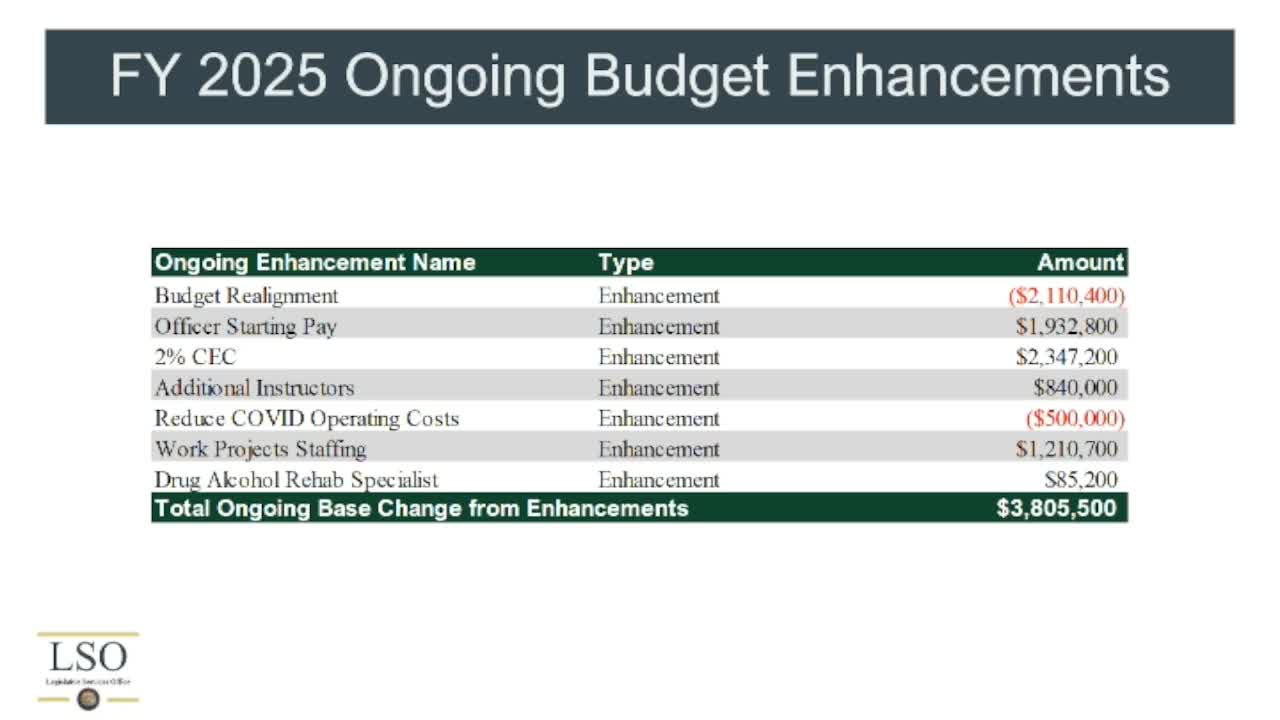
The incident and the response: Agency officials described a spring 2024 incident in which a gunman ambushed a transport returning from a hospital, wounding three IDOC staffers. Noah Peterson, the committee’s budget analyst, said the agency’s supplemental and enhancement requests are designed to “address vulnerabilities that were discovered within the agency so as to not allow them to happen again.”
Technology package requested: The agency requested $795,000 in supplemental funds for initial implementation and $2,397,000 ongoing to run three technologies statewide: digital mail scanning (to open/scan and digitize incoming mail for inmates), drone detection (a layered system to detect small unmanned aircraft), and LEO intelligence software for phone‑call transcription and analysis. Peterson said Idaho residents in custody made 4,000,000 phone calls totaling about 49,000,000 minutes in 2023, which the agency says creates intelligence opportunity.
On the phone‑analysis tool, Director Tewalt said transcribing calls and surfacing patterns “is one of the most exciting and revolutionary tools that I've seen in my time in corrections,” and argued it can be used with state and federal law enforcement to disrupt organized criminal activity.
Transport bureau expansion: The agency asked for a $1,148,000 one‑time supplemental to expand the statewide Transport Bureau (12 positions, ~ $455,000 personnel for the remainder of FY 2025 and $693,000 for vehicles and equipment such as six SUVs and a wheelchair van), and $965,500 ongoing ($909,000 personnel) to sustain the expanded bureau. Director Tewalt said the change is not simply a transfer of duties but a response to an increase in emergency transports and thousands of overtime hours. He told the committee ISCC generated about 20,000 overtime hours and IMSI about 14,000.
Body‑worn camera pilot: The department sought a $1,051,000 supplemental — primarily federal funds — to pilot body‑worn cameras in three IDOC locations, with a state match that will create ongoing license costs an agency estimate puts at $505,000 when the state match is required in fiscal years 2026–27.
Why lawmakers pushed back: Senator Cook asked why the Transport Bureau expansion required 12 new FTP instead of reassigning existing posts; Director Tewalt said emergency transports historically have been handled ad hoc by facility staff, and that properly training and equipping staff for high‑risk transports either requires a large increase in facility relief factors or a specialized transport team to avoid shutting down posts and generating still more overtime.
Governor’s recommendation: The governor recommended the surveillance technologies, transport expansion and body‑worn camera items as presented; committee members asked for clarifying documentation on overtime and on long‑term staffing implications.
Taper: Committee members asked the agency to provide detailed overtime and relief‑factor calculations; the director said the changes are intended to plug security gaps and better protect staff and people in custody.