Get Full Government Meeting Transcripts, Videos, & Alerts Forever!
Get email alerts on the Case Management Software topic
No spam. Unsubscribe anytime.
Idaho corrections seeks ongoing funding for Recidiviz data tools after pilot work
Summary
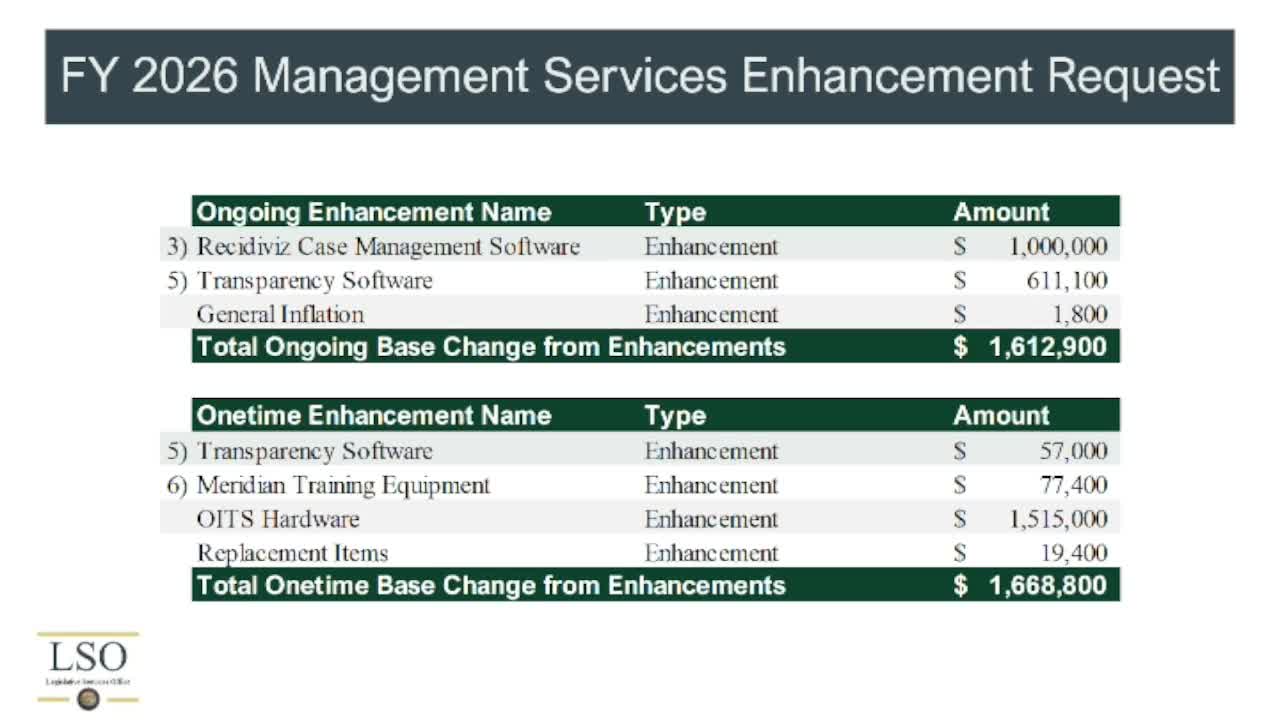
The Department of Correction asked legislators for ongoing appropriation to expand work with Recidiviz — a nonprofit data partner — saying the tool automates case management and helps staff prioritize supervision; lawmakers asked for ROI data and details about data control and philanthropic matching.
The Idaho Department of Correction asked the Joint Finance Preparations Committee on Feb. 4 to consider ongoing funding to expand its use of Recidiviz, a nonprofit technology partner the agency says has helped it automate case triage and bring disparate data together for corrections staff.
“No ma signal when you’re ready for me to stop talking,” Director Josh Tewalt told the committee as he described the partnership. “With Recidiviz in particular, it's probably the most transformative partnership we've entered into as an agency in my entire tenure there.”
Why it matters: Department officials said Recidiviz helps probation, parole and prison case managers identify where staff should focus their time, compare officer-level outcomes and automate repetitive back‑office work. The agency told lawmakers the nonprofit matches public spending with philanthropic funds, increasing the leverage of each state dollar.
What the agency said: Budget analyst Noah Peterson said Recidiviz work was funded previously with one-time federal funds and other appropriations in 2021 and 2023 “that amounted to about $1,500,000 and those were mostly appropriated from federal funds.” Director Tewalt described Recidiviz as a partner that “finds data across different, outdated systems and brings them together” and said the firm’s work is designed to limit new data entry demands on line staff while surfacing management dashboards.
Lawmakers’ questions and agency responses: Several legislators asked for objective measures of return on investment and assurances about who controls the underlying data. Senator Cook said, “Do we have any data or numbers that shows our ROI on that investment?” Mr. Peterson replied he did not have hard data at the hearing but offered to obtain it. Representative Tanner asked for sample dashboards used by the agency; Tewalt said he would provide regularly used dashboards and cautioned about interpreting officer‑level outliers without context.
On data control, Tewalt told the committee the state retains control and uses data‑sharing agreements: “We control the data. We have data sharing agreements and a lot of protections in place so they pull the data from our systems where it lives… it's not otherwise being manipulated by a third party.”
On philanthropy and matching funds, a committee member read budget paper language saying a $1 million state commitment is matched by $2 million in philanthropic funds; Tewalt noted Recidiviz’s funding comes from a range of foundations and described the nonprofit as “agnostic” about policies, focusing instead on helping participating correctional systems build tools they request.
Open questions and next steps: Committee members asked for (1) quantifiable performance data or ROI from the pilot work, (2) examples of dashboards and officer-level visualizations, and (3) documentation of data‑sharing and privacy protections. The agency committed to provide additional materials to the committee after the hearing.
Taper: Committee discussion moved on after the agency agreed to deliver follow‑up materials and clarifications on outcomes and data controls.