Get Full Government Meeting Transcripts, Videos, & Alerts Forever!
Get email alerts on the Public Safety topic
No spam. Unsubscribe anytime.
Officials outline need for new Clark County jail, present half‑percent sales tax levy plan
Summary
County officials told the Springfield City Commission that Clark County’s jail is overcrowded and in need of major repairs and replacement; a feasibility study recommends a new 450‑bed facility and county leaders said a half‑percent sales tax levy would be placed on the November ballot to pay remaining costs after state and reserve funds.
At a Springfield City Commission work session, county officials presented an overview of public‑safety facility needs and a proposal to fund a new county jail, saying the current building is overcrowded, in disrepair and cannot be remodeled to add capacity.
The presentation, delivered by Ginny Hutchinson, Clark County administrator, and Sheriff Clark during the commission’s informal meeting, summarized a feasibility study and a proposed funding plan that county leaders said includes $2 million in county reserves, an anticipated $15 million from a state capital fund and a half‑percent sales tax levy on the November ballot to finance the remainder of a roughly $85–$100 million construction estimate.
Hutchinson said the downtown jail was built in the late 1970s (opened 1980) and was designed to hold about 160 inmates; county officials reported the facility now averages more than 200 people housed there. Hutchinson said the building’s multilevel design and aging systems create recurring maintenance problems, including flooding tied to clogged toilets that in one instance forced the sheriff’s office out of its space for roughly three months. She said “over $3 to $5,000,000 worth of improvements” would be needed immediately if the county chose to keep the existing building in service.
A feasibility study by engineering firm DLZ, first completed around 2017–18 and updated twice since, recommended building a new facility sized for about 450 beds to meet needs for the next 30 years, Hutchinson said. The study recommended a single‑story, pod‑style layout that would improve officer sight lines and allow separate housing and programming for people with behavioral health needs, people who are arrested for low‑level offenses and people charged with serious crimes.
Sheriff Clark described the operational consequences of overcrowding. He said the county jail’s state‑listed capacity is 167 beds but that the facility routinely holds about 200–204 people. “We are putting 204 individuals inside a facility that’s designed to hold a maximum of 167,” Clark said, adding that pods built for 12 people are sometimes holding 18–20, creating sanitary, safety and classification problems.
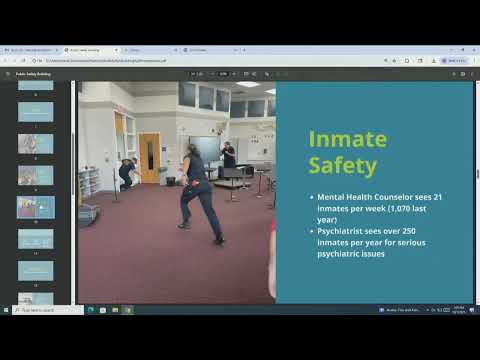
Clark also told commissioners that the jail increasingly functions as a de‑facto mental‑health and substance‑use crisis center because the county lacks space and programming to treat those needs in custody. He said that causes extra hospital transports, raises costs for the county and complicates officer and inmate safety. “When we don’t address the lower end stuff, we as a society approve it,” Clark said, describing how unaddressed misdemeanor offending can escalate to more serious crimes.
Hutchinson and Clark described a specific site the county has under contract: roughly 30 acres south of Interstate 70 on State Route 72 that has been annexed into the city. Hutchinson said the study estimated a new facility would require at least 10 acres and that the county prefers a site inside city limits because, she said, state law requires the sheriff’s office to locate within the city.
On funding, Hutchinson said the county holds about $2 million in reserves that could be used, and the county hopes to secure $15 million from a state capital fund; the remainder would be raised by a proposed half‑percent county sales tax levy to appear on the November ballot and levied for roughly 20 years. Hutchinson said the levy is projected to generate money used to pay annual principal and interest on bonds and that commissioners could end the levy early if bond obligations are satisfied. She provided a construction cost range of “about $85 to $100 million” if the county sought bids in 2026 and said the county has toured recently built facilities in Warren, Greene and Coshocton counties as models.
Commissioners and other speakers at the work session described firsthand observations and concerns that supported the county’s case: one commissioner recounted ride‑along experiences and an instance when police had to release an arrestee for lack of space; another said they were “floored” by the condition of building systems and obsolete replacement parts. A public commenter who had provided suicide‑prevention training at the jail described inmates arriving without access to medications and staff shortages that limited care.
The presentation did not include a formal commission vote; officials described the levy as scheduled for the November ballot and sought commission members’ questions. Hutchinson directed commissioners to the county website’s “Hot Topics” page for more information and said the county planned additional, smaller public presentations in places including New Carlisle.
The work session combined programmatic, operational and financial detail: the feasibility study’s recommendation for a 450‑bed, pod‑style facility; an estimated construction cost range; site information; short‑term repair needs to the existing facility; and a funding plan centered on state assistance, county reserves and a proposed half‑percent sales tax.
County officials said the next public steps include continuing community outreach and finalizing financing details ahead of the ballot. They did not take a final binding vote during the commission meeting.