Get Full Government Meeting Transcripts, Videos, & Alerts Forever!
Get email alerts on the Child Welfare topic
No spam. Unsubscribe anytime.
Idaho health agency asks for $14 million supplemental to expand prevention, recruit foster families
Summary
Director Adams told a Senate committee the Department of Health and Welfare is prioritizing child welfare to reduce costly congregate placements, asking for a $14 million supplemental and proposing targeted pay increases and retention supports for foster families while emphasizing prevention services.
Director Adams, director of the Idaho Department of Health and Welfare, told the Senate Health and Welfare Committee on an unspecified date that the agency will make child welfare its strategic priority and is requesting a $14,000,000 supplemental this year to address rising costs driven by congregate-care placements and higher-acuity children.
Adams said the department receives roughly 24,000 hotline calls about possible abuse or neglect in a year, responds to about 15,800 assessments, and that 89 percent of assessed children are judged safe while 11 percent (about 1,700 cases annually) are deemed unsafe. He described two program categories for children who come to the department's attention: prevention cases, in which children remain at home while services are provided, and placement cases, in which children are removed from the home and placed in foster care, kinship care or congregate settings.
The department plans to emphasize prevention and foster-family recruitment to slow budget growth. "Your lowest cost setting, a prevention case, has your best outcomes," Adams said. He showed agency data comparing costs: prevention cases cost about $1.80 per day (about $657 per year), foster-family placements about $16 per day (about $5,800 per year), and congregate-care placements averaged $385 per day in 2024 and can reach about $1,400 per day in some contracts. Adams added congregate care can cost over $140,000 per child per year in extreme cases.
Adams explained recent trends the department links to the rising budget: a higher share of children placed in congregate care since 2020 and increased behavioral and substance-use acuity among children entering care. He said the department's supplemental requests have grown in recent years — from roughly $1.5 million in 2022 to $14 million this year — and described the current request as tied to the entitlement nature of custody: "Any child that is connected, committed to the custody of the department, I have a legal obligation to care for them," Adams said.
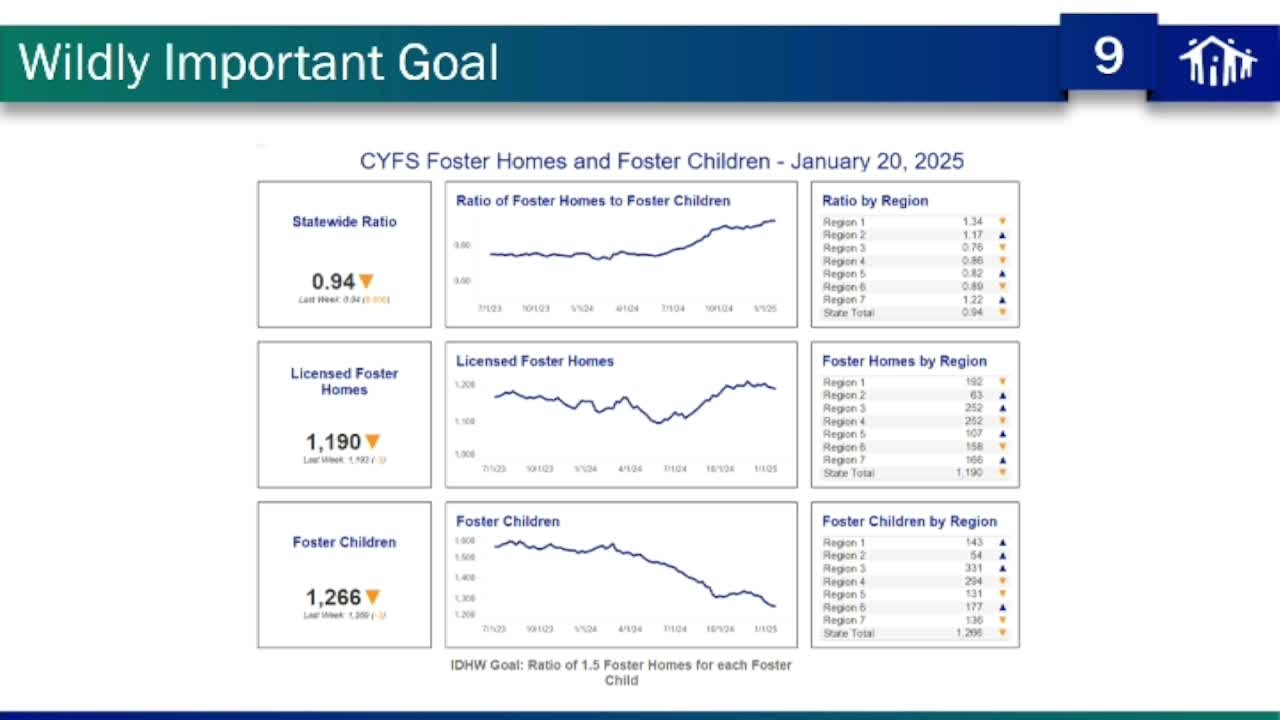
To change the cost trajectory, the department set a "wildly important goal" to double the rate of foster families within 24 months, which Adams defined as either recruiting more foster families or reducing the number of children entering care. He reported the agency's foster-family ratio improved from 0.74 when he started to 0.94 (meaning 94 families for every 100 foster children) and said congregate-care census has fallen from about 268 to about 90, with out-of-state placements down to about 49.
Deputy Director Monte Pro told the committee the department aims to bring worker caseloads toward the national standard of 12–15 cases per worker, while acknowledging regional variation and case complexity. "On average might be a little misleading," Pro said, noting some regions have caseload ranges that can be as low as about 8 and as high as about 19.
Adams summarized several policy and operational changes the department has implemented or proposed: making temporary licensure rule changes permanent to streamline foster licensing; encouraging paid family leave for fostering through the governor's extension of state employee leave; partnering with community organizations (parks passes, fishing licenses) to raise awareness; waiving adoption fees and home-study costs; investing in kinship-identification software; and proposing targeted pay increases for foster families (larger increases for hard-to-place older children and sibling groups, smaller increases for infants). He also proposed a 24-hour warm line with clinical support for foster families and additional staff to speed licensure and reduce social-worker caseloads.
Members asked about specific items the department reported. Adams said the last use of short-term Airbnbs to house children was closed in November and the department had zero Airbnbs or children in them at the time of his remarks. He attributed prior use of nontraditional settings to a national shortage of congregate beds following COVID-related closures.
Committee members questioned how prevention services operate in neglect cases. Deputy Director Pro explained prevention aims to reduce risk factors and increase protective factors through services such as concrete supports (food, rent assistance), behavioral-health treatment for parents or children, and community-based referrals. Adams said the department is exploring community-based models used in other states (for example, Care Portal) to connect family needs to faith-based and community resources.
Adams told the committee the department intends to limit reliance on discretionary federal grants and has instituted central clearance and exit plans for federal funding, saying mandatory streams such as Title IV-E are exempt from recent federal executive-order actions. He listed LIHEAP and some IRA-related weatherization funds as the more at-risk discretionary items the department has reviewed.
The presentation included a clear distinction between discussion, direction and potential decisions: the committee heard the department preview the upcoming JFAC (Joint Finance-Appropriations Committee) budget hearing and the department's budget ask; lawmakers asked questions and offered comments but no formal committee action or votes on funding were recorded in the transcript.
The department gave senators district-level metrics and invited partnership ideas for districts with lower foster-family ratios. Adams said the department expects to show results within about a year and to see a flattening of budget growth in roughly two years if recruitment, retention and prevention work as planned.
Ending: Adams thanked the committee for past oversight and said the department looks forward to discussing the full budget with JFAC in the coming weeks. Committee scheduling and adjournment concluded the hearing.