Get Full Government Meeting Transcripts, Videos, & Alerts Forever!
Get email alerts on the Substance Abuse Funding topic
No spam. Unsubscribe anytime.
Agency seeks fund swaps, reports opioid and Millennium grants; federal cap forces accounting shifts
Summary
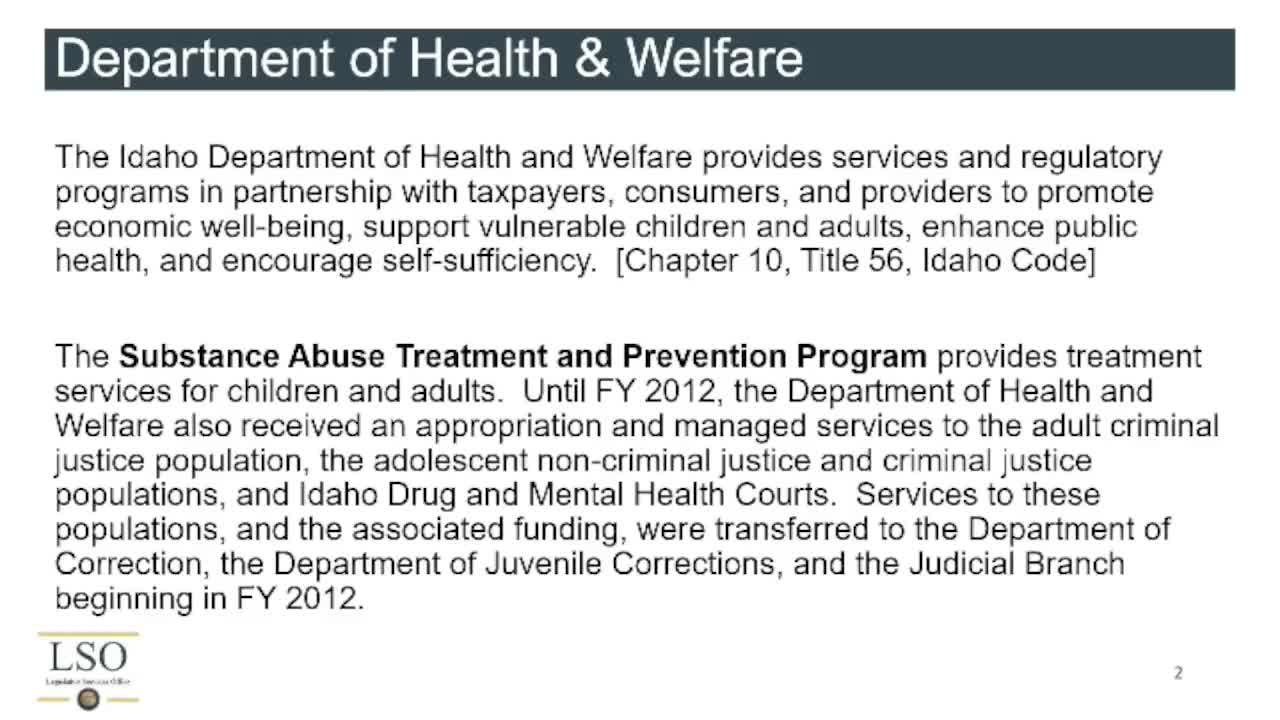
Legislative staff and agency officials described multiple federal and state grant streams for substance-abuse treatment in Idaho, including ongoing opioid-response funding and Millennium Fund allocations for community recovery centers; the department requested account transfers to comply with a federal 5% cap on administrative spending.
Alex Williamson, Legislative Services analyst, told the committee that substance abuse treatment and prevention programs received a one-time $8.3 million appropriation in fiscal 2022 for COVID‑related activities and an $8.0 million state opioid response grant that was made ongoing in fiscal 2024.
For fiscal year 2025 the division received ongoing additions including $1.6 million: $1.35 million was identified for community-based recovery centers and $250,000 for the Idaho Drug Free Youth program, Williamson said. The division also had a $1.2 million one-time appropriation from opioid settlement recommendations in FY2025.
Williamson explained the department is requesting internal fund shifts so the state can comply with federal rules for the Substance Use Block Grant. She said the federal grantor has placed Idaho on a corrective action plan for exceeding the 5% cap on administrative (personnel) spending and the department is proposing to move $533,900 from liquor-control/dedicated funds into operating (personnel) and move $673,900 from personnel to trustee-and-benefit payments on the federal fund side to regain compliance while maintaining staffing.
Senator Cook pressed whether the proposed shifts are only accounting changes to avoid a federal “hand slap.” Williamson said the department will also reduce FTP (from 16 to 12) and personnel costs in some places. Director Adams said the department tried to avoid asking for more general fund or personnel and instead rebalanced dedicated and federal funds while proposing net reductions in FTP where feasible.
Committee members asked for program updates on the Boise State collegiate recovery program and the Idaho Drug Free Youth program. Adams said Boise State established a collegiate recovery program that has hosted seven social events and served students, and that the department’s role is as a pass-through check-writer for some of these grants; he said the department has no operational oversight of the grantees. Adams and agency staff offered to supply written follow-ups on program outcomes and metrics.
No formal committee vote was recorded on the requested fund shifts and accounting changes; agency staff presented the shifts as corrective and asked the committee to approve transfers consistent with federal compliance.