Get Full Government Meeting Transcripts, Videos, & Alerts Forever!
Get email alerts on the Energy And Minerals topic
No spam. Unsubscribe anytime.
Office of Energy requests $24.5M federal for home energy rebates and supports governor's Speed Council; director frames need amid rising energy demand
Summary
The Governor's Office of Energy and Mineral Resources told JFAC it seeks a $24.5 million ongoing federal appropriation to operate a Home Energy Rebates program (roughly $20M for rebates, $4M for administration and about $502,000 for four limited‑service staff) and the governor recommended $311,000 ongoing general fund for a Speed Council to streamline permitting for large projects.
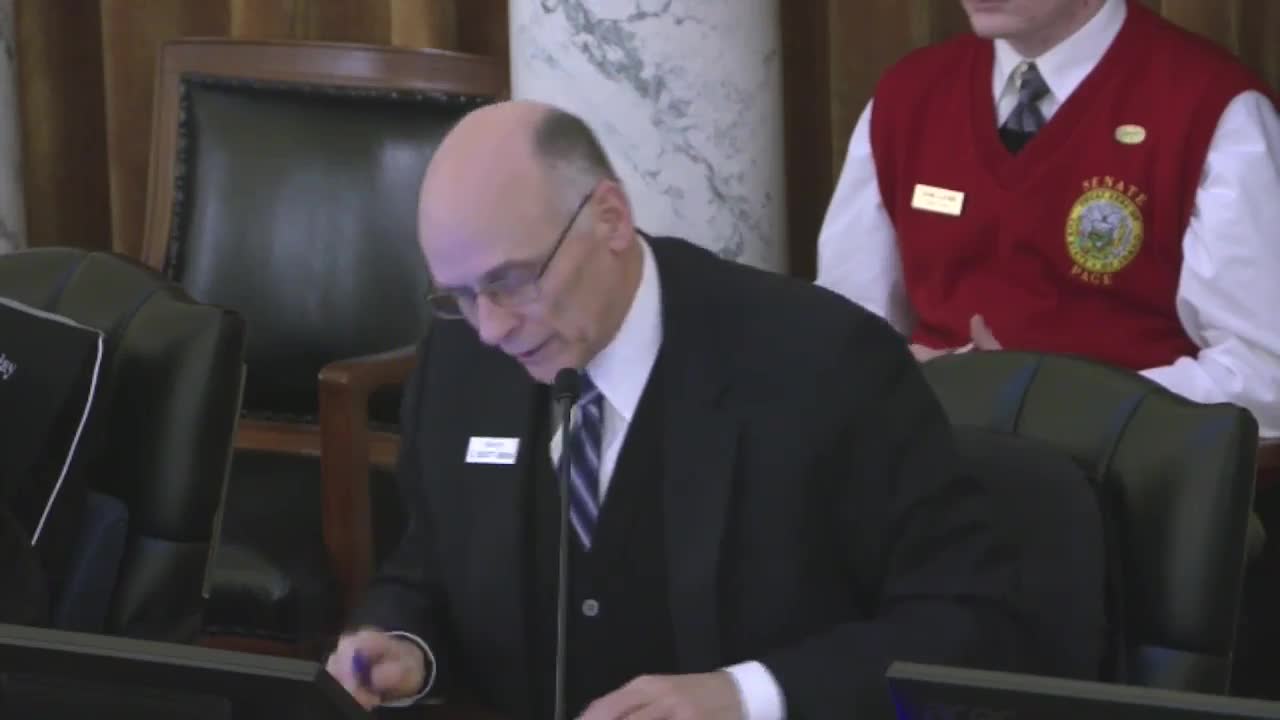
Richard Stover, administrator for the Governor's Office of Energy and Mineral Resources (OEMR), and Legislative Services analyst Kellen McGurkin presented the office's budget and program priorities, including federal grant activity, a Home Energy Rebates program and a proposed Speed Council to coordinate permitting for large projects.
Federal grants and the state's role
McGurkin summarized recent federal awards and a prior $15 million one‑time transfer that represented the state's match for an energy resiliency grant program (POREG). He described how OEMR has seen federal appropriations grow and that the office has administered multiple rounds of competitive grants to strengthen grid resilience and related projects.
Home Energy Rebates request
OEMR requested an ongoing federal appropriation of $24,500,000 to implement the Home Energy Rebates program created under the Inflation Reduction Act. McGurkin summarized the top‑level allocation: about $20,000,000 is for rebate payments (trustee and benefit payments), about $4,000,000 is budgeted for administrative and implementation costs (including procurement of a third‑party implementer and software), and $502,000 is requested for personnel costs to add four limited‑service full‑time positions to manage the program.
On the 20% administrative cap: Analysts and the administrator explained the federal rules allow up to 20% of the grant to be used for administration. McGurkin said that the $4,000,000 is intended to be used to competitively procure a third‑party implementer to run software and eligibility verification; Stover said some of the administrative allotment may not be fully drawn and that OEMR will seek to put as much as possible into rebates.
Speed Council and permitting coordination (governor's recommendation)
The governor's recommendation includes $311,000 ongoing from the general fund to stand up a Speed Council, as outlined in Executive Order 2025‑02. The council would bring together leadership from multiple state agencies (OEMR, Office of Emergency Management, DEQ, Water Resources, Agriculture, and others) to increase permitting transparency and predictability for large projects, manage a public project dashboard and coordinate staff and consultant resources. Stover described the three primary council goals as: "transparency," "accountability and predictability," and recommending permitting reforms.
Energy demand, nuclear and resiliency examples
Stover framed the office's proposals by citing projected increases in electricity needs: "In Idaho alone, we're expected to see over the next 10 to 20 years an increase of 30 to 50% of needed energy generation." He also discussed OEMR's role in coordinating the state's response to project proposals and federal programs and described work to explore advanced nuclear energy through the Idaho Strategic Energy Alliance.
On spent fuel and recycling, Stover said states and Idaho National Laboratory are engaged in research and that recycling technologies may become more viable.
On resiliency investments, Stover gave practical examples of grant results: funding wildfire‑resilience measures (mesh wrap for poles) that preserved poles and saved replacement costs, and energy efficiency funding that lowered operating costs for public buildings.
Legislative questions and contract/ wind‑down concerns
Legislators asked about the 20% administrative cap, how third‑party implementers will be procured, and how limited‑service positions will be handled when federal funds end; analysts and the administrator said positions would be limited service and contracts drafted to allow wind‑down if federal funds are rescinded. Several senators and representatives asked about program design to avoid imposing state energy codes; Stover said the rebate programs are structured to require demonstrable energy and cost savings for recipients and that OEMR will not impose codes beyond state law.
Why it matters
OEMR's grants and the Speed Council connect to grid resilience, infrastructure permitting, and statewide energy capacity planning. The home rebates program would move federal dollars into Idaho households and contractors while the Speed Council seeks to streamline permitting for large energy and economic development projects.
Next steps
Committee discussion continued; no final appropriation votes were recorded in this hearing. OEMR staff said they will proceed with procurement planning and that the office's contract language will include standard federal‑fund wind‑down and rescission protections.