Get Full Government Meeting Transcripts, Videos, & Alerts Forever!
Get email alerts on the Public Defender Statewide topic
No spam. Unsubscribe anytime.
New State Public Defender seeks millions to cover transfers, transcripts and staffing amid rollout
Summary
The new State Public Defender requested several one‑time and ongoing appropriations to use a $39 million cash transfer, cover transcript and expert costs after a Supreme Court ruling, and fund staff and institutional offices during statewide rollout.
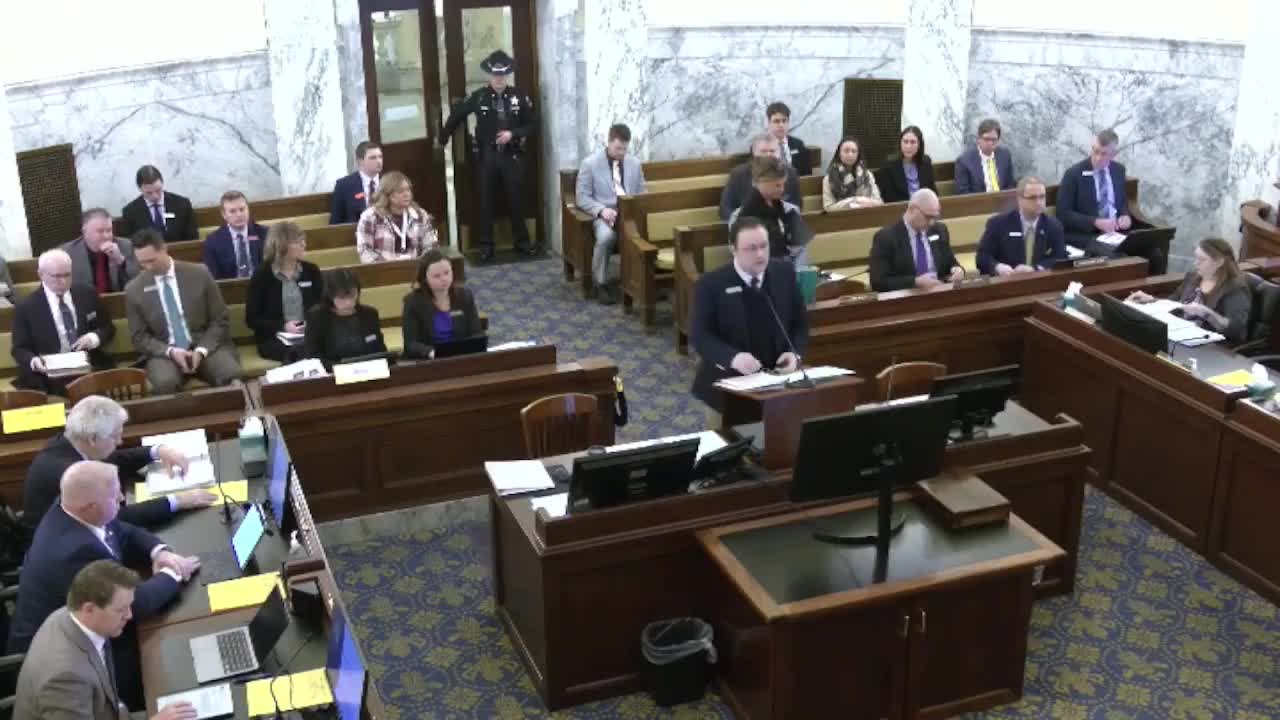
The new State Public Defender office asked the Joint Finance‑Appropriations Committee for multiple one‑time and ongoing appropriations to fund operations, absorb counties into the statewide system and cover transcript and expert costs tied to higher‑complexity cases.
Budget analyst Christopher Lahoset explained the office was created in Title 19, Chapter 60 (presentation cited statutory creation language) and that the State Public Defense Fund — established in statute and seeded by a $39 million transfer from the tax relief fund — is the agency’s primary dedicated fund. Lahoset said the base appropriation after initial enhancements is about $49 million and that total authorized appropriation for the current fiscal year was roughly $52,000,015.30.
Lahoset outlined the agency’s enhancement requests: a one‑time supplemental of $2.5 million in the current year to fully utilize a $39 million cash transfer (the appropriation for spending the cash was omitted during prior budget formulation), a governor’s supplemental for transcript costs (one time $390,200) after the Idaho Supreme Court’s Dec. 5, 2024 ruling in State v. Blasick that the state must pay transcript costs, and a one‑time $5,427,600 supplemental for additional personnel and contract rate increases. For FY2026 the agency requested $2.5 million ongoing to use the transferred cash, $16,000,380 ongoing (plus $80,800 GF noted in presentation) for operating increases (contract attorneys, investigators, experts, capital litigation costs, training, transcripts and miscellaneous), authorization for about 17.96 FTE to open four institutional offices (Benewah, Elmore, Jerome and Shoshone counties were listed for onboarding), and a requested one‑time cash transfer of $16,867,400 from the general fund for recruiting, retention and contract rate increases.
State Public Defender Eric Fredericksen told the committee the office inherited a “significant increase” in caseload since the pandemic and that the transition into a statewide agency has been demanding: staff and district defenders were pulled into direct casework when the agency began operations Oct. 1 and the office “walked into 1,300 withdrawals and cases,” Fredericksen said. He said flat‑fee county contracts previously in place were often inadequate and that the office is moving to better pay and uniform rates across counties to attract counsel in rural areas.
Fredericksen and staff described specific cost categories driving the requests. They cited rising capital litigation costs and higher expert fees (psychosexual evaluations were named as an example, at about $2,500 each), transcript costs shifting from counties to the state after the Blasick decision, and previously undisclosed district‑court funds county‑level spending that the new agency must now anticipate covering. Fredericksen said counties are required by current statute to provide facilities through 2029; agreements to use county facilities are being handled via memoranda of understanding rather than leases to reflect that statutory timeline.
Committee members pressed on several operational points: whether supplemental funds can be spent before fiscal year end (Fredericksen said the goal is to spend them this year but the office will remit unused funds back to the state), how the agency will standardize pay and recruit to rural posts (Fredericksen said work with Human Resources and merit adjustments target uniform pay but higher rates are used to recruit in rural areas), and whether the office is being appointed to matters outside its statutory mission (Fredericksen said the office has been appointed to private terminations and custody matters and is litigating to clarify appropriate scope).
Lahoset and Fredericksen said the statewide case management system rollout is intended to move the agency from caseload counting toward workload measures that better capture complexity. Fredericksen characterized the early months as triage but said the agency is moving to a model where district public defenders manage district operations rather than central director involvement.
The committee received detailed line items in the budget book (LSB 5‑103 referenced) and asked for additional breakdowns on “miscellaneous” costs; Fredericksen agreed to provide further itemization. No formal votes occurred during the hearing; committee members indicated follow‑up requests for additional data and statutory clarifications.