Get Full Government Meeting Transcripts, Videos, & Alerts Forever!
Get email alerts on the Police Training topic
No spam. Unsubscribe anytime.
POST seeks staffing and replacement funding as academy enrollment rebounds
Summary
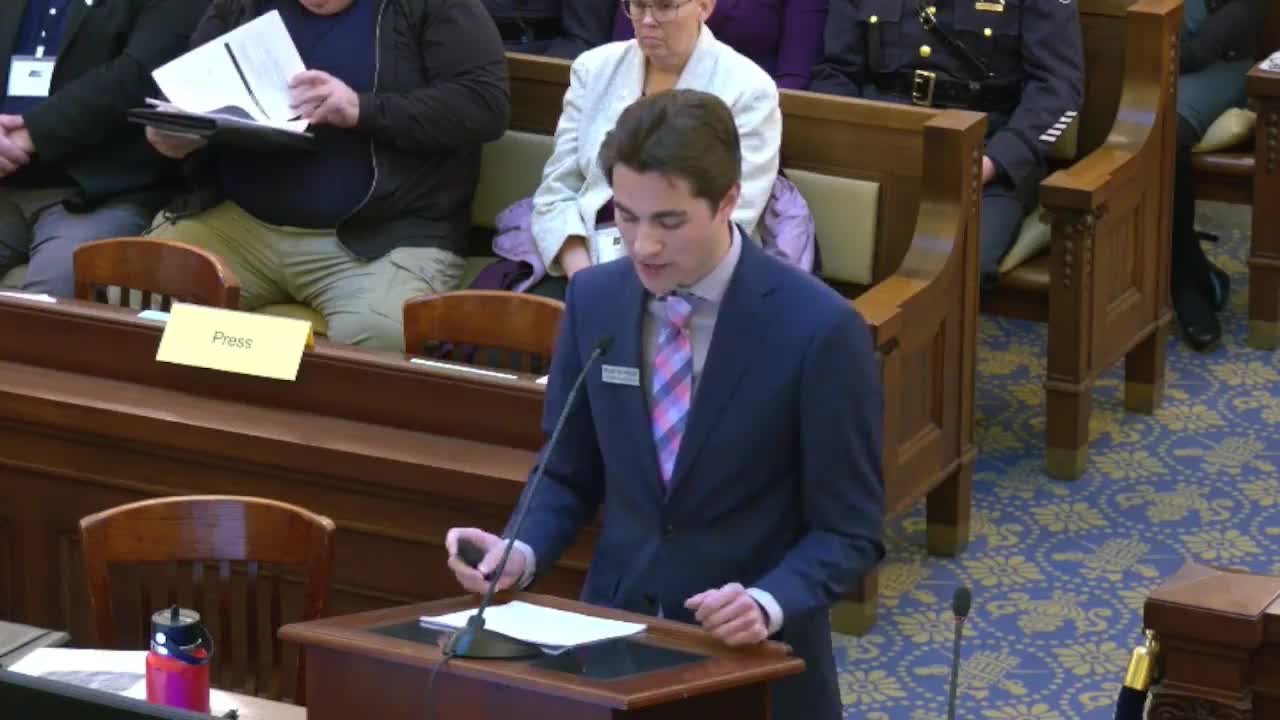
Brad Johnson, administrator of Peace Officer Standards and Training, told the Joint Finance and Appropriations Committee on Feb. 12 that POST seeks a 0.33 FTP technical records specialist, vehicle and IT replacements, and continued fiscal monitoring as academy enrollment recovers.
Brad Johnson, administrator of Peace Officer Standards and Training (POST), and Legislative Services analyst Noah Peterson presented POST’s FY26 request and revenue review at the Feb. 12 Joint Finance and Appropriations Committee hearing, emphasizing a modest personnel addition, replacement equipment and the need to clarify long‑term funding for statewide basic training.
POST requested conversion of a currently part‑time technical records specialist to 0.33 FTP and $20,800 in personnel funding to reduce certification processing backlogs. Replacement requests include one 15‑passenger van and one half‑ton pickup (combined $111,600 one‑time) and IT replacements recommended by OITS ($61,600). Peterson said POST’s fiscal picture has been strained in recent years by rising operating costs and temporary revenue shortfalls, prompting a series of one‑time general‑fund transfers in earlier years. House Bill 469 (2022) provided a recurring liquor‑fund transfer (1.5% of annual liquor revenue) beginning in FY2023 and POST received $620,000 in FY2023 and $804,300 in FY2024 from that source.
Johnson explained POST’s revenue sources to the committee — a $15 court fee on fines/forfeitures, fingerprinting and filing fees, educational and dormitory fees, a share of motor‑vehicle fine distributions, and miscellaneous revenue from training‑agreement repayments. He told the committee that POST enforces two‑year (academy) agreements: trainees who leave the profession during the agreement must repay training costs. Johnson said a renewed collections effort and use of outside collections agencies have increased recovered revenue and explained that academy tuition varies by program, with the patrol academy cost currently about $12,000 per attendee.
Committee members raised enrollment and workforce questions. POST’s patrol academy enrollment fell during COVID and a 2023 cancellation reduced numbers; Johnson said attendance is recovering and the post council convened a working group to develop a statewide basic‑training strategy. The working group plans to present recommendations within about a year on how basic training should be delivered across state, college and agency programs.
Senators and representatives asked about costs, recruitment and the long‑term balance of funding between state and local governments. Johnson said he will provide the committee with updated tuition numbers and that POST is monitoring its dedicated fund balance while seeking efficiencies. LSO’s Peterson noted that month‑to‑month dedicated‑fund revenue had recently exceeded projections after a period of underperformance.
The committee did not take formal action on POST’s FY26 requests during the hearing; members asked for follow‑up details on training locations, program costs and a chart comparing statewide training providers and capacity.