Get Full Government Meeting Transcripts, Videos, & Alerts Forever!
Get email alerts on the Insurance Regulation topic
No spam. Unsubscribe anytime.
Department of Insurance requests actuary, compliance specialist and fire‑marshal pay as wildfires and PBM oversight pressure market
Summary
Director Dean Cameron told JFAC the department is seeking a staff actuary, a regulatory compliance specialist, pay increases for the fire marshal team and capital outlay to replace turnout gear and vehicles amid wildfire‑driven market stress and increased pharmacy benefit manager complaints.
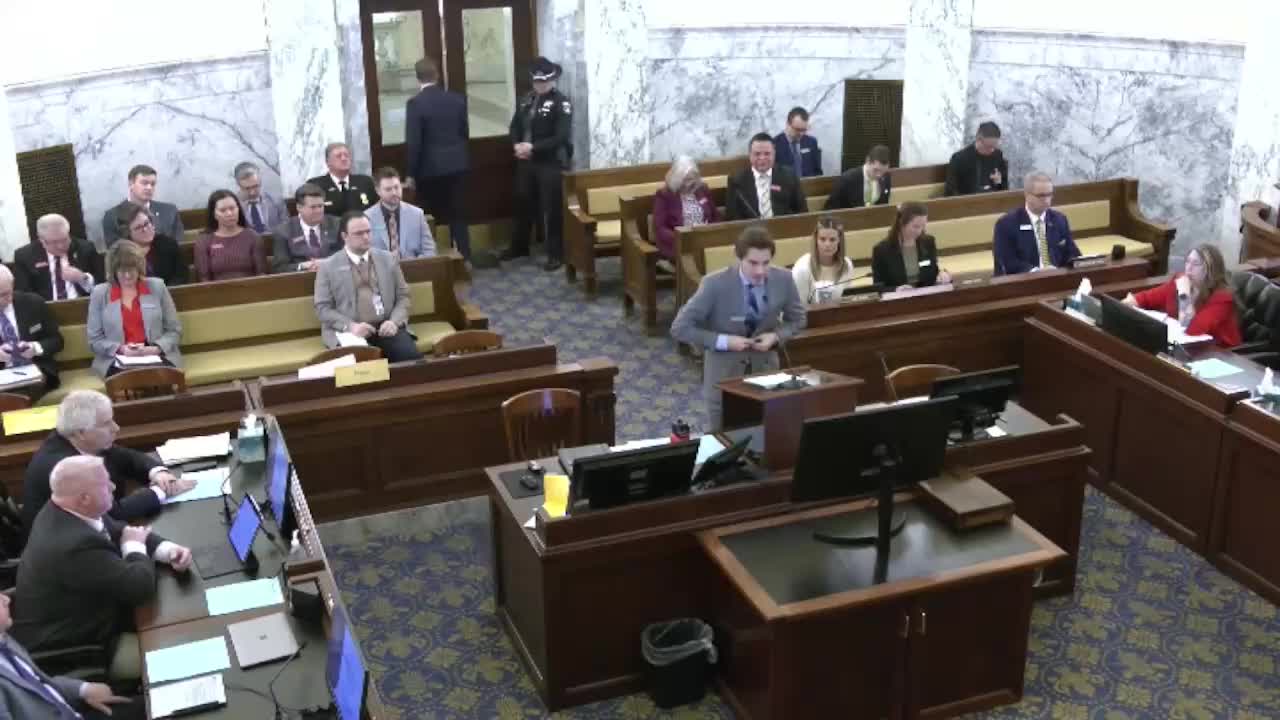
Noah Peterson, budget and policy analyst with the Legislative Services Office, and Dean Cameron, director of the Department of Insurance, presented the department's fiscal 2026 budget request and agency priorities to the Joint Finance‑Appropriations Committee on Jan. 21.
The department requested four FY2026 enhancements: one staff actuary ($201,900 total, $198,900 ongoing and $3,000 one‑time for equipment) to conduct actuarial reviews of rates and products; one regulatory compliance specialist ($41.03 per hour, budgeted at 80% of policy for pay grade O) to serve as an internal legal and policy resource; ongoing compensation increases for the state fire marshal and deputies ($48,100 ongoing: $38,100 salary, $10,000 variable benefits); and $162,200 in one‑time capital outlay for the state fire marshal (about $10,000 for turnout gear, $16,200 for cameras and $136,000 for two medium‑duty pickup trucks equipped for field work), Peterson told the committee.
Cameron told legislators the department oversees two budget programs—the Insurance Regulation Division and the State Fire Marshal—and has 75.5 approved full‑time positions, with 63.5 in insurance regulation and 12 in the fire marshal division. He reviewed the agency's dedicated funds, including the Arson Fire and Fraud Prevention Fund (used for state fire marshal expenses) and the Insurance Administrative Fund (used for licensing, examinations and investigations). Peterson and Cameron also described how premium tax collections are statutorily distributed among insurance funds, the firemen's retirement fund, the high‑risk reinsurance pool and the general fund.
On implementation of last year's pharmacy benefit manager reform, Cameron said the department hired an analyst to handle complaints and that a large number of complaints have come in. "She's receiving numerous complaints," Cameron said. The department required PBMs to submit data in a standardized format; most have complied, he said, and a few remain noncompliant while the department works to obtain the files. Cameron described the complaint types as ranging from billing and dispensing‑fee disputes to contract and responsiveness issues and said the agency is compiling more detailed breakdowns as it continues its work.
Cameron also described Idaho's use of a federal Section 1332 waiver and a state high‑risk reinsurance pool that the department has maintained and modified in recent years. "We instituted [the 1332 waiver] several years ago," Cameron said, and the state used the waiver and reinsurance approach to help lower individual market premiums and attract more carriers to the exchange. He described the high‑risk pool as a form of reinsurance that identifies costly conditions by CPT code and shares claims with the pool to spread risk and hold down rates.
On wildfire and property insurance market pressure, Cameron said insurers nationwide have tightened underwriting and increased reinsurance costs in response to catastrophic losses and inflationary pressures. "We started seeing forest fires in California, Oregon, Colorado and it started a tightening of the property insurance market," he said. Cameron said Idaho burned just under 1 million acres the previous year and that the state lost more than 140 structures, including about 40 residences. He told the committee carriers have pulled back in higher fire‑risk areas, the surplus lines market has grown, and the department has seen recent carrier insolvencies. He said his office is proposing legislation to create a mitigation pool to help homeowners harden properties against wildfire and to create a mechanism that might help carriers remain in the state market.
Peterson told the committee that in FY2024 the department reverted just under $2.2 million of its appropriation—about $917,000 in personnel and $1,277,000 in operating funds. For FY2025 the department received ongoing enhancements and a trailer appropriation to implement House Bill 596 (amending Idaho Code section 41‑349), which provided one FTE and $132,400 to support pharmacy benefit manager reporting and enforcement efforts.
Cameron introduced senior staff present at the hearing and said the department is largely staffed: "I believe we have all of our positions filled," he told the committee. He reiterated the department's intent to provide the committee with additional data about PBM complaints and market impacts as staff collect and verify submissions.
No formal vote or appropriation occurred during the presentation; committee members asked the department for follow‑up data and a more detailed breakdown of PBM complaints and market indicators to inform budget and policy decisions.