Get Full Government Meeting Transcripts, Videos, & Alerts Forever!
Get email alerts on the Bsu Budget And Campus Issues topic
No spam. Unsubscribe anytime.
Boise State president outlines budget, student success gains, defends use of non-tax funds for lawsuit
Summary
Boise State University President Marlene Tromp updated the Joint Finance-Appropriations Committee on FY2026 requests, cited gains in graduation rates, described LAUNCH participation, and said the university used non-tax funds to defend a lawsuit that has cost about $1.5 million to date.
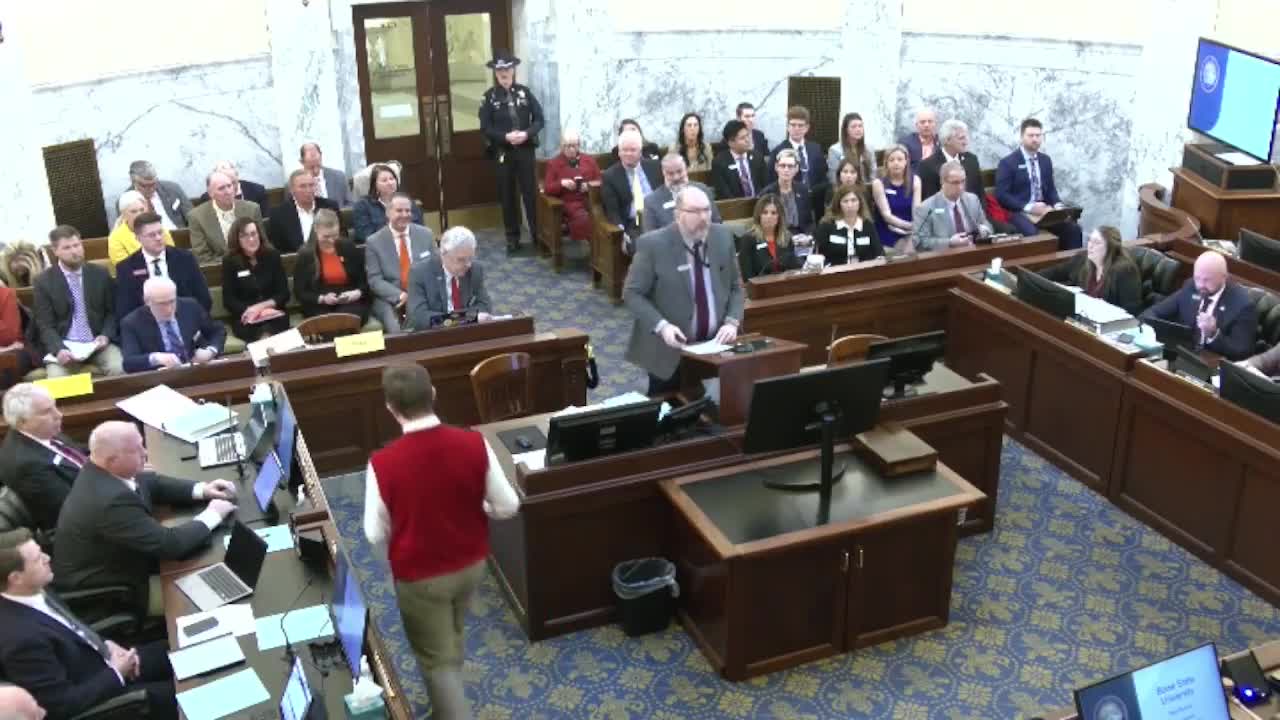
Boise State University President Marlene Tromp told the Joint Finance-Appropriations Committee on Jan. 29 that BSU has improved graduation rates, continues to expand workforce programs, and used non-tax funds to defend a recent lawsuit that the university is required by state law to defend.
Tromp opened the university's presentation after a Legislative Services Office briefing and said Boise State has 27,000-plus students and a base of instructional and operating activity that the university manages under a responsibility-centered budget model. "We operate on a responsibility-centered management model," Tromp said. "Our academic units are responsible for determining how much revenue they're taking in and balancing their budget around that intake of revenue." She added that the model has helped BSU close a structural deficit and maintain a balanced budget.
Why it matters: Committee members pressed BSU on several items including how LAUNCH is working, the university's approach to centers and staffing after state board policy on DEI, a pending appeal in a civil lawsuit, and how BSU would use potential state funding to add program capacity.
Key fiscal and program points: Tromp said Boise State reported roughly 1,300 students enrolled in the state's LAUNCH program, with 600 students relying on LAUNCH as their only financial support. She said 54% of BSU graduates leave with no federal student loan debt and that, in inflation-adjusted dollars, Boise State tuition is lower than in 2016. The university requested FY2026 operational capacity enhancement dollars to put toward compensation and capacity growth; the Legislative Services Office summary noted BSU requested $11,781,100 for operational capacity enhancement for FY2026 and $195,700 in enrollment workload adjustment.
On DEI and campus centers: Tromp described a multi-year effort to reconfigure student-support centers and said staff numbers tied to diversity-oriented centers have fallen; she characterized the work as a transformation toward student-success models that serve broader campus populations and said the university has not eliminated veteran services. She told senators and representatives that although staff numbers were reduced by five in recent adjustments, the university may expand services depending on student-success needs.
On a recent lawsuit: Tromp told the committee Boise State has spent about $1,500,000 to defend a lawsuit (known in public reporting as Big City Coffee) and said the university used non-taxpayer funds for legal defense. "We used only non taxpayer funds to support the defense of that lawsuit," Tromp said. She added that employees who appeared at trial either served as members of the general counsel team or used personal leave; Tromp said she did not expect the appeal to materially increase the total defense cost at this time.
Free-speech and campus dialogue: Tromp described the Institute for Advancing American Values, programming to bring varied speakers to campus and adoption of the Chicago principles by faculty and student government. "People come to university with their own values and they can learn to be stronger in those values," Tromp said, summarizing the institute's goals. Senator and committee members praised events organized by the institute for civil dialogue.
Curriculum questions and UF 100/200: Committee members asked whether specific course sections on gender or related topics were required. Tromp said UF 100 and UF 200 are required course sequences but students may choose from multiple sections and are not required to select any single topical section. She said courses across campus must comply with state and federal law and with State Board directives.
Workforce and Micron: Lawmakers asked about workforce needs tied to Micron and semiconductor growth. Tromp said Boise State is expanding engineering, natural sciences and industry partnerships and noted a piece of equipment called an "Xtron" used for depositing crystals onto silicon wafers; she said it is the only such unit outside private industry in North America and is being used for student training and research.
Federal funding pause: Committee members asked about potential short-term federal funding disruptions. Tromp and BSU staff said they had reviewed the guidance and were working with state finance offices; Tromp described federal grants as restricted-use funds that cannot be spent outside grant terms and said Boise State would follow law and any directives.
Ending: Tromp closed by reiterating the university's role in workforce training and student success, and said BSU is prepared to scale nursing, computer science, construction management and engineering programs if state grants for capacity are awarded.