Get Full Government Meeting Transcripts, Videos, & Alerts Forever!
Get email alerts on the Isu Budget And Accountability topic
No spam. Unsubscribe anytime.
ISU president says university will return forensic lab funds, vows tighter controls
Summary
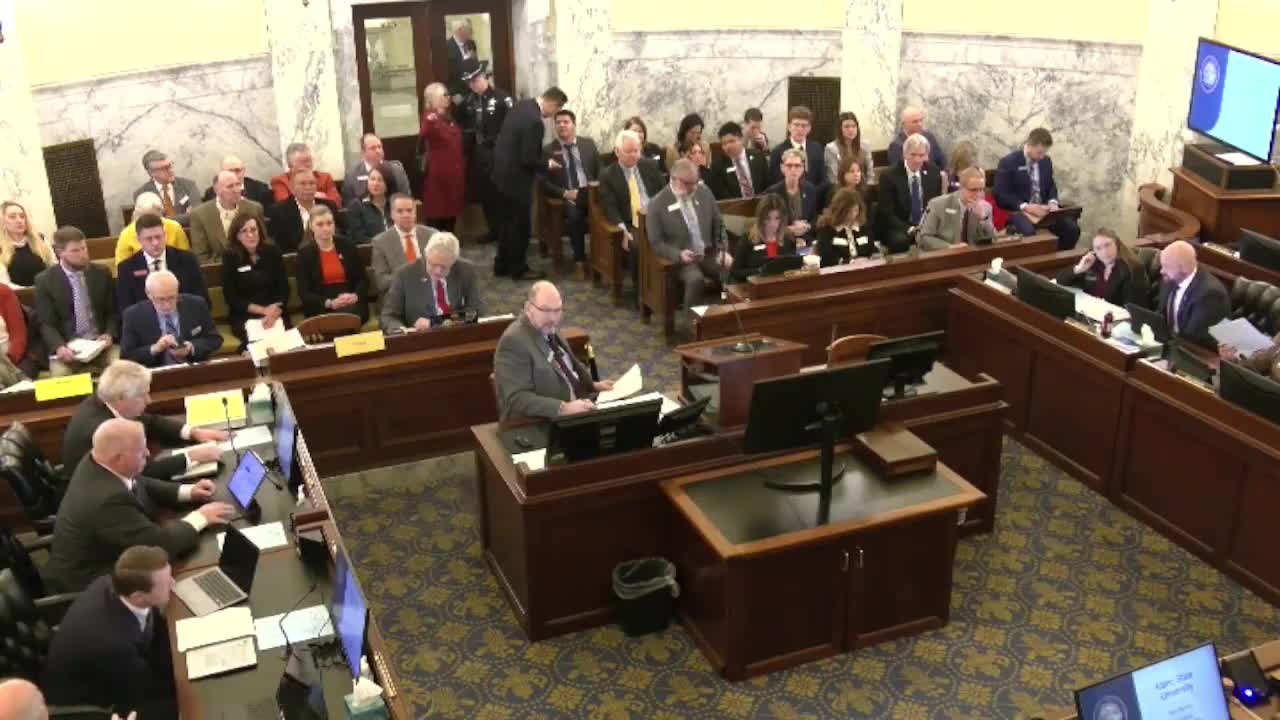
Idaho State University President Rob Wagner told the Joint Finance-Appropriations Committee that ISU will return funds tied to an Eastern Idaho forensic pathology project, and pledged stronger internal controls while presenting the university's FY2026 budget request and student-success initiatives.
Idaho State University President Rob Wagner told the Joint Finance-Appropriations Committee on Jan. 29 that ISU will return previously appropriated funds tied to an Eastern Idaho forensic pathology laboratory and that the university will strengthen procedures to ensure legislative intent is followed.
The clarification came as Kevin Campbell, budget and policy analyst with the Legislative Services Office, gave an overview of ISU's budget and highlighted technical reporting issues in the tuition and fees fund balances. Campbell told the committee he had identified a data error that made the beginning fund balance appear inaccurate and that he was tracking down the cause. "I discovered this in the course of preparing this presentation," Campbell said. "If appropriate, I'll update this data later for the record. For now, I want to note that I reviewed the actual fund balances in the State Treasury and happily, ISU has not overdrawn its bank account."
Why it matters: Lawmakers pressed ISU leadership about a legislative appropriation intended for an Eastern Idaho forensic pathology center that later was moved to a county partner. Committee members sought assurance that the university will follow appropriation law and provide clear accounting for any transferred funds.
Wagner told the committee he became aware of the situation in late 2023 and reviewed communications between ISU and county partners. "In looking back, I believe Idaho State University should have kept those funds," Wagner said. He said ISU had spent a small amount on a consultant and that following a memorandum of understanding the remaining funds were transferred to the county; under his administration the university will track and document ownership and use of legislative funds more carefully. He said an audit request is now in process and that the university will cooperate with the review.
Campbell opened the briefing with a fiscal overview. He said ISU has more than 12,000 students, about 1,244 full-time equivalent staff and a reported base budget of $171,100,000. He described the composition of ISU expenditures (about 74.8% personnel, 21.2% operating, 3.9% capital outlay) and reviewed five-year appropriation and expenditure trends, cautioning that reappropriated tuition and fees can make apparent year-to-year gaps in the bar charts. "Reappropriation is not the same as unspent or uncommitted," Campbell said, explaining the timing mismatch between the budget cycle and academic year.
On enrollment and student success, Wagner and committee members discussed ISU's efforts to increase student completion. Wagner described recent organizational changes: two campus resource centers tied to diversity and gender were closed and staff FTE were reassigned, including moving one position to student involvement and another to the office of equal opportunity and Title IX reporting to the president. Wagner said the university created the Bengal Success Center, a consolidated student-success unit, to serve traditional and nontraditional students across ISU campuses.
Lawmakers also asked about ISU's role in workforce and health services. Wagner said ISU wants to partner with other governments and health providers to address public-safety and clinical workforce gaps in eastern Idaho, and noted ISU's health sciences expansion across campuses including Meridian, Idaho Falls and Pocatello. He described a new doctor of nurse anesthetist program that received more than 200 applicants for 25 seats.
Fiscal requests and budget adjustments: For FY2026 ISU requested $907,300 in operational capacity enhancement, $233,700 in endowment fund adjustments and $988,100 for enrollment workload adjustment. Campbell also summarized prior-year reductions and adjustments that affected ISU, including general fund reductions in FY2021 and administrative consolidations to the Office of Shared Services or OSB in later years.
Discussion versus action: Committee members repeatedly emphasized that legislative intent is law and asked for clear documentation. Wagner committed to returning the forensic lab funds to the state and to improving ISU's procedures; the committee did not take a formal vote on those items during the hearing.
What's next: Campbell said he will follow up if the technical reporting error in the tuition and fees fund is corrected, and Wagner said the university will cooperate with the ongoing audit request. Committee members asked for continued engagement as ISU refines tracking and accountability procedures for legislative funds.
Ending: Wagner closed by emphasizing ISU's statewide role in workforce development, access and student success and reaffirmed his commitment to cooperative work with the legislature.