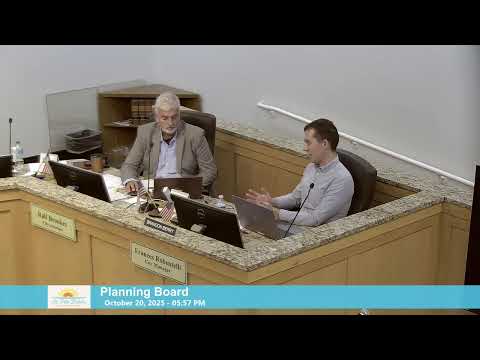
Planning board recommends changes to stair, equipment and accessory-structure rules for elevated homes

6406332 · October 21, 2025

Loading...

AI-Generated Content: All content on this page was generated by AI to highlight key points from the meeting. For complete details and context, we recommend watching the full video. so we can fix them.

Summary

At its Oct. 20 meeting, the St. Pete Beach Planning Board, sitting as the Local Planning Agency, recommended approval with modifications of Ordinance 2025-21, a package of zoning amendments aimed at easing permitting barriers tied to house elevations and redevelopment while adding technical standards for stairs, equipment and accessory structures.

At its Oct. 20 meeting, the St. Pete Beach Planning Board, sitting as the Local Planning Agency, voted unanimously to recommend approval with modifications of Ordinance 2025-21, a draft zoning amendment package that would change rules for stair encroachments, equipment elevation, accessory structures and nonconforming residential buildings.

The ordinance package was presented by planning staff member Brandon, who said the changes respond to “the most common issues encountered when we see redevelopment,” noting a surge in house elevations this year. Brandon told the board the draft standards are intended as working text the city can refine after feedback from the board and the City Commission.

Board members and staff focused discussion on several recurring issues: how far stairs may project into front yards, minimum landing dimensions, whether previously nonconforming accessory structures (gazebos, detached decks, pool covers) may remain when the primary residence is elevated, rules for small storage buildings, and whether in-place elevation of mechanical equipment is permissible.

Key elements described in staff materials and discussed by the board include: - Stair encroachments: Draft language would allow front-yard stair encroachment by right for certain elevated nonconforming homes (staff described an administrative permission to allow stairs to come forward to as little as 10 feet from the front property line in many cases). Open-base stairs would be required to meet an 80% transparency standard under the treads and landings. For new and redeveloped residences staff proposed standards (previously in section 6.22) permitting limited encroachments; the board debated measurements and asked staff to clarify a single consistent approach applying mainly to elevated/reconstructed homes rather than new construction. - Landings: Member Perry cited Florida Building Code provisions and recommended minimum landing sizes based on that code. Perry summarized working options in the packet that “the landing could either be the minimum would be 4 feet 6 inches, or you could go to 5 feet.” The board asked staff to incorporate a clear reference to the Florida Building Code and to define landing depth precisely in the ordinance language rather than leave it ambiguous. - Accessory structures: The draft would allow some nonconforming detached structures (gazebos, deck covers, pool cages) to remain when the primary residence is elevated or substantially improved, provided the accessory structure is not itself substantially improved or rebuilt and does not cross property lines or easements. Board members asked staff to clarify pool-cage treatment and whether detachment/reassembly during elevation work would count as substantial improvement. - Storage buildings and tie-downs: The draft would raise the allowed size of backyard storage buildings from 80 to 120 square feet (height to remain 8 feet) but would require that storage buildings be tied down to meet wind-load and elevation requirements when the primary residence undergoes substantial improvement. The board asked staff to explicitly define mechanical equipment and to clarify whether and how electrical service or powered tools in detached accessory structures would be allowed. - Mechanical equipment elevation: Staff proposed allowing in-place elevation of existing mechanical equipment when an owner elevates a house in place, with limits for front-yard equipment (5-foot encroachment limit) and side-yard pedestal setbacks (3 feet). Equipment would be limited to 1 foot above the structure’s lowest living floor or design flood elevation for rating purposes; newly installed equipment would generally have to meet yard setbacks. - Balconies and outdoor living: Board members raised quality-of-life concerns for owners who lose at-grade outdoor living space after elevation. Staff said the draft could permit reestablishing an existing balcony “in the same footprint” at the new living level (replace-in-kind), and the board asked staff to draft specific “replace in kind” language for balconies and decks that restores previously existing footprint and openness where feasible. - Substantial-improvement language and floor-height limits: Several board members said a phrase in the draft that effectively limited reconstructed living floors to the same ceiling-to-floor height as the prior living level was confusing and could unnecessarily constrain resilient rebuilding. The board asked staff to remove or clarify that ceiling-height limitation so homeowners who reconstruct living floors above converted ground-level parking are not forced to the prior ceiling height.

After a detailed line-by-line discussion and requests for minor scrivener edits, the board voted to recommend approval of the ordinance with the modifications they outlined to staff. The motion passed on a roll call vote of 5–0: Member Grocott, Member Izzy, Member Perry, Vice Chair Angelides and Chair Hubbard all voted yes.

Chair Hubbard and members asked staff to return with revised ordinance text that: (1) clarifies the landing-size standard and references the Florida Building Code; (2) spells out the replace-in-kind approach for existing balconies and decks; (3) defines “mechanical equipment” for accessory-structure rules and clarifies when detached pool cages or similar elements will be considered substantially improved; (4) cleans up repeated subsection numbering and inconsistent phrasing across sections; and (5) removes or clarifies the ceiling-to-floor height limitation tied to conversions of ground-level space. Brandon said staff will present the amended ordinance to the City Commission for first reading the following Tuesday and will return to the board for further review as needed.

The board’s recommendation is advisory; final adoption requires City Commission action and, in some instances, consultation with Pinellas County and state reviewers for comprehensive-plan changes.

Board members used the Local Planning Agency session to record their recommendation and then reconvened as the Planning Board to continue other agenda items.

Ending: The board's action was procedural: staff will redraft the ordinance text to incorporate the board’s clarifications and return it to the commission. No new code wording became law at the Oct. 20 meeting; the board provided direction and a unanimous recommendation to move the draft forward with the specified edits.