Get Full Government Meeting Transcripts, Videos, & Alerts Forever!
Get email alerts on the Prison Security Upgrades topic
No spam. Unsubscribe anytime.
After staff shooting, Idaho DOC seeks technology, transport and body-camera spending
Summary
Following a spring ambush that left correctional staff wounded, the department proposed drone detection, digital mail scanning, phone-call transcription, an expanded transport bureau and a body-worn camera pilot to address vulnerabilities.
The Idaho Department of Correction asked the Joint Finance Preparations Committee on Feb. 4 to fund a package of security upgrades and transport resources it said are intended to address vulnerabilities exposed by an ambush during an inmate transport last spring.
Analyst Noah Peterson described three supplementals tied to the incident: $795,000 in one-time funds for advanced surveillance technology; $1,148,000 to expand the transport bureau; and a $1,051,000 body-worn camera pilot, mostly funded by federal grants. Director Josh Tewalt told the committee the items respond to a planned attack that compromised a medical transport and left three IDOC staff shot.
What the technology would do: The “advanced surveillance” request combines digital mail scanning, drone detection and a phone-call transcription/analysis system (identified in the presentation as LEO intelligence software). Peterson said digital mail scanning would move mail off-site to be opened, scanned and delivered digitally to inmates; drone detection would “identify when a drone has entered the vicinity” and phone-call transcription would process large volumes of recorded inmate calls for analytic use. Peterson said prison residents made roughly 4 million phone calls totaling 49 million minutes in 2023.
Transport bureau expansion: The agency asked for 12 full-time positions and seven equipped vehicles (six SUVs and a wheelchair van) to professionalize emergency/high-risk transports. Peterson said the one-time request included $455,000 for personnel costs for the remainder of the fiscal year and $693,000 for operating costs and vehicles; the ongoing cost would be roughly $965,500 annually. Director Tewalt told the committee the requested transport team would bring specialized high-risk training and equipment, avoiding the need to pull staff from facility posts to perform risky transports.
Body-worn cameras: The supplemental asks for the first-year costs of a pilot in three locations — Idaho Maximum Security Institution, a District 3 probation and parole office, and the IDOC special investigations unit — with most of year-one funding coming from federal grants and the state on the hook for the later state-match costs.
Debate and rationale: Senator Cook questioned why the state would add 12 FTP to the transport bureau rather than reassign existing posts; Peterson and Tewalt said overtime used to cover past emergency transports and the relief-factor math made simply reallocating posts infeasible without large additional hires. Tewalt said ISCC generated 20,000 overtime hours and IMSI 14,000 hours related to these duties. Questions also arose about drone and LEO technology: Tewalt argued mail scanning would “completely eliminate” a porous contraband entry point and that phone-call transcription could help law enforcement identify criminal activity originating in facilities.
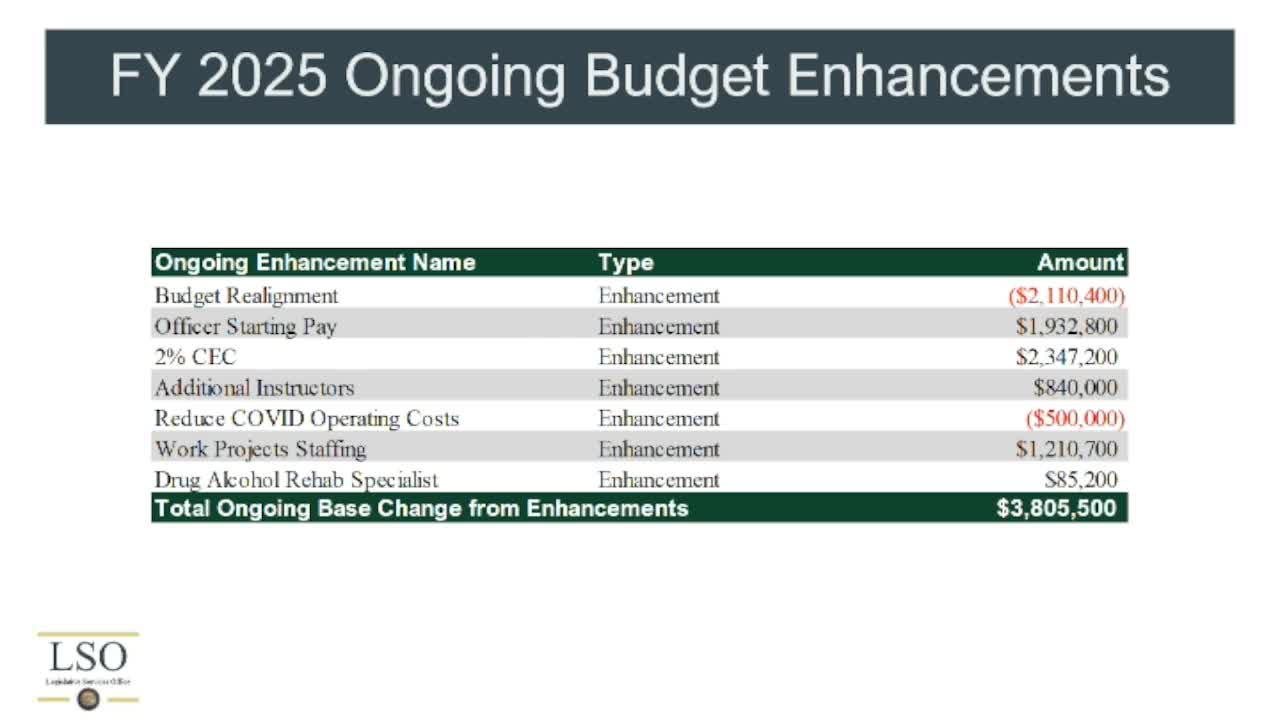
Other items: The division also requested a skid-steer loader for St. Anthony work camp ($83,200 one-time in the agency request) for snow removal; the governor recommended instead a $30,000 ongoing contract for snow removal to avoid equipment ownership concerns. Peterson listed additional replacement items, inflation adjustments and vehicle replacements included in the division’s package.
Next steps: The governor recommended most items; committee members pressed for detail on staffing, overtime and alternatives. No formal appropriation occurred during the hearing.